Rapporten er basert på presentasjoner på .. workshop om førertrøtthet og søvnighet, en workshop om utmattelse og kjøring i regi av TØI som en del av EU-prosjektet IMMORTAL i september 2003. Det er viktig å øke bevisstheten til sjåførene om risikoene forbundet med dette. med kjøring i trøtt eller søvnig tilstand, og om effekten av ulike mottiltak.
INTRODUCTION AND BACKGROUND
THE “ IMMORTAL ” PROJECT
ORGANIZATION OF THE WORKSHOP
RESPONSIBILITY FOR THE PRESENT REPORT
THE SCOPE OF THE PROBLEM
- INCIDENCE OF FALLING ASLEEP AT THE WHEEL
- THE ROLE OF SLEEP AND FATIGUE IN CRASHES
- T IME OF DAY VARIATIONS IN SLEEP - RELATED CRASHES
- CRASH RISK AND PREVIOUS SLEEP
- CRASH RISK AND TIME ON TASK
He also found that the risk increased fourfold during the nighttime hours if the driver had been driving for 11 hours or more. Therefore, countermeasures against sleep-related accidents must address the problem of falling asleep during the day as well as during the night.
DAYTIME SLEEPINESS – GENERAL AND CLINICAL ASPECTS
- N ORMAL SLEEP
- S LEEP DISTURBANCES AND DISORDERS
- A SSESSMENT OF SLEEPINESS
- C ONSEQUENCES OF SLEEPINESS
- T REATMENT
- OSAHS AND DRIVING
- I NTRINSIC SLEEPINESS - NARCOLEPSY
Excessive daytime sleepiness occurs in about 5% of the adult population, as shown by many population surveys. A third cause is intrinsic sleepiness, for example disturbances of the internal clock – a phase delay syndrome. There are also wide variations in heart rate that accompany the variations in oxygen levels that are part of the sleep apnea condition.
The correlation between subjective and objective methods is low - the methods measure different things. It is defined as the coexistence of the complaint of sleepiness with irregular breathing at night. And the narrowing of the airway can progress to the airway closing in sleep, which is sleep apnea.
This means that for the simple license it is simply the responsibility of the drivers themselves not to drive when they are drowsy. This particular HLA subtype is very common and is present in one quarter of the population.
PRECURSORS AND INDICATORS OF DRIVER FATIGUE AND SLEEPINESS
T HE SIMULATOR AT CNRS-CEPA
The subject is asked every 10 minutes to give the number corresponding to his or her level of sleepiness at the time of the question. Behavioral measures are collected along with the physiological measures, such as eye closure, low muscle tone, gaze deviations, yawning, change in posture and self-centered movements, which can be seen from the video taken in front of the driver. From the physiological and behavioral surveys, the driver's level of alertness as well as the direction of his gaze can be monitored.
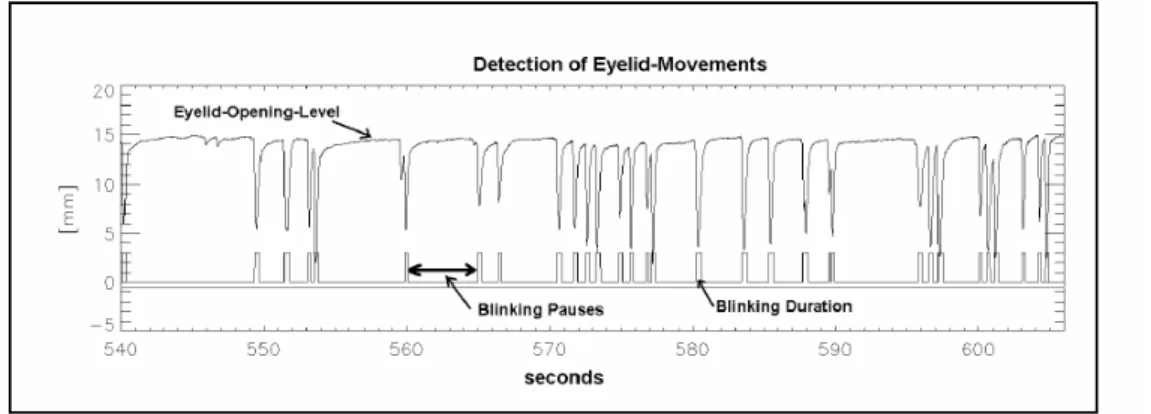
As the driver becomes drowsy, beta is gradually replaced by alpha (8-12 Hz) and theta (4-7 Hz) activity. Simultaneously with the appearance of alpha activity, we can observe a change in the form of blinking, which is another important indicator of sleepiness. When the driver becomes drowsy, a wider blink curve can be observed, indicating that the blinking activity has slowed down.
In the simulator, drivers will exhibit full eye closure for extended periods of time while behind the wheel, still driving, in which case any oncoming traffic or a turn will be followed by an "accident". Additional evidence to verify the occurrence of eye closure comes from the driver's video recording.
S OME RESULTS
In the recordings of a fully awake driver, one can observe the low-amplitude fast beta activity. One group of drivers drove from the beginning to the end of the trip on an unlit highway, while another group drove on fully lit highways. And there was no difference between the groups in the way drowsiness occurred during the drive.
This was to study the impact of arriving in an illuminated area - would it reactivate the driver or not. The most interesting finding was that the second illuminated area had no activating effect on the driver. Changes in the average lateral deviation of the car were measured in an experiment involving six hours of non-stop driving.
Several behavioral signs appear to be characteristic of a driver transitioning from being somewhat drowsy to falling asleep behind the wheel, based on video recordings in the simulator. Using difficult situations such as a parked car suddenly starting from the side of the road is an effective way to demonstrate long reaction times in drowsy subjects.
THE SENSITIVITY AND SPECIFICITY OF EYELID MEASURES, DRIVERS’
- E YELID MEASUREMENTS
- T HE STRUCTURE OF SUBJECTIVE SYMPTOMS OF FATIGUE
- D RIVER - INITIATED COUNTERMEASURES
- O PERATIONAL COUNTERMEASURES
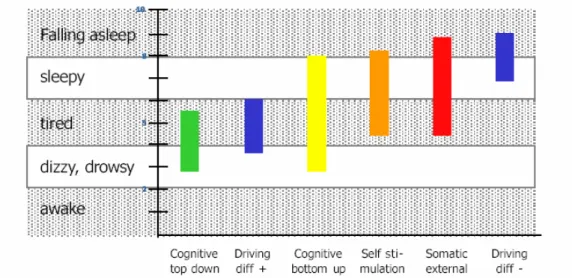
In the next step, the categories were rated by 30 drivers on a time scale from 1 (=awake) to 10 (=just before falling asleep), regarding the time of onset of the symptoms and their duration. Taking the start and end values of the occurrence of each symptom as variables, a cluster analysis was performed, yielding three time clusters of fatigue stages. Taking the beginning and the end of the occurrence of countermeasures as variables, a cluster analysis was performed, yielding four clusters.
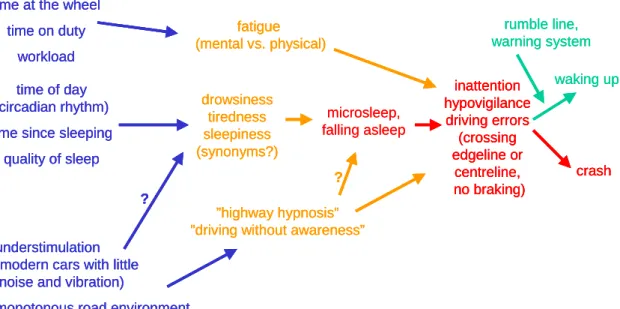
Against the background of the driver's assessment of his/her fatigue symptoms and his/her efforts to manage these symptoms (as shown in Figure 4), operational countermeasures (technical systems in the car) should have the following goals. It has been reported that driver fatigue or drowsiness caused about a third of the accidents on French motorways during the period 1979-94. So it must take into account both the driving environment and the driver's capabilities.
It will be adapted to the specific driving characteristics of the user through continuous driver monitoring and expert-based adjustment. There is a clear need for controlled evaluation studies to evaluate the effects of the fatigue management training (including its various elements) on accident risk.
FATIGUE IN COMMERCIAL DRIVING: ADDITIONAL ISSUES
F ATIGUE AND VIGILANCE PERFORMANCE
P OSSIBLE IMPLICATIONS FOR HOURS OF SERVICE REGULATIONS
It is desirable to be able to adapt the regulations to personal needs regarding sleep and rest time (and when to take them). As long as flexibility can be increased without increasing the total workload and/or reducing the total amount of rest and sleep, this would likely contribute positively to better working conditions and safety. Breaks should cover at least 10% of the working day, and breaks should be at least 15 minutes long every 5 hours.
However, the proposal to avoid night driving is controversial from a total road safety point of view. Due to the higher traffic volume during the day, transferring heavy traffic from night to day may increase the number of collisions with other vehicles, and the overall effect on safety is therefore uncertain. Apart from the proposed restriction on night driving, the mentioned recommendations appear to accept slightly shorter breaks and longer driving hours than the current opening hours.
Until stronger research evidence is available, these guidelines should be considered absolute minimum requirements for rest periods and maximum requirements regarding driving time.
IMPLICATIONS, AND RELATIONS TO OTHER PARTS OF IMMORTAL
SUMMARY AND CONCLUSIONS
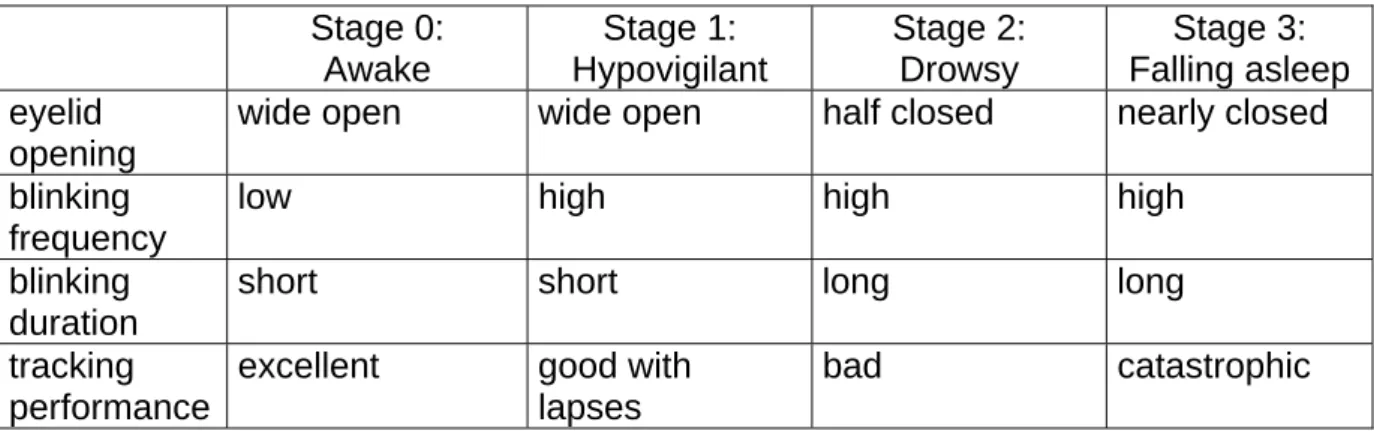
Eyelid radiographs seem to provide useful information to identify different stages in the development of sleepiness. Based on the parameters of eyelid opening, blink frequency and blink duration, four different stages in the progression from wakefulness to falling asleep were identified, which were associated with progressively worse driving performance. Others, for example the system being developed in the EU project AWAKE, are based on multiple parameters related to the condition of the driver, the vehicle and the requirements of the traffic environment.
Research has shown that most such activities (opening the window, turning up the volume on the radio, etc.) can delay sleep for only a few minutes at best. It is important to make drivers more aware of the risks associated with driving when tired or drowsy, and of the (in)effectiveness of various countermeasures. The management of companies that employ drivers has a special responsibility under occupational safety and health legislation to ensure that their employees are rested, fit and sufficiently aware of the risks, and also that their work schedules (particularly for shift workers) compatible with the need for rest and sleep.
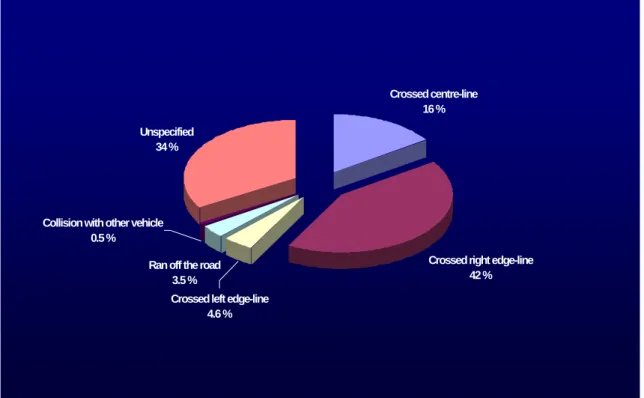
Regarding warning systems, an important message should be that these systems do not reduce sleepiness or fatigue, but are only backup systems if the driver is not sufficiently aware of the symptoms. Rumble lines along the edge or center of the road (profiled edge lines/center lines) are an example of a secondary prevention that has proven to be very effective.
LITERATURE REFERENCES
1993) Strategies to combat fatigue in the long-haul road transport industry: a bus perspective. 1987) Time habits of truck drivers at work and their participation in traffic accidents. 1995) Time of day and traffic accidents in Sweden. 1995) Revised estimates of the magnitude of the drowsy driver crash problem in the US based on reviews of general assessment systems. 1978) Effects of hours of work, regularity of schedules, and load loading on fatigue of truck and bus drivers.
1995) Characteristics of crashes attributed to driver drowsiness. 1997) Suppression of sleepiness in drivers: Combination of caffeine with a short nap. 2002) The effect of a 'functional energy drink' in counteracting driver sleepiness. Transportation Research and Marketing (1985) A report on the determination and evaluation of the role of fatigue in heavy truck accidents. UK Department of Transport (2002) Sleep-related vehicle crashes on sections of selected main roads and motorways in Great Britain 1995-1998.
Fatigue, alcohol, other drugs, and medical factors in heavy truck fatalities. Development of measures of fatigue using an alcohol comparison to validate fatigue effects on performance.
WORKSHOP PROGRAMME
ABSTRACTS OF PRESENTATIONS
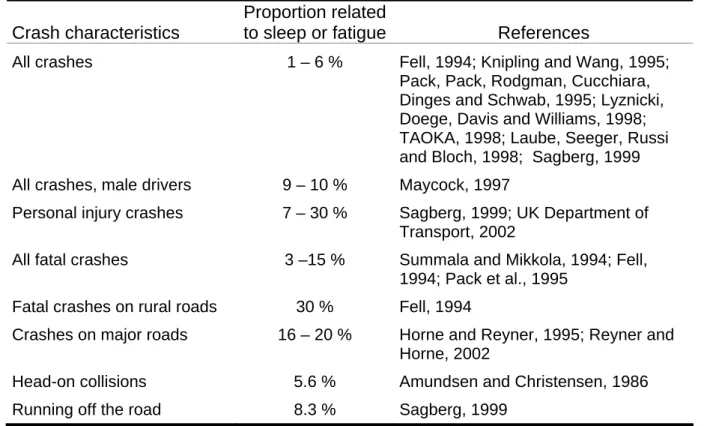
Estimates of the contribution of sleep and fatigue to the number of road accidents vary considerably, both due to under-reporting of these factors by drivers and due to different methods of investigating the problem. Although people with sleep disorders are overrepresented in sleep-related accidents, a large majority of incidents and crashes occur among healthy drivers. Knowledge of behavioral aspects of sleep and fatigue is essential to predict the efficacy of various countermeasures, which may focus on in-car warning systems, road infrastructure, and/or driver awareness.
While in the latter, it is recognized that there is the greatest pressure to sleep at two points of the day, either in the early morning hours around 5-6 am. The European project AWAKE is one example of the possible approach to such a difficult task. Experiments in the driving simulator as well as in real driving were carried out to determine the usefulness of the index.
To develop a Traffic Risk Estimation (TRE) module to assess the risk of the traffic situation. Therefore, our approach begins with raising awareness of the extent of the problem before providing trainees with effective countermeasures that can be implemented in the workplace and at home.
LIST OF WORKSHOP PARTICIPANTS