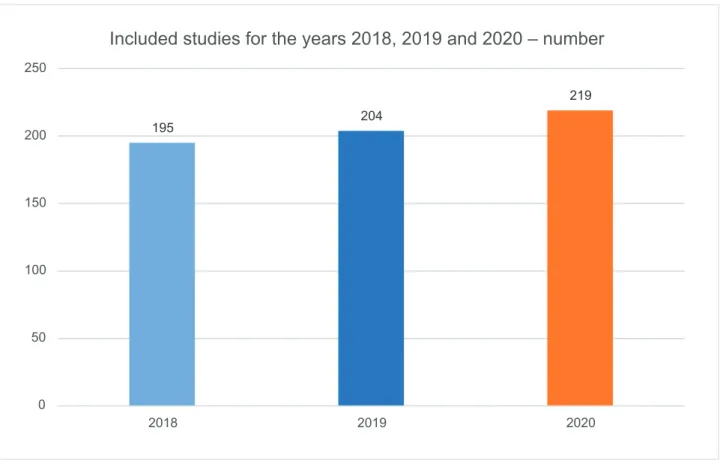
This report is part of an extensive series of reports on Scandinavian research into early childhood education and care. The 2020 evaluation shows that the number of publications related to Nordic early childhood education and care (ECEC) continues to increase.
Background
Purpose
In this chapter, we will describe the methodological guidelines implemented during the preparation of the 2020 research review. The purpose of this chapter is to explain the different stages and methods used to create transparency and strengthen the reliability of the findings.
Literature searches
Inclusion and exclusion criteria
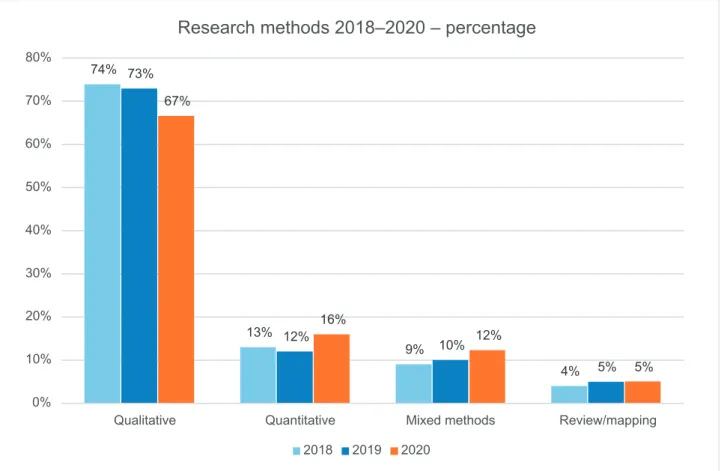
The quality of the studies has been assessed solely on the basis of what is presented in the publication itself. These 169 publications are therefore included in the Nordic Base of Early Childhood Education and Care (NB-ECEC) for the year 2020. At the same time, Figure 5 shows an increase in the number of studies using quantitative and mixed methods.
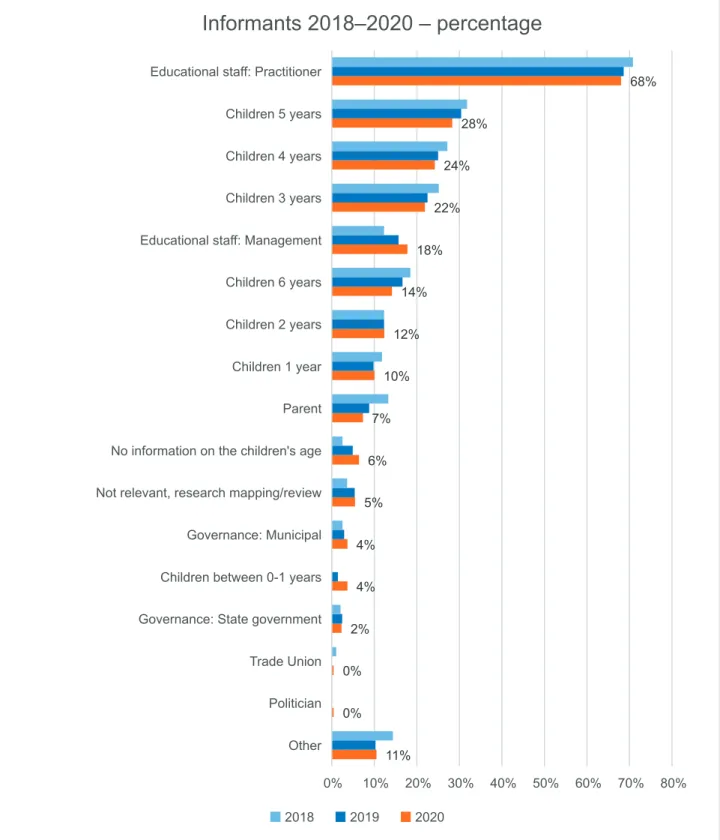
The content of the studies is coded for the different topics covered in the studies. Children in general (all age groups, including those for which age was not specified) are informants in 47% of studies included in 2020. However, in 2020, there was a slight decrease (4 percentage points) in the ratio of secondary quality studies.
The decrease in the share of medium-quality studies in 2020 therefore corresponds to an increase in the share of high-quality studies. However, there has probably also been an improvement in the quality of study implementation and reporting. A large proportion (84%, 125 out of 149 studies) of studies written in English achieve high or medium quality.
Otherwise, we find that the increase in the proportion of studies published in English continues from previous years. The integration of the toy internet into early childhood education: a platform for multi-layered interactions. Lines in the snow; minor roads in search of preschool education for planetary well-being.
Children's involvement in free play and the use of play materials in the outdoor education and childcare environment for young children.
Screening
Coding and assessment of quality
For 2020, a total of 169 of the 219 publications that met the inclusion criteria were rated as medium or high research quality. To ensure reliability in the evaluation of studies, all researchers without experience from previous years participated in a mandatory course providing training on coding and quality assessment of research literature.
Included studies and distribution by country and language
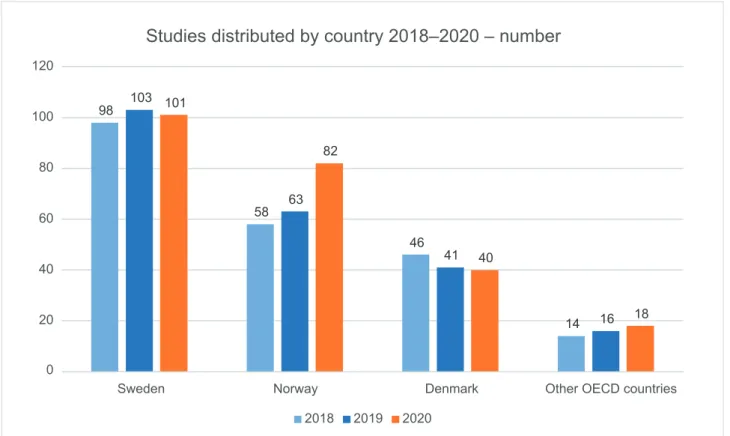
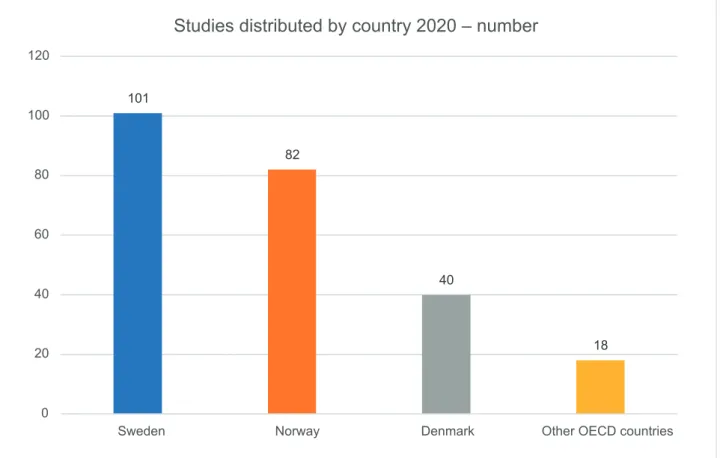
This chapter describes and analyzes the most important trends in empirical Scandinavian ECEC research for 2020, as well as any changes compared to reporting for 2018 and 2019. We will also report on the quality of research for included studies for 2020 and compare findings with the previous review. Developments in the last three years (Figure 3) show that while the results from Sweden and Denmark are relatively stable, there has been a noticeable increase in the number of Norwegian studies from 2019 to 2020.
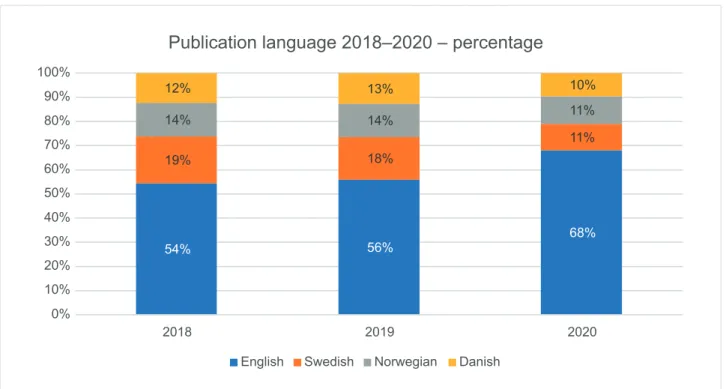
Many licensing theses now consist of one or more articles, and published articles will, of course, be included in the selection, regardless of whether they are part of licensing theses. In summary, we can say that Norway is mainly responsible for the increase in the number of included studies since 2019, while the contributions from Sweden and Denmark have remained stable. Compared to the previous reporting, there was a small reduction in articles in Norwegian and Danish (both down 3 percentage points) and a somewhat larger reduction in articles in Swedish (down 7 percentage points).
In Furunes et al, (2022) (Figure 2), the language development since the creation of the database in 2006 is illustrated, and this indicates a possible stagnation in the increase in studies published in English. The proportion of studies published in English increased again in 2020 and is now at the highest level ever recorded. That the proportion of studies published in English is so high and increasing compared to previous years could indicate more international collaborations where English is the common language, as well as a trend observed in most research fields: namely that English has been preferred language in the academic world to ensure that the research has an international scope.
Applied research methods
Study design
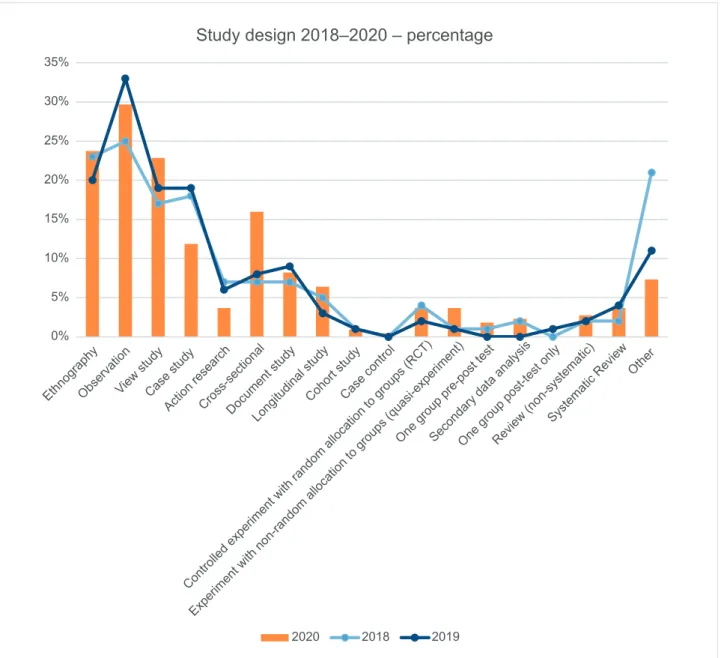
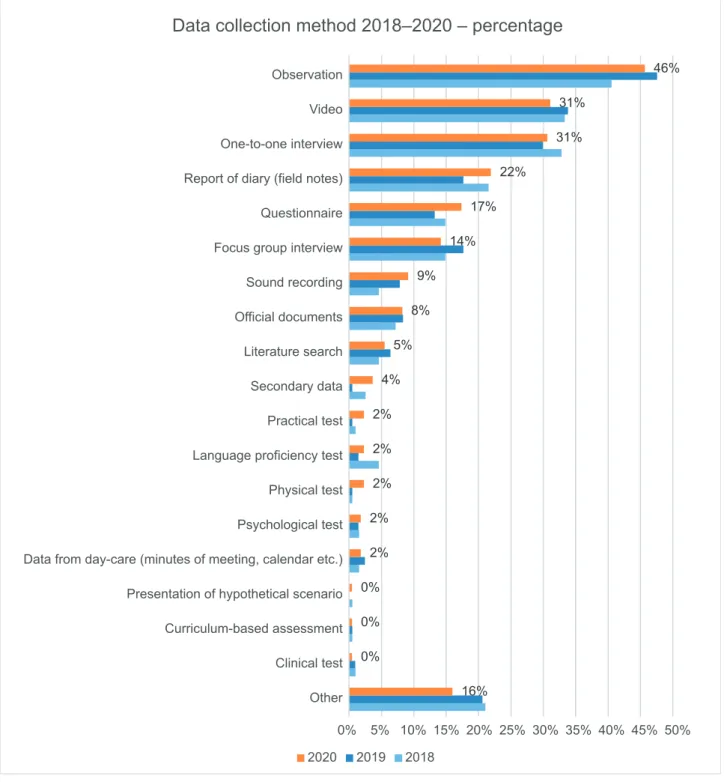
Although there was a small increase in the number of studies using observation as a method for 2020, the percentage still dropped from 48% to 46%. In 2018, 41% of studies reported using observation, so the proportion seems to fluctuate slightly from year to year. Additionally, video and face-to-face interviews remain the second most commonly used data collection methods, and both were used in 31% of studies.
Video observation has seen a small decline (down 3 percentage points) compared to 2019, while one-on-one interviews have a. Clinical test Curriculum-based assessment Presentation of hypothetical scenario Childcare data (meeting minutes, calendar, etc.) Psychological test Physical test Language proficiency test Practice test Secondary data Literature review Official documents Audio recording Focus group interview Questionnaire Journal report (field comments) One-on-one interview Video observation. Additionally, in this year's assessment we also saw an increase for the fourth and fifth most commonly used data collection methods, diary reports (field notes) (up 4 percentage points to 22%) and questionnaires (up 4 percentage points to 17%), while there has been a decrease in the number of focus group interviews (by 4 percentage points to 14%) and in the category other (by 5 percentage points to 16%).
The purpose and content of the research
The category with the fewest studies for and 2020 is mapping/synthesizing research, with 4%, 5%, and 5% of studies listing this as their goal, respectively. As the figures show, there has been little change in the latter category in the last three years. Furthermore, the figure shows that the topics of organization and management, play practices, child perspective, quality of day care, equal opportunities, methodology and curriculum each represent 10-15% of this overview.
We cannot see any major changes in these categories except methodology, for which the proportion has more than doubled in the last two years (from 4% . to 10%). It is worth noting that none of the studies in 2020 looked at matters concerning the economy. 26% of the 2020 studies were also coded as 'other' subjects, representing a decrease of 2 percentage points compared to 2018, but an increase of 2 percentage points compared to 2019.
Teacher career Class management Transition from day care to school Physical functioning and development of children in day care Evaluation and assessment Health policy Technology and ICT Curriculum Methodology Equal opportunities Quality of day care Child perspective Play practices Organization and management Pedagogical practices Teaching and learning. This means studies where observations or interviews of children were included as part of the basic data. Some of these studies focused on preschool children or the Swedish preschool class, while others looked at children in preschool education and care across the different age groups in the study, including six-year-olds.
Assessment of quality in early childhood education and care research
In summary, this year's review shows a general increase in the quality of Scandinavian ECEC research compared to 2018 and 2019. This is a trend that continues from the "low point" reached in 2016, when it was historically high. a proportion of low quality studies and a low proportion of high quality studies. With a larger share of studies published in international journals, there could be stricter requirements for publication, which in turn affects quality.
Annexes 6–10 show that there are certain differences in the assessed quality, depending on the publication type, research method, purpose, language and country. We also see that qualitative studies generally have a lower proportion of studies rated as high quality compared to quantitative studies, reviews and studies using mixed methods. This can be linked to the somewhat different traditions for methodological reporting in the different research methods.
Finally, we should also note the differences in quality ratings based on language and country. Here we can see that the quality of articles in English is significantly higher compared to articles published in Scandinavian languages. Regarding differences in quality assessments by country, this could potentially be related to differences in methodological traditions or the trend of publishing through international journals, but we have investigated this further in this report.
Summary and conclusion
Learning about science in kindergarten: play-based activities to support children's understanding of chemistry concepts. Children's physical activity level and sedentary behavior in Norwegian early childhood education and care: effects of a staff-led, cluster-randomized controlled trial. The preschool environment and preschool teacher's physical activity and their relationship to preschool children's activity levels.
Painting trees in the wind: sociomaterial ambiguity and sustainability politics in preschool education with refugee children in Denmark. Receiving additional support in Norwegian center-based childcare: the role of children's language and social-emotional development. A comparative study of ECEC professionals' perceptions of child well-being and their role in South Korea and Norway.
The heartbreak of social rejection': Young children's expressions of how they experience peer rejection in ECEC. Barriers to outdoor play in early childhood education and care (ECEC) institutions: Perceptions of risk in children's play among European parents and ECEC practitioners. Becoming-with-the-bees: generating affect and response skills with dying bees in early childhood education.
Conceptual subitization and preschool children's learning of the part-part-whole relationships of number. Children's understanding of representations of basic chemistry after participation in an early childhood drama pedagogic activity.