In summary, it is SHK's opinion that the accident was caused by incorrect planning of the ship's meeting combined with a misunderstanding in the communication regarding this meeting. Another contributing factor may have been that the officers on duty on the vessels were likely suffering from fatigue.

FACTUAL INFORMATION
Narrative
- The planning phase
- The collision phase
- The aftermath
Shortly thereafter, the pilot and master at TERNVIND discussed the upcoming meeting with the upcoming STENA JUTLANDICA (this information comes from TERNVIND's VDR). A few minutes later, the pilot ship called VTS in Swedish and informed them that they were on their way to the city (ie the pilot station in Gothenburg) as they had "heard nothing".
Damage
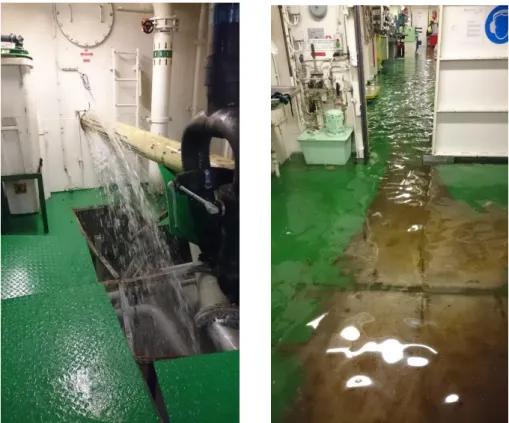
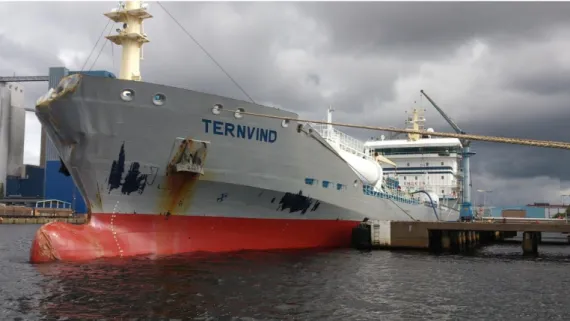
The port fin stabilizer, which was out during the collision, was damaged and in turn damaged several pipes, which also led to a pumping room that took in water. To protect this equipment and make pumping possible, a well was drilled in an empty tank under the pump room.

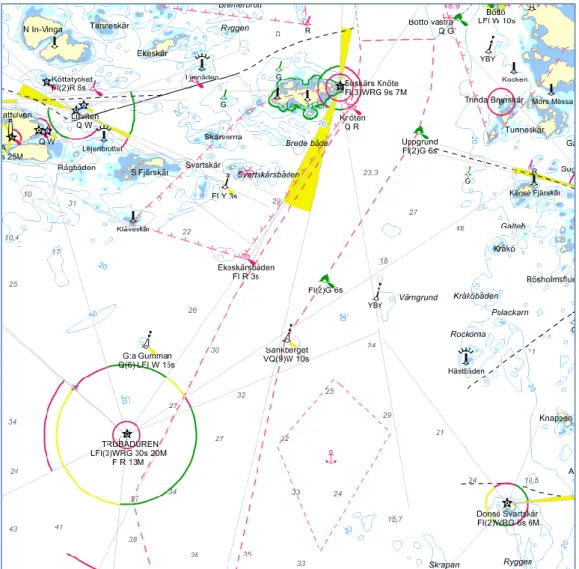
Location of the event
The vessels
- STENA JUTLANDICA
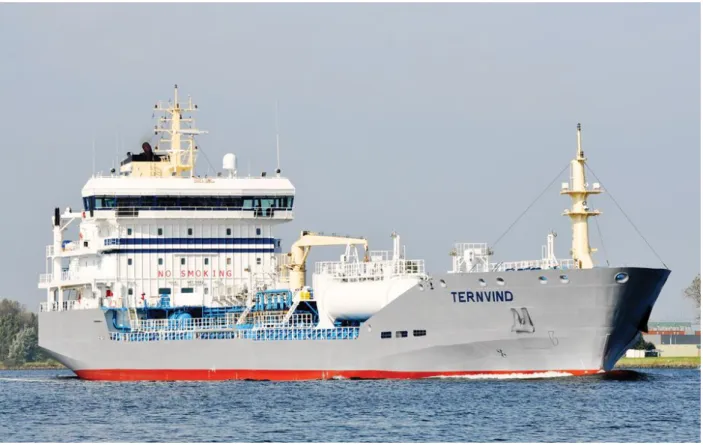
- TERNVIND
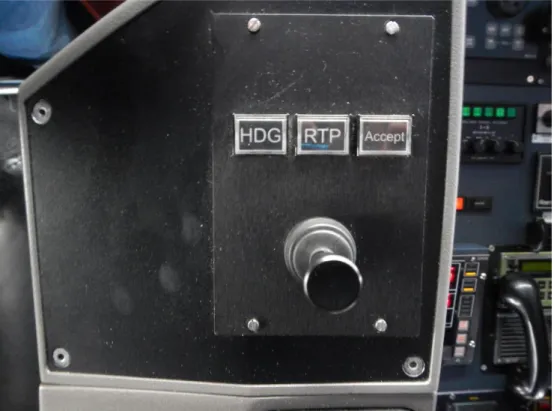
In the foreground, in the center of the image, is the desk where manual control takes place. At the time of the present incident he had been on board for two and a half months and this was his first tour22 on the ship.

Meteorological information
At the time of the collision, the master was in the starboard seat and supervised the landing of the pilot. The officer of the watch went to sea as an able seaman, but had now been an officer for eight years. The able seaman of the watch had been at sea for 20 years, the last twelve with Terntank.
The student deck officer, 41 years old, completed the third of the four internships that were part of the Master Mariner program on board TERNVIND. None of the crew involved, apart from the student deck officer, spoke Swedish.
The rescue operation
- Information about the JRCC
- Reconstruction of the sequence of events with respect to the rescue
Neither vessel did this and the JRCC therefore classified the case as NIL (see section 1.6.1). The JRCC is an integrated air-sea rescue center that is part of the Swedish Maritime Administration. In addition, the assessment instructions in the operational manual state: “The SMC makes an assessment of the incident based on the collected facts.
JRCC responds that the incident is noted in the log, but nothing else is done. The SMC therefore assumed that there was no risk to human life, which explains why the accident was classified as "NIL"; the lowest of the four classes.
Vessel traffic service (VTS)
During the evening and night, a few other cases had been dealt with, but the SMC did not feel that the particular shift was particularly demanding. In connection with the development of the VTS operation, there has been a discussion in the Swedish Maritime Administration about how an intervention should be carried out without disrupting operations on board or stealing the attention of the vessel's crew unnecessarily. VTS Göteborg, which is the VTS area where the collision in question took place, has radar surveillance of the area and access to AIS.
AIS traces are recorded, along with radio traffic occurring in the VTS area. The VTS operator at the time of the incident was a Master Mariner and had served as an officer since graduation in 2006 until his employment as a VTS operator in 2012.
Pilotage, the pilot boat and related activities
The crew of the pilot boat had worked between 6 p.m. and midnight on the evening of July 18, after which they switched to standby, in which they formed “first drive”, that is. The pilot who operated TERNVIND states that the location where he disembarked from TERNVIND was suitable to reduce the influence of wind and waves. The pilot of B GAS LYDIA, a smaller ship than TERNVIND, also states that the weather justified an earlier disembarkation.
However, if the wind is from the south, it is less important where the pilot assembles or lays down, as there is nothing in the area to provide shelter. The pilot who piloted TERNVIND was a seaman's master and had been working at sea on an off and on basis since 1996, becoming an officer in 2001.
Voyage data recorders and technical information
- VDR, AIS and audio files
- Radar and ARPA
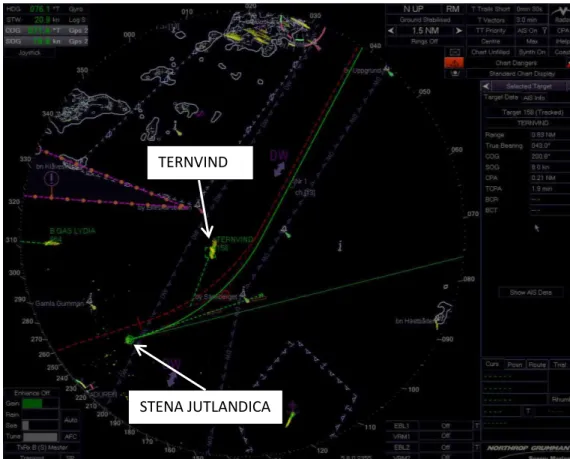
Radar image (shown north facing up) from STENA JUTLANDICA as she begins a turn to port with a radius of 1.4 M. The solid, curved green line in front of STENA JUTLANDICA is the course she will follow when the turn begins. Radar image (shown north facing up) from TERNVIND's X-band radar when the commander calls STENA JUTLANDICA at 02:15:12.
TERNVIND is in a small circle on the upper right, with a white direction indicator approx. There is also a delay in the system, so a change in direction is often easier to see optically than on a radar screen.
Reconstruction and simulations
Relevant regulations
- Navigation rules
- Watchkeeping, lookout and navigational information
- Liability if someone is found in distress
- Communication
- Compulsory pilotage
- VDR
- Requirements, guidelines and advice for steering systems
According to Chapter 2, Section 1 of the Swedish Transport Agency's regulations (TSFS 2012:67) on guard keeping, the master must organize a suitable, effective and safe guard. Under the direction of the master, the officer of the watch on the bridge is responsible for ensuring that the ship operates safely. Under Chapter 3, Section 3, the master or officer of the watch is also responsible for ensuring that the watch is reinforced if necessary to enable the ship to operate safely.
According to Chapter 4, Section 21, the officer of the watch must know where the ship's safety and navigational equipment is located and how this equipment is used. According to section 9 of the Swedish Transport Agency's regulations and general advice (TSFS 2011:2) concerning safety of navigation and navigational equipment, the English language must be used on all ships on international voyages in safety communications between ships and between the ships and the Shore.
Fatigue and working hours
- Night work
- Investigation of work, rest and sleep hours for officers of the watch
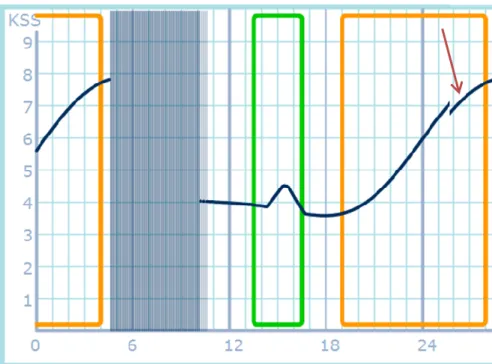
There is a direct correlation between the time of day when the primary sleep period begins and how long it lasts. The end of a long shift with a lot of time on the bridge has thus been placed at the most critical time of the day and just before the primary sleep period. That this specific schedule, which is the summer schedule, is perceived as demanding has been confirmed by the supervisor's information.
However, he did not feel that he was more tired than normal at the time of the incident in question. The night of the collision itself, the captain was also on duty at a time that is normally designated as a rest period.
Procedural drift
No information has come to light to support the statement that none of the watch officers complied with regulatory requirements regarding work hours and rest.
Other occurences of relevance
SMART (IMO GISIS C0009375-R01), MELLUM (IMO GISIS C0006109-R01), KATIE (IMO GISIS C0005650-R01), CROWN BREEZE (IMO GISIS C0007373-R01): these phenomena (two collisions and two touchdowns) have in common that they occurred immediately after the pilot disembarked early or after pilotage was not continuous in conjunction with the pilot being replaced. POMERANIA/RIO GRANDE - Collision 31 January 2005 (Swedish Maritime Administration. The vessels collided when an officer on a departing ship accepted too little difference in CPA (well below the IMO standard) for another ship and when follow- LANGELAND - sinking on 31 July 2009 (AIBN Norway Maritime 2012/08): The vessel contacted the shipowner and informed them that they had developed a list of 10-15° and intended to proceed inside the shear.
GOTLAND (SHK RS grounding off Oskarshamn on 2 January 2014: One of the reasons why this vessel ran aground was the lack of possibility for the navigator to quickly and easily switch to manual steering and thus take control of the vessel himself.
ACTIONS TAKEN
Stena Line
Terntank
The Swedish Maritime Administration
Furthermore, a procurement process is underway to acquire a new navigation system that makes it easier for the pilot to monitor vessels from the pilot boat.
ANALYSIS
- The pilotage
- The communication
- Navigation
- TERNVIND
- STENA JUTLANDICA
- VDR, radar and ARPA
- Fatigue and working hours
- The function of the VTS in conjunction with the collision
- The damage
- Pathways for raising the alarm
- The rescue services
The SHK is of the opinion that it is understandable that an English-speaking person who hears the response of STENA JUTLANDICA gets the perception that the two vessels will pass starboard to starboard. In this context, one must be aware that there can be large variations in the accuracy of the radar equipment. Similarly, it can be concluded that the encounter with the incoming ferry was not unknown to the master of TERNVIND, but that he was still surprised by the ferry's rapid appearance after the departure of the pilot.
In summary, SHK believes that fatigue may have contributed to the accident in this case. JRCC learned of the collision at 02:22 (five minutes after the collision) when the pilot planning center called on behalf of VTS.
CONCLUSIONS
Findings of the investigation
Causes
SAFETY RECOMMENDATIONS
Ensure that a lookout is maintained on board its vessels in accordance with applicable regulations (see 3.3.1). Check that VDRs on the shipping company's ships store the data required by the regulations (see 3.3.3). The Swedish Accident Commission respectfully requests to receive information on measures taken in response to the recommendations in this report by 3 October 2016 at the latest.
Simulations
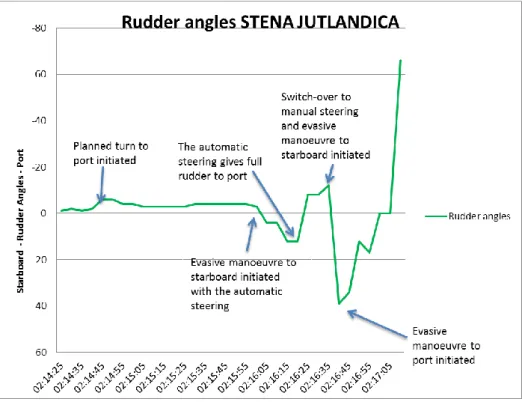
STENA JUTLANDICA turns to the left with a turning radius of 2.0 M, followed by evasive maneuvers to starboard and then to port. STENA JUTLANDICA turns left with manual rudder by 20° after the VHF call and passes 0.18 M behind TERNVIND, which executes a turn to left. STENA JUTLANDICA begins turning to port prior to rendezvous, but turns to starboard on auto-steering only (radius 2.0M) following VHF call and collides with TERNVIND's starboard side.
STENA JUTLANDICA starts its left turn before the meeting and then turns right with a turn radius of 0.50 M, without correction with a left turn. STENA JUTLANDICA turns left only when the TERNVINDA mast lights are in range41.