Scandinavian Investments in Renewable Energy in Developing Countries
REPORT | November 2018
REPORT
PROJECT Scandinavian Investments in Renewable Energy in Developing Countries
DOCUMENT CODE
10206507-01-Report SUBJECT Renewable Energy in Developing Countries –
Investment levels, Policies and Support Instruments
ACCESSIBILITY
Open
CLIENT ZERO, Norfund, The Norwegian Solar Energy
Cluster
PROJECT MANAGER
Mari Sofie Furu CONTACT
Per Kristian Sbertoli (ZERO), Ola Nafstad (Norfund), Trine Kopstad Berentsen (The Norwegian Solar Energy Cluster)
PREPARED BY Mari Sofie Furu, Shreya Nagothu
RESPONSIBLE UNIT Multiconsult Norge AS
This report has been prepared by Multiconsult on behalf of Multiconsult or its client. The client’s rights to the report are regulated in the relevant assignment agreement. If the client provides access to the report to third parties in accordance with the assignment agreement, the third parties do not have other or more extensive rights than the rights derived from the client’s rights. Any use of the report (or any part thereof) for other purposes, in other ways or by other persons or entities than those agreed or approved in writing by Multiconsult is prohibited, and Multiconsult accepts no liability for any such use. Parts of the report are protected by intellectual property rights and/or proprietary rights. Copying, distributing, amending, processing or other use of the report is not permitted without the prior written consent from Multiconsult or other holder of such rights.
TABLE OF CONTENTS
Forewords ... 4
Executive Summary ... 6
1 Introduction ... 9
1.1 Background: SDG 7 – Affordable and Clean Energy for All ... 9
2 Level of activity in commercial investments ... 11
2.1 Overview of relevant actors ... 11
2.2 Comparison of investment activities ... 13
2.3 An apparent renewable energy business cluster in Norway ... 19
3 Barriers hindering Renewable Energy investments in LDCs ... 21
3.1 Size- or technology-specific barriers ... 22
3.2 Barriers for Distributed Energy Solutions ... 25
3.3 Managing risk ... 28
4 Publicly financed support mechanisms and instruments ... 31
4.1 Public Institutions Support and Official Development Assistance for Energy ... 32
4.2 Development Finance Institutions ... 40
4.3 Export Credit and Guarantee Agencies ... 43
4.4 Other Relevant Organizations/Institutions ... 45
4.5 Stakeholder Opinions and Perceptions ... 48
4.6 Nordic cooperation ... 49
4.7 Lessons ... 49
5 Strengthening the Norwegian cluster ... 51
5.1 Policy recommendations to strengthen the Clean Energy for Development initiative ... 51
5.2 Suitability of existing suite of instruments for DESCOs ... 52
5.3 A case for a Norwegian guarantee mechanism ... 53
6 Conclusions ... 58
7 Bibliography ... 60
8 APPENDIX ... 61
ANNEX I. List of Abbreviations ... 61
ANNEX II. Methodology and Limitations ... 63
ANNEX III. Understanding distributed energy business models ... 66
ANNEX IV. Detailed overview of Scandinavian companies engaged in renewable energy in developing countries ... 68
Forewords
by ZERO, The Norwegian Solar Energy Cluster (Solenergiklyngen) and Norfund
Developing countries need energy to grow out of poverty, but if they base their growth on fossil sources, it will be impossible to stop climate change that will have the most disastrous consequences in the same countries. In spite of steadier lower prices on renewables, new coal plants and diesel aggregates are still being built. Rich countries that have spent most of the world’s carbon budget, have no business pointing a moral finger on countries with much lower emissions per capita. But we do have a shared obligation to offer better alternatives.
ZERO is a Norwegian environmental organization dedicated to use Norway as a tool to create the biggest possible impact in stopping climate change. We believe that investing in renewable energy in developing countries is one major way Norway can make a global difference. Norway has capital and energy competence that gives us both a great responsibility to contribute to combat climate change and poverty, and great opportunities to create new jobs and income streams, in a future where our own income from oil will fade.
This leads us on a quest to find the right mechanisms to drive further growth in these investments. The Nordic countries share many similarities in business and governance, making it useful to see what we can learn from each other. Our hope is that this report can be used to develop new policies that can contribute to further develop the emerging Norwegian cluster of businesses investing in renewables in developing countries.
The Norwegian Solar Energy Cluster consists of more than 80 industrial partners, major R&D institutions and regional and national public partners. The cluster aim to strengthen the Norwegian partners’ innovation capacity and competitiveness, and to supply both
markets at home and abroad with clean, renewable and sustainable solar energy.
In a world where 1 billion people - one in seven of the world´s population- do not have access to electricity, we have the work cut out for us. The report suggests that Norway has the most active and mature business community investing in and developing commercial renewable energy projects in developing countries. Our long history, experience and competence in the area is considered to be relevant for partner countries, and should also be strengthened as a competitive advantage.
Norwegian energy businesses emphasize the importance of risk mitigating support. Norwegian public support to risk mitigation in the early phases of project development is available, but can be difficult to access for some, in particular for companies lacking technical or operational track-record. This limits new ventures and innovative start-ups, which is contra productive in a business where fast changes due to digitalization and technology innovation is vital.
The report shows we have something to learn from the Danish approach to portfolio risk instead of project risk, which allows higher-risk projects to access support. Pinpointing the debate on investment guarantee instrument, the report shows that although the Norwegian public offer a range of guarantees, they are risk averse and expensive. We need a guarantee mechanism dedicated to renewable energy projects in developing countries to unleash more private investments. Also there is a huge untapped potential to financing renewable energy projects if more pension funds could be mobilized.
Norfund’s mandate is to contribute to economic growth and job creation through sustainable investments in developing countries. Norfund is fully funded from the Norwegian development aid budget, is completely untied, and operates on commercial terms.
Teaming up with the best commercial partners is crucial to making good investments. In our energy investments, Norfund has over time worked successfully with, among others, Nordic partners like Scatec Solar, KLP, Trønder Energi, BKK, Statkraft and Vestas, as well highly qualified consulting firms and legal advisors. A major aim of this study is to map commercial and financial companies in the Nordic countries that operate in developing countries, to get a better understanding of Nordic companies’ capabilities in this area, and how we can strengthen our common contribution to development in the clean energy sector. A particularly interesting finding is that Norway has, partly due to heavy and targeted political priorities over a long time, a strong and experienced industrial cluster, well positioned for further efforts in contributing to developing the energy sector in poor countries. Another interesting finding is that we may have some lessons to learn from our neighbours, particularly with respect to mobilizing more private capital for energy investments in developing countries.
About the author
Multiconsult is one of the leading firms of consulting engineers and designers in Norway and Scandinavia, with close to 3000 permanent staff and expertise spanning a wide range of disciplines. Multiconsult’s 295 highly skilled consultants dedicated to the renewable energy sector provide consultancy and design services both in Norway and internationally. Working at the intersection between experience, research and development enables us to create efficient, sustainable energy solutions for the future.
At Multiconsult, we look at the bigger picture when developing renewable energy projects, from production and distribution to consumption. Long experience with the Ministry of Foreign Affairs, the Norwegian Embassies in developing countries, Norad, Norfund, various Norwegian private Renewable Energy companies, as well as on assignments commissioned by Sida and other bilateral and multilateral donors, has provided us with the insight that creates the foundation for this report.
Multiconsult would like to thank ZERO, Norfund, and The Norwegian Solar Energy Cluster for close and good cooperation throughout the compilation of this report. A special thanks is extended to Tom Erichsen and Kjetil Røine in Differ AS (www.differgroup.com), who have written the sub-chapters that are specifically related to off-grid, distributed energy and the specific challenges faced by distributed energy companies.
Finally, we thank the significant number of interviewees from companies and institutions across Scandinavia, who have provided insight, data, references, and opinions that this report builds upon.
Without these, there would be no report.
Oslo, November 2018
Executive Summary
This report presents a benchmark assessment of Scandinavian countries in terms of levels of activity among commercial entities related to investment in renewable energy in developing countries, and the public support mechanisms and instruments set up to promote such investments. Through this assessment, the report seeks to discuss and provide possible answers to four key questions.
A summary of the conclusions related to each question are presented below.
Norway’s business community is the most active in investments in and development of commercial renewable energy projects in developing countries, compared to our neighbouring countries.
Norwegian renewable energy businesses have characteristics of an emerging industrial
‘cluster’ – with small and big companies and financiers representing a wide array of expertise:
technological solutions, equipment supply, business development, equity and portfolio investment and advisory services; and backed by industrial associations.
Norfund’s large proportion of renewable energy in the investment portfolio contrasts Swedfund and IFU’s smaller shares of renewable energy.
Norway, Denmark and Sweden all offer relatively comprehensive suites of mechanisms and funding approaches to support international private sector development;
Norway is the country among the three that most strongly emphasises renewable energy as target area. Norway’s long history, experience and competence in the area is considered to be relevant for partner countries;
Norway combines a strong commitment to the principle of untied aid with an explicit intention to also facilitate and encourage application of Norwegian renewable energy experience and competence. Meanwhile, Sweden does not emphasize involvement of Swedish industry.
Danish support mechanisms on the other hand explicitly target Danish companies and Danish exports.
The combination of public support available to the private sector and the leadership represented by Norfund and some other leading actors in Norway have likely been one driving force in the emergence of a Norwegian ‘cluster’. Danish tied support has been actively used by the export industry and has promoted equipment suppliers and exports rather than encouraged investments.
The various Norwegian early stage support schemes are not formed to effectively support Distributed Energy Service Companies (DESCOs) to go to scale and make them attractive for investments by DFIs.
Consistent Norwegian focus on energy as a target sector in development assistance and the role that the Norwegian energy sector can play has been a driving force to encourage investment activities in developing countries.
The Danish approach to business support provides an interesting example in considering portfolio risk instead of project specific risk, which allows higher-risk projects to access support.
Engagement of Danish pension funds to invest in commercial projects in developing countries with a focus on energy, climate and infrastructure has been made possible and strengthened through provision of guarantees to the funds’ investment.
Danida’s Business Finance promotes Danish industry through concessional lending exclusively to Danish companies; while Norwegian aid is untied and grant-focused and cannot be granted on exclusive basis.
While Sweden strongly emphasises guarantees, the guarantee mechanism have not in itself had any promotional effect on the investment level of Swedish businesses.
Sida’s piloting of a special guarantee for the TRINE platform as an approach to enable crowdfunding is an example of innovative use of support mechanisms, which also supports distributed energy solutions.
The Norwegian suite of support mechanisms has been relatively consistent over time. While this ensures predictability for beneficiaries, it may also indicate that Norwegian public support to Norwegian renewable energy companies is less innovative than Danish and Swedish support and potentially less adaptable to changing needs.
While public support has been a driving factor for the emergence of the cluster, it is likely that more could be achieved through innovative approaches, strengthened support for early phase development and business scaling, and better access to risk mitigation measures.
Norwegian energy businesses emphasize the importance of risk mitigating support. Norwegian public support to risk mitigation in the early phases of project development is available and valued, but can be difficult to access for some, in particular for companies lacking technical or operational track-record. This limits new ventures and innovative start-ups, which also limits the growth of the cluster.
Distributed energy has a potential and Norway could play a leading role among the Nordic countries in making distributed energy business bankable. DESCOs are facing a different set of risks than on-grid developers, specific policy attention, budgets and a tailored set of support mechanisms should be considered.
Guarantees that cover a range of different types of risks are available in Norway and internationally. Norwegian energy businesses involved in developing countries have argued that guarantees available in Norway are risk averse and expensive, and that the international instruments are difficult to access. They argue that a dedicated Norwegian guarantee mechanism for renewable energy in developing countries could be instrumental to unleash more investments.
Extended scope and outreach of publicly backed guarantees or subsidies for already available but expensive guarantees could count as Norwegian climate funding under the Paris Agreement. The white paper “Common Responsibility for Common Future (Meld. St. 24 (2016–
2017)” also notes that such aid could have a catalytic effect on funds mobilization for development.
A full evaluation of Norwegian publicly guarantees and how they could be structured should assess what gaps Norwegian public funding could fill in terms of coverage, terms or accessibility; the related costs, funding and management structure; and the potential impact it could have on Norwegian investments in developing countries.
1 Introduction
1 Introduction
The purpose of this report is, primarily, to assess the activity level among Scandinavian business communities related to investments in renewable energy, with a specific focus on developing countries. Secondly, it aims to assess the Scandinavian countries’ level of public support that are offered to commercial businesses in this space. The level of investment identified is considered as an indicator of the mechanisms’ effectiveness and whether there is room for improvement.
The report benchmarks the level of private and commercial activity in renewable energy in developing countries in Norway against Sweden and Denmark, and provides an overview of the available policies and public instruments available to commercial actors to promote and support such investments.
To assess the relevance of such instruments, the report also briefly examines the barriers that investors and developers of renewable energy projects face when investing in renewable energy in developing countries; and whether existing instruments meet the investors’ needs.
Against the backdrop of investment levels and available instruments, the report summarizes policy recommendations for the further efforts to support clean energy development through promotion of commercial investment, with a particular focus on the debate around a possible additional Norwegian investment guarantee instrument.
The report does not aim at assessing the overall results that have been achieved through the respective countries’ energy sector development assistance other than with respect to investment activities.
The report is based on publicly available information, such as reports from various development agencies and financial institutions, as well as internal expertize and external interviews, information from companies’ websites, news articles, other reports on the subject, (SE4ALL, u.d.) etc.
Differ AS have written the sub-chapters that are specifically related to off-grid, distributed energy and the special challenges faced by companies working in this area.
1.1 Background: SDG 7 – Affordable and Clean Energy for All
On January 1st, 2016, the 17 Sustainable Development Goals (SDGs) of the 2030 Agenda for Sustainable Development — adopted by world leaders in September 2015 at a historic United Nations (UN) Summit — officially came into force. Through adopting the SDGs, countries have committed to eradicate all forms of poverty, combat inequality and climate change. The SDGs are not legally binding, but governments are expected to mobilize efforts and establish national frameworks to achieve the 17 goals.
SDG number 7, “ensure access to affordable, reliable, sustainable and modern energy for all”, is not only a goal in itself: it is also a crucial factor for attaining many of the other SDGs. Be it goals related to employment, inequality, security, climate change, food production or increasing incomes; access to energy for all is essential.
More than 1 billion people globally – one in seven of the world’s population – do not have access to electricity. The majority of these people is concentrated in about twenty countries in Sub-Saharan Africa and Asia. Furthermore, close to 3 billion people rely on solid
“dirty” biomass such as wood, charcoal, dung and coal for cooking and heating1.
1 Sustainable Energy for All. (u.d.) Energy Access. Retrieved from: https://www.seforall.org/energy-access Figure 1 SDG 7
1 Introduction
According to the UN, “the world needs to triple its investment in sustainable energy infrastructure per year, from around $400 billion now to $1.25 trillion by 2030”2. McKinsey has estimated that close to USD 500 million would be required to meet the needs for new electricity generating capacity in Sub- Saharan Africa until 20403. As it is increasingly recognized that Official Development Assistance (ODA) can only support a very limited part of this need, private investments are gaining importance as a means to achieve the target. Private investors in sustainable energy services can also more efficiently bring new technologies to the market quickly from a diverse supplier base.
Against this backdrop, the Norwegian development assistance strategy has specifically aimed at contributing to achieving SDG 7, while recognizing the importance of access to energy for other SDGs.
These contributions are ensured both through development assistance and financing, as well as through Norwegian companies’ activities in developing countries’ energy sectors.
2 United Nations. (u.d). AFFORDABLE AND CLEAN ENERGY: WHY IT MATTERS. Retrieved from: https://www.un.org/sustainabledevelopment/wp- content/uploads/2016/08/7_Why-it-Matters_Goal-7_CleanEnergy_2p.pdf
3 McKinsey & Company. (2015). Brighter Africa: The growth potential of the Sub-Saharan electricity sector. Retrieved from:
https://www.mckinsey.com/~/media/mckinsey/industries/retail/our%20insights/east%20africa%20the%20next%20hub%20for%20apparel%20sourcing/brighter_af rica_the_growth_potential_of_the_sub%20saharan_electricity_sector.ashx
2 Level of activity in commercial investments
2 Level of activity in commercial investments
2.1 Overview of relevant actors
In evaluating the level of activity in renewable energy in developing countries in Norway, Sweden and Denmark, the starting point is to get an overview of the different companies and organizations in this field in the respective countries. Although the overview is not exhaustive, it gives an indication as to how developed a “cluster” in this field is in each of the countries.
The cluster overview presents companies that in some way or the other have renewable energy activity in developing countries; developing projects, investing in projects, exports, consulting services etc. The players that have been included are those that have a track-record of some activity or strategic focus on developing countries, and where information has been available to verify that this is the case. There could for instance be other players that have some indirect activity in developing countries that are not included here (i.e. suppliers in up-stream value chain that contribute with parts that end up in products that are sold to developing countries).
2.1.1 Definitions of types of companies
The various types of actors that make up a cluster, as defined in this report, are described below.
1. Developer & investors. The companies whose main activity (in this field) is to own projects and/or invest in project development.
On-grid: Companies that focus mainly on projects connected to the central grid.
Distributed: Companies that focus mainly on mini-grid, micro-grid and other off-grid systems and appliances, such as solar lamps and battery chargers.
2. Equipment/technology suppliers. The companies that do not necessarily provide capital to a project, but supplies equipment, products or technology of some kind that contributes to increasing capacity and access to renewable energy.
3. Financial institutions. Banks, funds, and other organizations/instruments whose main role is to fund projects and other players in the field, by providing capital through loans, equity and guarantees for instance.
4. Advisors. Companies or organizations, usually consultants, who provide services such as feasibility studies, market studies, projection of projects, etc.
5. Public agencies. Export Credit Agencies and other public organizations that extend credit or provide guarantees.
2.1.2 Industry Mapping
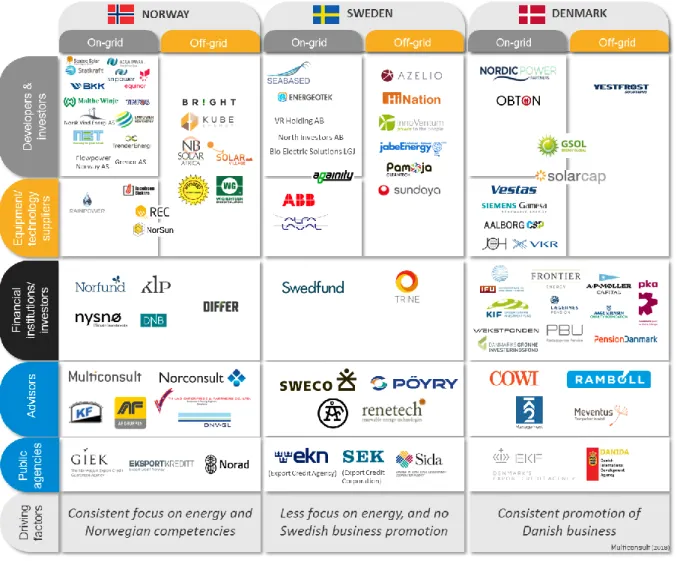
The following overview shows actors in each of the Scandinavian countries with some activity in renewable energy in developing countries. Some companies are involved in two categories, such as suppliers that supply to both on-grid and off-grid markets, and companies that both develop projects and act as suppliers.
2 Level of activity in commercial investments
Figure 2 Mapping of active companies in the renewable energy sector in developing countries
The mapping above is not exhaustive due to data availability. Both Norway and Sweden have significantly more companies that can be categorized as developers/investors, and suppliers, both in the on-grid and off-grid space, compared to Denmark. Norway especially seems to have more active on-grid developers/investors than the other two.
Many of the names listed under Sweden is received from Sweden Business as companies that have voiced interest in business in Africa. As far as we have been informed and our research shows, many have not yet realized business or investments in developing countries, or only at a very small scale, and would not be significant on an aggregated investments overview. Furthermore, the Swedish business community does not operate as a joint interest group through a common representation, as the Norwegian example with Norwep and The Norwegian Solar Energy Cluster. Thus it appears that Norway has the most active and mature business community in this field.
Several relevant consultancy and advisory firms are identified in all three countries. Denmark stands out when it comes to institutional investors, shown by the number of pension funds that have been involved in relevant investments.
A detailed description of each company and their activities is presented in ANNEX IV.
2 Level of activity in commercial investments
2.2 Comparison of investment activities
In the following assessment of the level of investment activities related to renewable energy in developing countries, the focus is on developers/investors and financial institutions, as these contribute directly to promoting renewable energy with capital out of their domicile country.
To compare the activity levels across by Norway, Sweden and Denmark, we consider the following categories of activity separately:
Investments of the countries’ Development Finance Institutions
Investments/projects of developers/investors and other financial investors
Investment level assessment methodology
The following central assumptions and limitations of scope should be noted. A fuller, detailed description of the methodology applied is provided in ANNEX II.
In general only projects in developing countries outside Europe have been taken into consideration.
Unless otherwise stated, only power generation facilities are taken into consideration.
Auxiliary infrastructure such as power evacuation infrastructure or factories producing devices for renewable energy plants are not included.
When it comes to off-grid energy, investments are primarily made by the energy users and are therefore counted as “trade” or “import” rather than “investments” and thus not reflected in investment statistics. This further implies that companies involved in off-grid activities contribute capital mainly as investments into the company, work capital etc. falls outside the scope of the investment analysis in this report. A suggestion for methodology on how this type of investments could be accounted for is presented in ANNEX II, section C, although not dealt with in this report.
Where possible to isolate, only green-field and rehabilitation investments are taken into consideration. Investments in or loans to existing projects/companies are counted only where there are clear indications of that capital having catalysed projects that in some way add additional capacity to existing generation.
Where possible to isolate, investments in biofuel driven power plants are not included.
Where otherwise not stated, investments in energy efficiency are not included.
Where planned investments4 are found, these are also included in the analysis. Value is included in the year of commitment.
Identification of projects, companies and investment and the research faces a number of challenges. The information given in the following should therefore not be considered an exhaustive overview, and direct comparison may not be possible. Despite these limitations, we believe that the findings give an accurate indication of relative activity and investment level.
Although companies that export equipment/technology and export credit agencies have been included in the mapping of players, renewable energy exports and export finance is not included in the benchmark, as this does not qualify as investments. Furthermore, it has not
4 Projects that have been publicly announced and have reached or are close to reaching financial close, but investments have been committed but not yet made
2 Level of activity in commercial investments been possible to isolate the share or renewable energy of total exports and export finance for all the countries, thus benchmarking would not be possible.
Institutional investors, such as pension funds, portfolio investors etc. are accounted for to the extent information has been available. This information does not specify type of investments, such as project size and type of technologies.
2.2.1 Development Finance Institutions (DFIs)
The DFIs Norfund, Swedfund and IFU5 (in Norway, Sweden and Denmark respectively) are among the countries’ main channels for commercial investments into developing countries, also when it comes to renewable energy. A more detailed description of each DFI and their roles is available in sub-chapter 4.2.
Renewable energy focus
The share of energy/power related investments within the respective DFIs’
total portfolios is a useful indication of the relative importance placed on (renewable) energy.
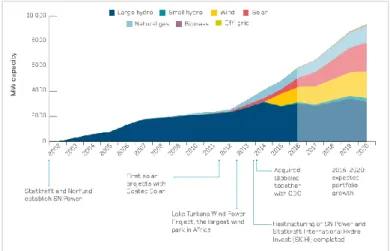
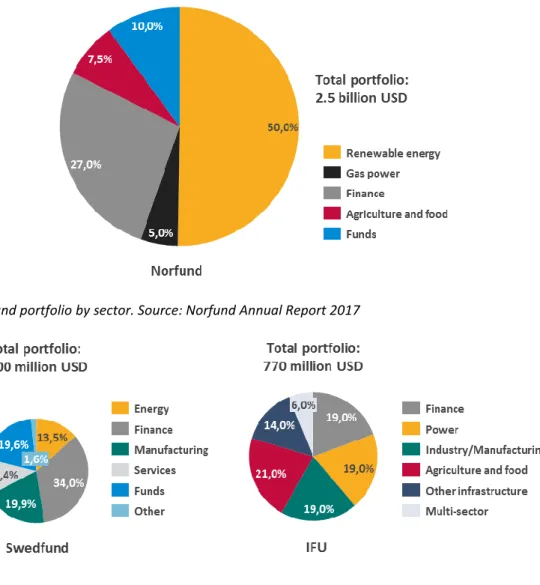
As Figure 4 shows, renewable energy represents 50 % of Norfund’s total committed portfolio of about 2.5 billion USD as of end 20176. Norfund’s investments had resulted in about 5000 MW total installed renewable energy capacity in mid-2016 (Figure 3).
In comparison, only 13.5 % of Swedfund’s
portfolio, with just above 500 million USD contracted amount, was invested in energy as of the end of 20177. Note that this also includes some legacy of investments in non-renewable projects.
IFU’s committed portfolio value is about 770 million USD8. 19 % of the portfolio was invested in the power sector at the end of 2017. Some of these investments are in non-renewable energy, as it has not been possible to isolate renewable energy investments. Also, there could be other renewable energy investments that are not included in the “power sector” share. In terms of installed capacity, IFU has invested in 764 MW of renewable energy in developing countries and 280 MW of fossil energy.9 In brief, Norfund has a substantially larger portfolio than the other two DFIs, as well as having the absolutely largest share of investments committed in power/energy.
5 Investment Fund for Developing Countries
6 Norfund. (2018). Annual Report 2017. Retrieved from: https://www.norfund.no/getfile.php/138333- 1534759775/Bilder/2017%20Annual%20report%20%28ID%20271534%29.pdf
7 Swedfund. (2018). Integrated Report 2017: Equation 2030. Retrieved from: https://www.swedfund.se/media/2085/swedfund_integrated-report_2017_part-1-and- 2.pdf
8 EDFI. (u.d.). Meet our members: IFU, Denmark. Retrieved from: https://www.edfi.eu/member/ifu/
9 IFU. (u.d.). Fact sheet: IFU IS AN EXPERIENCED EMERGING MARKET INVESTOR.
Figure 3 Development of Norfund’s energy portfolio.
Source: norfund.no
2 Level of activity in commercial investments
Figure 4 Norfund portfolio by sector. Source: Norfund Annual Report 2017
Figure 5 Swedfund and IFU portfolios by sector.
Sources: Swedfund Integrated Report 2017; EDFI web site: https://www.edfi.eu/member/ifu/
Commitments
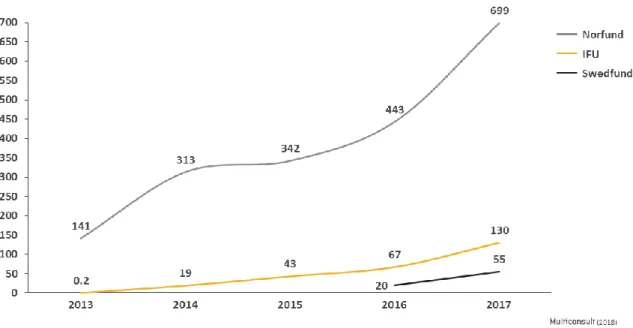
With regard to renewable energy, Norfund represents the highest level of investments of the three DFIs considered. From 2013-2017 renewable energy investments accounted for a total of about 700 million USD. This is more than three times IFU’s investment in renewable energy in the same period;
Swedfund is significantly below this. Investments in SN Power and projects developed by Scatec Solar represent a significant share of Norfund’s investments and commitments. Norfund’s portfolio includes investments in companies engaged in the off-grid sector. The investments into the off-grid sector are not isolated in the overview above.
IFU’s major financing source for renewable energy investment is the Danish Climate Investment Fund (DCIF). In the years between 2013 and 2017, nearly all of IFU’s renewable energy investments were financed from the DCIF10. These investments, as defined in this report11, amount to about 130 million USD. The DCIF commits a significant amount of capital as loans through Nordic Power Partners12.
10 DCIF’s total capitalization is about 1.3 billion DKK (~200 million USD), funded by the Danish state, partly through IFU, and by private investors. About 1 billion DKK was invested at the end of 2017.
11 I.e. excluding biomass and projects that are not directly related to power production or distributed solutions
12 Nordic Power Partners develops power projects and is owned by the DCIF and the Danish energy company European Energy.
2 Level of activity in commercial investments Swedfund invested a total of 55 million USD in renewable energy in the period 2013-2017, but only since 2016 as a result of a dedicated sector focus following a strategic shift in Swedfund’s investment strategy in 201513. In 2016, 44% of the annual government allocations to Swedfund were allocated to renewable energy %, increasing to 72 % in 2017. Swedfund expects a significantly increased focus on renewable energy, and consequently increased investments (both in absolute and relative terms) in the coming years. Swedfund’s investments can be grouped into platform investments (where Swedfund effectively finances a developer of renewable energy projects such as the commitment to the Berkeley Energy Asia-focused fund REAF II); long-term debt through the Interact Climate Change Facility; and smaller direct investments.
Figure 6 shows cumulative investments and loans committed by DFIs into renewable energy in developing countries in the years 2013-2017.
Figure 6 DFI commitments from Scandinavian countries, 2013-2017. Does not show investments before 2013, and is not equivalent to total committed value in 2017.
Source: Web sites, annual reports and reported numbers from respective DFIs.
Based on the above, it is clear that with regard to renewable energy in developing countries through DFI activity, Norway showcases a much higher level of activity than the two other countries.
2.2.2 Commercial investors and developers, and other financiers
In addition to DFI activity, commercial investments stems from private sector investors (both companies and institutional investors) and developers/IPPs141516. To the extent possible, we have identified investment amounts by each of these actors in order to estimate the combined value of their investments. As mentioned above, availability of this type of data and information is very limited and not easily available, and the following is based on a compilation of sources and assumptions made and is not fully comprehensive or exhaustive.
13 Numbers are provided by Swedfund.
14 Independent Power Producers
15 We note that in relation to stand-alone solutions, an important element that is not reflected in these figures are investments made by the end users. For a SHS, the customers themselves typically carry 30-100% of the infrastructure investment cost. The same is often the case for project developers. This is different from on-grid power plants, where the full investment in carried by the investors, while end users only pay for the usage.
16 As only project investments are accounted for, the overview does not reflect equity capital insertions in companies. This implies that e.g. off-grid business activity is under-reported, as companies engaged in this space may invest in working capital for project development, marketing and sales, and stock.
2 Level of activity in commercial investments
Norway
The private developers and investors in Norway represent investments amounting to about 2.85 billion USD (Figure 7).
In relation to this figure the following is noted:
The estimate for SN Power’s investments is based on equity investments between 2005 and 2017, as reported in the annual reports. Agua Imara’s investments are assumed to be a part of SN Power’s investments.
In the estimate of investments by developers, both larger and smaller actors are included. Among these are Scatec Solar, Equinor, Kube Energy, Tinfos and the Nkusi project in Uganda.
The investments by developers and investors also include the investments made by KLP through KNI17, their partnership with Norfund. Only KLP’s part of the investments KNI is included, as Norfund’s part has already been accounted for as DFI investment (section above).
KNI has invested in several of Scatec Solar’s projects, but the Scatec Solar numbers have been isolated to not include the KNI funding or other Norfund funding, to avoid overlap.
As only project investments are accounted for, the overview does not reflect equity capital insertions in companies. This implies that e.g. off-grid business activity is under-reported, as companies engaged in this space may invest in working capital for project development, marketing and sales, and stock. A thorough assessment of the contributions from this sector would need to take a different approach, for example by assessing total sales figures in developing countries.
We emphasize that there are caveats related to estimating an aggregated level of investments, in particular related to lack of reliable data. For example, investments made by Statkraft, besides those made through SN Power, have not been included here due to lack of data. Further, many small projects – often within off-grid activities, have not been possible to account for.
While the above thus is no exhaustive overview, it can be considered as a good indication of the size of investments that have been made by Norwegian private developers and investors.
Sweden
Various developers and suppliers have been identified in Sweden, both in the on-grid and off-grid sectors. To the extent research has uncovered, and considering the likeliness that we have missed some investors or companies, there are not many Swedish developers or investors that have yet invested in or developed projects within renewable energy in Africa or other developing countries, as mentioned in Section 2.1.2. As for the Norwegian assessment, off-grid activities are not reflected as investments by the companies themselves are limited. Nevertheless, this shows that the Swedish business community in ‘renewable energy in developing countries’ is less vibrant than what is seen in
17 KLP Norfund Invest
Figure 7 Investments by Norwegian companies and private investors.
2 Level of activity in commercial investments Norway. This statement has been confirmed by various players who are likely to be well informed, including Swedfund, Sida and Business Sweden.
A number of activities that may be relevant but are not regarded in this context:
Consultants/advisors such as Sweco are engaged in renewable energy projects, but are not investors and thus not reflected. ABB is also involved in various projects globally, including developing countries, but as they are focused more on grid and other infrastructure which is not part of generation, they fall slightly outside the scope.
Some other developers/investors, such as Seabased AB18 and North Investors AB19 also have some activity, but these are either relatively small-scale projects so far, not yet realized or no investment data is available. VR Holding AB applied to build a 600 MW off-shore wind farm off the coast of Kenya20, which would have made it the largest wind farm in Africa (the largest so far, the partly Norwegian owned Lake Turkana, also in Kenya, has 310 MW capacity, see Box 1).
The Kenyan government did not approve this project, as it is too large for both institutional and infrastructure capacity to handle, thus VR Holding has set their sight on Tanzania instead, but no concrete project plans seem to have been established or approved.
About 11.4 million USD has been mobilized through Trine Crowdfunding Platform, since it was established in 2015. However, as the platform is not limited to Swedish persons, the capital cannot strictly be verified to be Swedish.
The energy company and developer Fortum has invested in solar power in India, in which the Swedish daughter company has been involved. However, as the mother company sits in Finland, this capital cannot be classified as Swedish either, according to the definition of this study.
Denmark
Denmark’s strong and leading wind power industry, especially wind turbine manufacturers such as Vestas, has been involved in several wind projects in developing countries. However, we have not identified many Danish investors or companies that invest in or actively develop renewable energy projects in developing countries. Information about Vestas’ role as financier of projects is not easily available, although it is known that they have invested in the Lake Turkana Wind Park along with other DFIs and private investors (see Box 1).
Again, the completeness of the overview is limited due to the following factors:
Several other Danish companies have some presence in developing countries, but most apparently not as investors. A limitation to these findings is unavailability of data showing mobilization through Danida’s support, which notably is tied to Danish companies and/or interest.
Nordic Power Partners is a developer similar to SN Power in Norway, owned by the DCIF and the Danish energy company European Energy. They are involved in wind and solar power projects in Brazil. Some of these are accounted for in the Danish DFI investments; but it has not been possible to identify the total value of NPP’s investments.
Denmark does, notably, distinguish itself by the relatively active engagement in renewable energy in developing countries by institutional investors. While some of the capital in the funds described in the following come from public funds, Danish pension funds are significant capital providers. This
18 Wave power company that has activity in Ghana
19 Private equity company which ventured into small hydro power in the Philippines.
Source: Gatdula, Donnabelle L. (2010, December 17). Swedish firm to invest in Phl power sector. Retrieved from:
https://www.philstar.com/business/2010/12/17/639503/swedish-firm-invest-phl-power-sector
20 Otuki, Neville. (2017, October 11). Swedish firm moves Sh253bn Malindi power plan to Tanzania. Retrieved from: https://www.businessdailyafrica.com/news/Swedish- firm-moves-Sh253bn-Malindi-Tanzania/539546-4134062-3qyewe/index.html
2 Level of activity in commercial investments investment willingness seems to be unique to
Denmark and could be explained to a great extent by the public guarantees backing the investments.
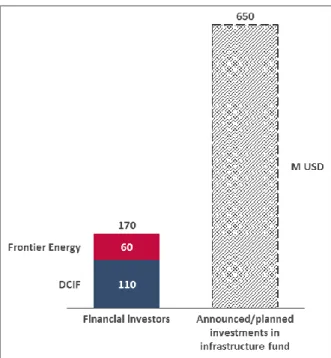
Similar levels of activity from institutional investors is not evident in the two other countries, with the exception of KLP in Norway. Figure 8 shows the investments from Danish financial investors in funds.
170 million USD has already been provided, while an unknown share of a 650 million USD planned commitment to a new infrastructure fund will go towards renewable energy in Africa.
Also referred elsewhere in this report, the DCIF is a PPP21 between the Danish state/IFU and private, mostly institutional, investors. Institutional investors have provided close to half of the total capital of DCIF, with a total of USD 110 million22.
Another 60 million USD is represented by the Frontier Energy Funds. The Frontier Energy Funds, targeted at investments in renewable energy and energy efficiency in Africa, has also been supported
by other, international organizations such as the CDC, GEEREF23 and DFIs.
The A.P. Møller Capital Africa Infrastructure Fund targets infrastructure projects within energy and power, roads, rail, airports and distribution centres. The commitment of the anchor investors, various Danish pension funds, is a total of 650 million USD, to be invested into 10 to 15 investments24. The amount is reflected in the overview of Danish institutional investments as ‘Announced/Planned’, but it must be noted that as the fund targets many types of infrastructure, it is uncertain what portion will be invested in renewable energy. Further, no fund investments have yet been reported. The dotted border in Figure 8 illustrates that these are still at the planning stage.
2.3 An apparent renewable energy business cluster in Norway
As the above shows, in terms of DFI investments, Norway’s Norfund has invested significantly larger amounts towards renewable energy in developing countries compared to both Sweden and Denmark.
Also with regard to other private and commercial engagement, there is a clear trend that Norway’s business community has been more active in investing in or developing renewable energy projects in developing countries than the other Scandinavian countries. Companies at various levels of the value chain are represented, small and big companies investing in small and big projects on and off- grid, suppliers and exporters, capital investors, and advisory firms. This gives the impression of a more complete ‘cluster’ than seen in other countries.
According to several interviewees, the active engagement of Norfund in energy has positive and catalytic effects, both through co-investments with Norwegian companies, and in terms of building significant expertise in energy project financing.
21 Public Private Partnership
22 Note that the DKK 110 mill shown in the figure do not represent renewable energy investments over and beyond the Danish DFI investments reported in the section above. The funds contribute to DCIF’s total capitalization and may be invested both in renewable energy and other sectors.
23 Global Energy Efficiency and Renewable Energy Fund
24 A.P. Møller Capital. (u.d.). Our Africa Fund. Retrieved from: https://www.apmollercapital.com/en/our-africa-fund
Figure 8 Committed and announced investments by Danish institutional investors. Funds are not strictly targeting renewable energy, but also other infrastructure and climate projects.
2 Level of activity in commercial investments The engagement of pension funds in Denmark relative to infrastructure investment in developing countries is interesting to note. It suggests that a huge untapped potential to financing renewable energy projects exists if more pension funds could be mobilized. The Danish experience in this regard should be followed, and could be leveraged to engage similar Norwegian resources.
There are several possible factors that may have contributed to this apparently prominent ‘Norwegian renewable energy cluster’. Some probable contributing factors include
The energy and hydro power history of Norway
Political commitment to and focus on energy sector development assistance
Development policy emphasis on the relevance of Norwegian competency and experience, and the role that private sector can play
Norfund’s consistent and heavy focus on renewable energy
Availability of private sector support for activities in developing countries, partly favouring the energy sector
The energy industry in Norway, including the development of a strong cluster of solar companies
The competency of the financial industry in Norway in relation to energy
The following question emerges from the above findings: Given that a capable cluster with interest and willingness to invest exists, what would it take to grow and strengthen this cluster and thereby further increase investments?
To address this question, we first explore some of the challenges associated with developing renewable energy projects. Thereafter, we provide an overview of the Scandinavian countries’ policies, mechanisms and instruments offered to support business development – either specifically targeting renewable energy or private sector in general. We finally present some emerging reflections relevant for public decision-makers looking to strengthen the cluster of Norwegian businesses engaged in renewable energy development.
3 Barriers hindering Renewable Energy investments in LDCs
3 Barriers hindering Renewable Energy investments in LDCs
Renewable energy represents potential for profitable investment, and the past decade has seen a high level of activity by private companies world-wide. Further, many developing countries have huge potential energy resources as well as a need to develop more energy to satisfy economic growth and a growing population. However, various barriers and challenges facing investors limit the growth of renewable energy compared to its potential in developing countries.
The cost-structure of renewable energy projects is at the core of renewable energy-specific barriers.
High investment up-front, very low marginal running costs, and often long payback periods, create a need for a secure revenue stream for the lifespan of the project. In many developing countries, such revenue streams are associated with high risk, including policy risk, currency risk, off-taker solidity, and may cause otherwise attractive projects to become too risky to attract private finance at a reasonable cost.
Many developing countries lack track-records of renewable energy development and well-functioning financial markets, are characterized by political instability and weak governance, and have heavily state-dominated and poorly regulated power sectors. Local partners and work force as a consequence do not have the skills and experience that could support international investors through establishment.
Lack of finance is often addressed as a barrier, but stems from the real and perceived risk and lack of access to bankable projects. Internationally capital is available, and investment in renewable energy increase annually, but developing markets still represent a small share of the total. Without standardized processes and commercial documentation, knowledge and capacity, small projects and developers cannot justify the transaction costs related to the time-demanding processes of structuring bankable projects to manage the risk.
IRENA’s report on risk mitigation25 provides a thorough description and analysis of different types of risk at different stages of a project (Figure 9).
Figure 9 Types of investment constraints in renewable energy. From IRENA report “Unlocking Renewable Energy Investment: Risk Mitigation and Structured Finance” (2016).
25 IRENA. (2016). Unlocking Renewable Energy Investment: The Role of Risk Mitigation and Structured Finance. IRENA, Abu Dhabi.
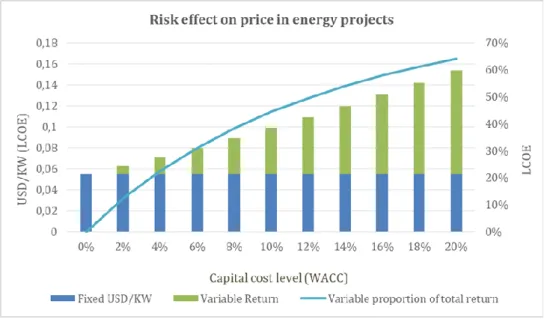
3 Barriers hindering Renewable Energy investments in LDCs If real or perceived risk does not altogether hinder investors and lenders’ interest, it will inevitably affect availability and cost of capital. High risk-premiums increase the cost of capital, ultimately increasing the cost of power that may be offered; financial costs may in some cases represent half of the total cost of power (Figure 10). This creates a vicious circle of expensive renewable energy and further aggravated risk of off-taker non-payments.
Figure 10 Weighted average cost of capital at 10 % can result in financial costs representing half of the levelized cost of energy (over the life span of a project). Source: Multiconsult 2016
3.1 Size- or technology-specific barriers
While the above mentioned risks are generally relevant for all or most renewable energy investments in developing countries, the characteristic of the project, the technology, and, naturally, the receiving country, influence the importance of the various risks.
3.1.1 Small vs. large projects
Barriers faced will vary between the nature of the projects, as well as the companies behind the projects and investments.
Larger projects, such as big hydro power plants, naturally require higher CAPEX, have longer pay-back periods, and the process from identification and conception to an investment-ready project can be very long. On the other hand, big projects may have advantages. They are often championed by large players who have long experience, are professional, have strong financial backing, and able to attract high level of interest from local governments and international developing partners, as well as from private investors.
Investors that that don’t have significant capital, track-record and experience behind them, and that promote small projects, often have more difficulties proving a bankable investment case and attract financing. They may not have financial muscle to handle the early-stage development process; not least development costs may be proportionally higher for small projects relative to the total investment. Start-up phase companies are often also more technology oriented and do not have the necessary experience or know-how to operate in developing countries. Working with local
3 Barriers hindering Renewable Energy investments in LDCs governments/regulatory bodies, understanding regulation, formal processes etc. can be challenging.
Accessing international mechanisms and instruments often require both a certain size and available resources (balance sheet or track-record) to be eligible, as well as capacity to go through often complicated application processes. Investors and banks may be reluctant to developers without proven experience, and may find the due diligence of small projects not worthwhile.
To ensure that smaller projects may be realised, a number of programs targeting renewable energy investments, including GET FiT, Scaling Solar, Energy and Environment Partnership, REACT, etc., offer transaction advisory, financial support for early stage development, and/or financing packages. This support specifically aims at addressing the specific risks related to small-scale project development, and to support developers to get through the challenging project development stages.
This report does not deal with the debate of whether projects that are promoted by investors without track-record, sufficient capital and experience behind them, should be backed or not, given the number of challenges they face. From a development assistance perspective, this may not be the most efficient use of resources, in terms of getting “most value for your bucks”. Nevertheless, in discussing public support also for these kind of projects and companies, in order to further advance the Norwegian ‘renewable energy in developing countries’ industrial cluster, an underlying assumption is that this is desirable from an industrial policy perspective, as all companies have to start from somewhere.
3.1.2 Technology-related risk Hydro power
Hydro power projects generally require significant up-front investments, take long to both plan and build, may have high technological risk (geology, hydrology, etc.) and long repayment periods, typically assumed from 25 years and more.
Hydro power projects are also site-specific. This implies that there may be long distances from the location of a good site and to where power will be used, increasing connection costs and need for well- functioning grid and transmission infrastructure.
Hydro power plants often face environmental and social challenges that must be managed, including local resistance, need for resettlement of local communities, loss of biodiversity and other issues. This also adds to the cost of early phase development as well as the required investment.
Increasingly in later years, hydro power competes with solar power that is quickly getting more competitive. Benefits of hydro power related to potential for storage capacity and stabilizing reserve may not be reflected in the power price that off-takers are willing to pay.
For hydro projects, there is need for support for development studies and access to long-term capital.
3 Barriers hindering Renewable Energy investments in LDCs Wind
While hydro power has a long history in developing countries, and solar has been expanding exponentially in the last decade, wind is still relatively new to most developing countries, particularly in Africa. There is still a general lack of experience and expertise among actors on all levels, including investors, financers, developers, utilities, regulators, etc. Wind power generally has high up-front costs and economies of scale, which makes smaller projects more expensive. As sites may be far away from demand centres, distribution and transmission infrastructure is crucial. These factors increase the risk related to wind power projects.
Wind could also face risks related to environmental and social issues, such as hydro power. However wind could also be possible in small-scale/off-grid setting, in which case it would face the same barriers/risk as small-scale/off-grid solar projects.
Solar power
Solar power (in this case solar photovoltaic power) projects generally are faster to develop and build. The resource, in terms of solar radiation, is amply available in many developing countries, in particular in Sub-Saharan Africa.
The flexibility in terms of location enable solar projects to be situated close to connection points and to demand centres, reducing the need for infrastructure. Also environmental and social issues are generally less challenging than for example for hydro power plants.
However, solar PV is very competitive and in fast development; making prices fast outdated.
This creates an additional off-taker risk; PPAs26 established may represent a relatively unattractive price of power to off-takers compared to later projects on offer. The price development is also a challenge for off-grid companies that sell to a market without PPA’s, requiring them to cover the revenue risk on own books. The stiff competition in the solar
26 Power Purchase Agreement
The Lake Turkana project in Kenya
The 310 MW Lake Turkana wind farm in North Eastern Kenya is to-date the largest wind farm in Africa, making up around 15 % of the of the country’s total installed capacity1. The project was developed by an independent power producer (IPP) and the power will be bought by the Kenya Power & lighting Company (KPLC) under a 20-year PPA1. The project was initially funded by KLP Norfund Investment, Finnfund, IFU, Vestas Eastern Africa, KP&P Africa B.V, Aldwych International and Sandpiper1.
The challenges and delays related to the power evacuation solution serves as a good example of prone risks. The Kenyan Government had committed to build a high voltage transmission line to off-take the power from the wind farm. In order to reach financial close, the project had to secure that the transmission line would be built in time, to deal with the consequent power off-taker and liquidity risk for the project and its investors in the event that it was delayed2. Thus, it was agreed that the KPLC would face consequences (financial penalties) in case the transmission line was not completed in time. After both the World Bank and MIGA declined to provide guarantees to the project, the AfDB came in and applied its first ever partial risk guarantee (together with the government of Kenya) to the risk of delay of the transmission line. The guarantee was crucial for reaching financial close in the project.
The wind farm initially planned to start power production in June of 2017 when installation of the 365 turbines was completed by Vestas. However, the construction of the transmission line was delayed, mainly due to the Spanish contractor in charge of building the transmission line going bankrupt and not being able to complete works. As a result, the project and its investors did not receive the agreed compensation from KPLC. The project did not bill the government as per the initial guarantee commitment, as the government had plans in place to complete the transmission line in 2018 and the penalty would affect consumers’ power bill significantly. In June 2018, the project did receive a “rather sizeable amount of money” as compensation, allowing it to address minimum financial obligations3. The project has now been successfully completed and delivered the first power to the grid in September 2018.
1) Lake Turkana Wind Power project homepage:
https://ltwp.co.ke/, October 2018
2) Risk Mitigation and Structured Finance, IRENA 2016 3) First power at Lake Turkana, Windpower Monthly, 26 September 2018:
https://www.windpowermonthly.com/article/1494069/first- power-lake-turkana
Box 1
Photo: Lake Turkana Wind Power Ltd
3 Barriers hindering Renewable Energy investments in LDCs market make investors very sensitive to risk premiums.
The location flexibility makes solar power particularly suitable for off-grid energy development. Off- grid projects however, face other, not less challenging risks. Risks and barriers specifically facing Distributed Off-grid energy projects is therefore discussed separately below.
Figure 11 The figure shows how financing costs particularly impact the power price of projects that require high up-front costs. Note: Actual CAPEX values have changes, in particular for solar power.
Source: Multiconsult report to Norfund, Zero and Kirkens Nødhjelp (2015).
3.2 Barriers for Distributed Energy Solutions27
To understand the risks and barriers that Distributed Energy Service Companies (DESCOs) are facing, it is important to keep in mind that these operations do not only include development of generation capacity but also distribution/retail networks, retail sales & marketing and after-sale service - both in terms of on-site technical work (installation, maintenance and repairs) and customer support/call- center. In addition, the assets base and need for financing is growing incrementally as the businesses get more customers. The up-front investment costs are mainly driven by the need for establishing a local presence, integrating with mobile phone companies and mobile banks and developing a sales network (recruiting retailers and sales reps). Hence there is not one large investment, as is the case for a grid-connected power plant.
There are different business models for distributed energy solutions, with different challenges and risks associated with each:
DESCOs selling against cash payments have business models similar to retailers of electrical appliances, selling e.g. lanterns, solar home systems or solar water pumps against a full cash payment at the time of sale.
DESCOs offering financing solutions are more comparable to the national or local power utilities or grid companies. Such “PAYGO” based business models (i.e. as a service based on a financed asset) require power sales to recover the investment costs of their assets (in theory) as installments over a period of time.
27 Entire sub-section courtesy of Differ AS