The number of road users killed or seriously injured in Norway can be significantly reduced. To what extent can road safety measures contribute to a further reduction in the number of road users killed or seriously injured in Norway.

Background
Research problems
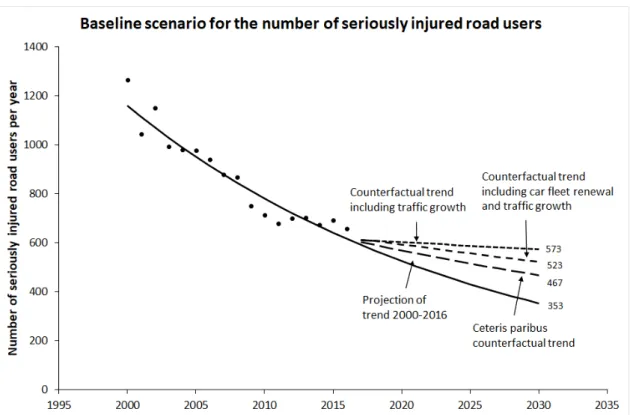
The baseline scenario shows how the number of road users killed or seriously injured can be expected to develop from now until 2030 if no road safety measures are introduced, but all other factors continue to exert their influence, as recent trends show. The resulting trends represent the best estimate of how the number of road users killed or seriously injured is expected to develop in the absence of road safety measures.
Trends for 2000-2017 and projection of them to 2030
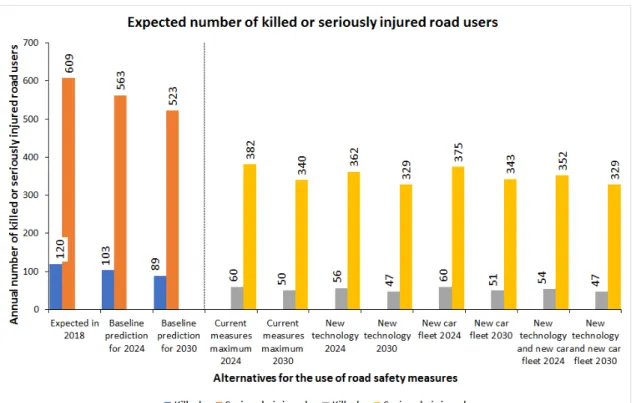
It is assumed that the number of deaths will decrease from 120 in 2018 to 89 in 2030 according to an exponential trend (the same percentage change each year). The baseline scenario for the number of seriously injured road users was developed in exactly the same way as the baseline scenario for the number of road users killed.
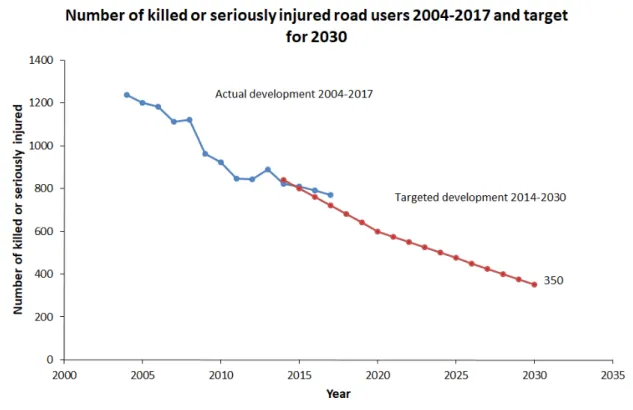
Political objectives for reducing the number of killed or seriously injured road
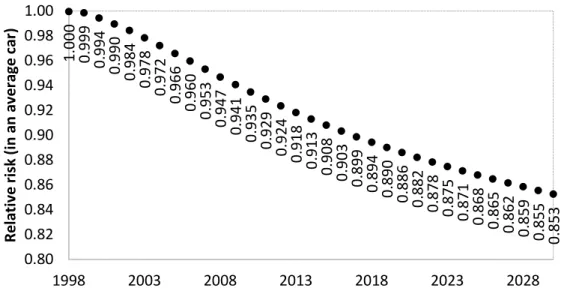
After adjusting the projected trend for traffic growth and the elasticity of fatalities with traffic growth, the upper adjusted hypothetical trend line in Figure 1 is produced, predicting 99 fatalities in 2030. After adjusting for the effect on fleet renewal fatalities, the final projected figure for 2030 89 dead.
Potentially effective road safety measures
Road-related measures
In the analyses, the effects are expressed as percentage changes in the total number of injured road users. Effects: Based on the Road Traffic Safety Measures Manual, it is expected that the number of injured road users will decrease by 10.
Vehicle-related measures
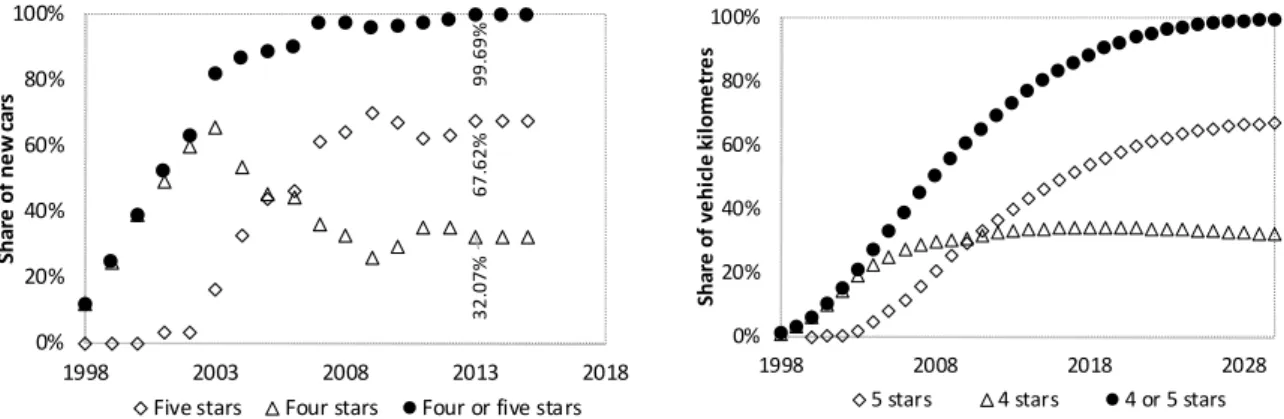
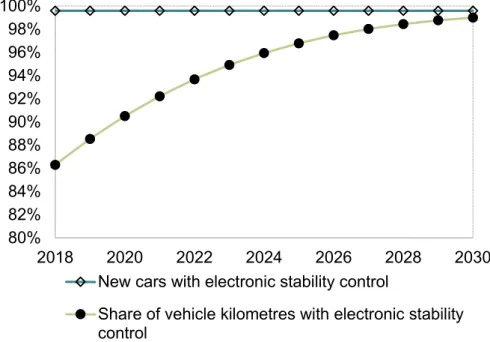
The proportion of vehicle kilometers performed by cars with first- or second-generation airbags is as indicated in Figure 5. New cars with second-generation frontal collision airbags Proportion of vehicle kilometers with frontal airbags. The right half of Figure 7 shows the proportion of vehicle kilometers driven by cars with four or five Euro NCAP stars.
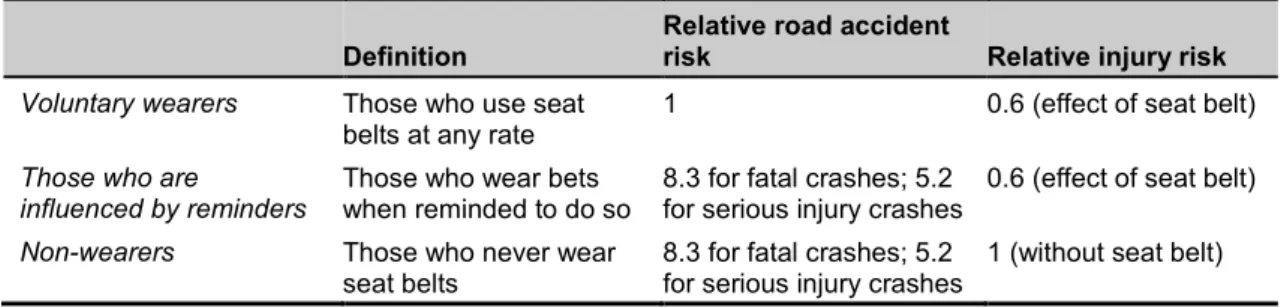
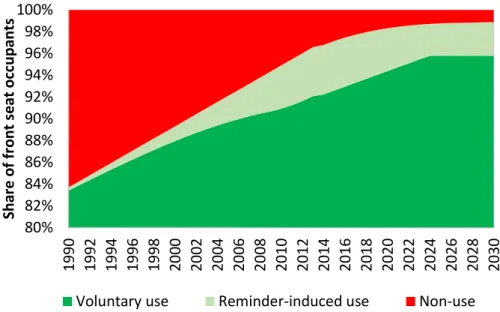
Extent of use: Figure 9 shows the share of new cars with different star ratings for pedestrian protection and the share of these cars in vehicle kilometres. Scope of use: It is estimated that the proportion of new cars have seat belts. According to Krafft et al., the seat belt wearing rate in cars with seat belt reminders is 98.9%.
Seat belt fitting in cars without reminder alarms is priced based on the fitting fees for all cars and cars with reminders.
Enforcement and safety management
Scope of application: A 100% increase in random breath testing is considered the maximum conceivable application of the measure. Scope of application: A 100% increase in enforcement is considered the maximum conceivable application of the measure. A 100% increase in enforcement would be associated with an 8.8% reduction in crashes involving drivers under the influence of drugs.
Effects: Based on Høye (2014A), speed cameras are estimated to reduce fatal and serious injuries by 49% and minor injuries by 32%. Effects: Under optimistic assumptions, it was estimated that (total) deaths could be reduced by 14%, serious injuries by 4.1% and minor injuries by 3.4%.
Maximum conceivable use of the measures
Too little is known about how things are going in the rest of the country to generalize the results. For speeding citations issued by police officers, doubling the 2012-13 rate would result in 10.64 citations per million. Safety management in transport companies: The highest level of the safety ladder is considered the maximum use of the measure.
The choice of approach depends largely on whether the effects of a measure are best represented as a point estimate or as a function of the level of use of the measure. Measures for which the effect is a function of the measure of use of the measure, i.e.
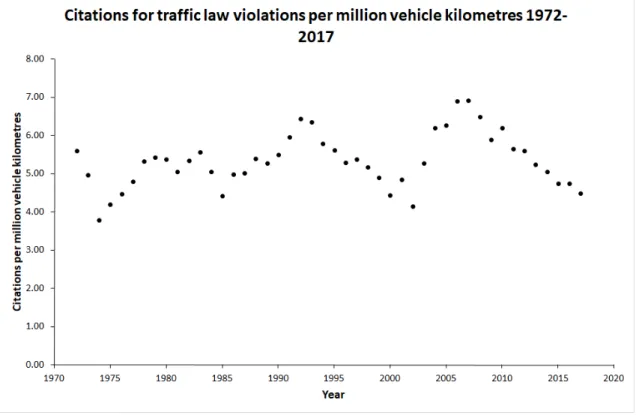
Measures for which the total impact increases as the measure is used more
Actions where the effect is stated as a percentage change in the number of deaths or injuries and where the total effect (proportion of target injuries affected by the action) increases as the action is implemented in an increasing number of locations or penetrates the market. Measures where the effect is stated as a percentage change in the number of deaths or injuries in the target group and that effect remains constant over time. As 100% market penetration approaches, the remaining potential to reduce fatalities and injuries diminishes.
The potential of vehicle-related measures to reduce fatalities and injuries is defined as the difference between 100% market penetration and actual market penetration in any year between 2018 and 2030. Thus, for a policy intervention to be effective, speeding would be necessary are. increase the renewal of the fleet compared to the base renewal rate.
Measures that have full impact at once
The safety ladder model for road safety management (Nævestad et al. 2018) is likely to be introduced gradually. The aim is to estimate the potential road safety gains if transport companies adopt more systematic safety management. To get an idea of the potential, two sets of assumptions have been developed, which indicate the minimum and maximum potentials.
The minimum assumes that the lowest level of the safety ladder is introduced by 50% of transport companies. The maximum assumes that 92% of carriers implement the highest level of the safety ladder.
Measures where effects vary according to the level of use
It is assumed that all motor vehicles have ISA, alcohol lock and seat belt lock. As the use of seat belts has increased, the group that does not use seat belts has gradually become more extreme and atypical. Using the coefficients estimated by Hössinger and Berger (2012), it can be estimated that a doubling of seat belt enforcement will increase seat belt use in Norway from 97.2 to 98.2.
Combining this with the risk model developed by Høye (2016C) and assuming that seat belts reduce the risk of injury by 60% at all levels of injury severity, injury modification factors associated with and 100% increase in seat belt use. Thus, it is estimated that increasing seat belt use from 97.2 to 98.2% would reduce the annual number of fatalities by 3.2.
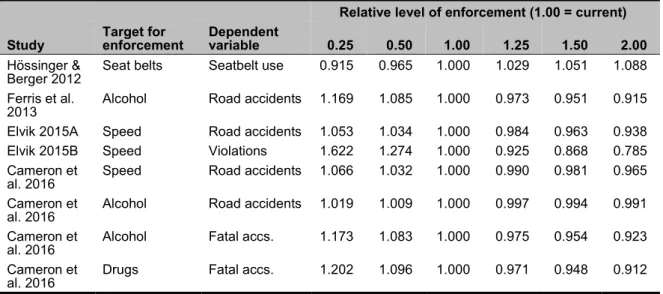
A comprehensive and unified framework for analysing the effects on traffic
In terms of implementation speed, a model developed by Elvik (2015B) was applied to estimate changes in the rate of speed associated with changes in the extent of implementation. Elvik (2015B) assessed the relationship between changes in the level of implementation and changes in the rate of speed. Changes in enforcement level were defined as the natural logarithm of the number of speed citations.
By looking for the contributions to the total number of fatalities, serious injuries and minor injuries made by the speeds in the respective intervals of the speed distribution, the expected reduction in the number of fatalities, serious injuries and minor injuries can be estimated. These reductions in offense rates translate into a 1.4% reduction in fatalities, a 1.3% reduction in serious injuries, and a 1.0% reduction in minor injuries.

Correlations between risk factors and the combined effects of measures
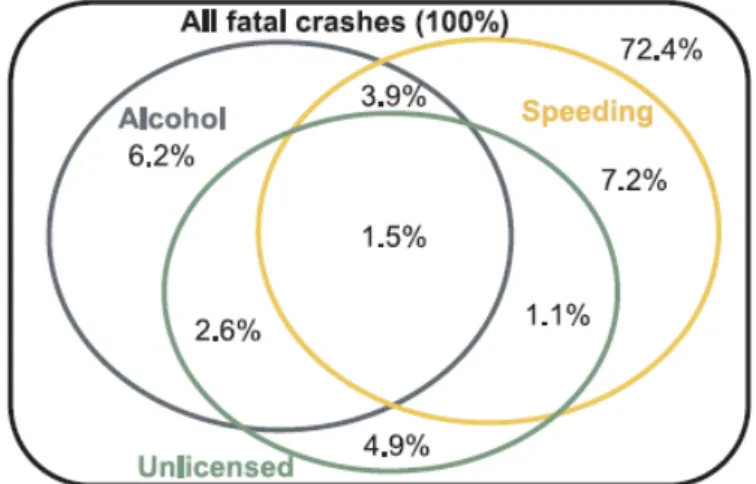
It turns out that none of the three risk factors occurred in 72.4% of fatal traffic accidents. This overestimates the effect, since none of the risk factors were present in 72.4% of fatal road crashes. The product of the residuals is raised to the power of the lowest residual.
This chapter presents the estimated effects of the road safety measures on the number of dead or seriously injured road users. It is discussed whether the targets for reducing the number of dead or seriously injured road users set for these years can be realized or not.
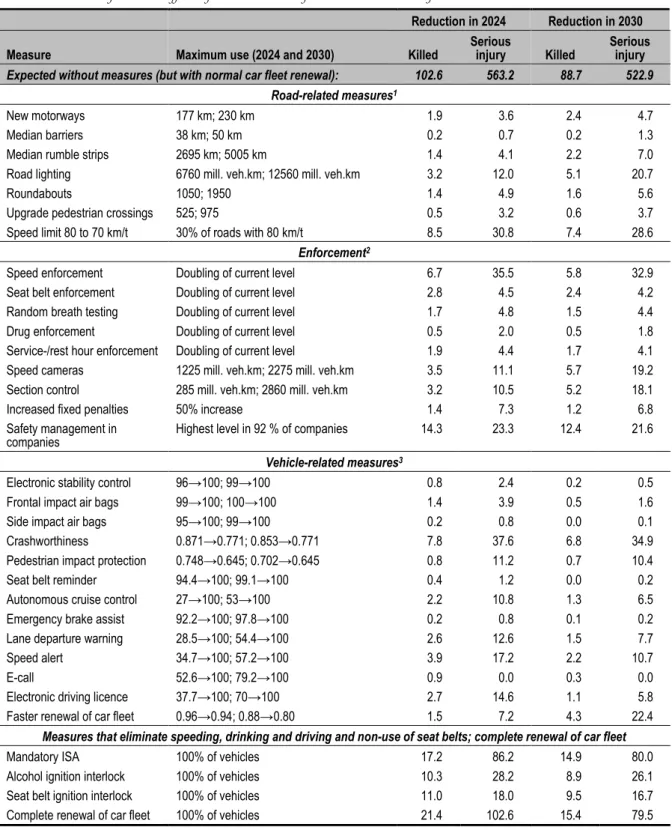
Estimated reduction of the number of killed or seriously injured road users in
For the years 2024 and 2030, targets have been set for reducing the number of dead or seriously injured road users. For most measures, the estimated reduction in the number of dead or seriously injured road users is smaller in 2030 than in 2024. First of all, it is expected that the number of dead or seriously injured road users will fall even if no new road safety measures are introduced.
A decrease in the number of road users killed or seriously injured is expected to occur even without new road safety measures. The estimated number of road users killed or seriously injured is close to that found for alternative 1.
Can the targets for 2024 and 2030 be realised?
They show that the lower the number of road users killed or seriously injured, the more difficult it becomes to further reduce the number. But even with 100% market penetration of automated cars at the highest level of automation, the number of road users killed or seriously injured will not be zero. There will always be the very rare event that the system is not prepared for, even with extensive machine learning capabilities.
There is no reason to believe that automation technology will be an exception to this trend. Even if the number of road accidents per kilometer becomes very low, any increase in the number of kilometers driven will have a compensating effect on the expected number of dead or injured road users.
The potential for reducing injuries among pedestrians and cyclists
Based on these assumptions, a potential injury reduction (full year) of 15% was estimated. It is possible to significantly reduce the number of fatal or seriously injured road users in 2024 and 2030. In fact, the uncertainty is greater than this interval if random variation in the effects of road safety measures is taken into account, and not just random variation in road safety measures. number of dead or seriously injured road users predicted using point.
The effects of the measures are expressed as a percentage change in the number of road users killed or injured. There has been a greater reduction in the number of victims and injuries than the analysis predicted. The analyzes most likely did not include all the factors producing the long-term downward trend in the number of fatalities and injuries.
The decrease in the number of dead or seriously injured road users is sharpest before 2024.