The high P content in the EBPR sludge has caused problems in sludge treatment systems, especially when anaerobic digesters have been used. This thesis was carried out at the Department of Construction and Environment. The thesis was completed over a period of 20 weeks, extending from January to June 2019.
Much of this thesis has been hands-on lab work, at NTNU's Wastewater Lab in Valgrinda. This master's thesis is a follow-up to a project that was completed in the autumn and was a subject of 7.5 credits. Blanca Magdalena Gonzalez Silva for the great help regarding the practical work in the lab, discussion around results and input in the writing process.
Finally, I would like to thank all the other people working in the lab who answered questions whenever needed. My fellow student Kine Hagelund Svendby has been a great support in the lab and has made the lab a social place to work.
Introduction
Phosphorus
Outline of work
Theory
- EBPR
- Polyphosphate Accumulating Organisms
- Glycogen Accumulating Organisms
- Denitrifying PAO
- Parameters effect on the EBPR process
- Struvite
- Anaerobic digester
- Struvite precipitation in anaerobic digester
- Settling and dewatering properties
- Fermentation of Primary Sludge
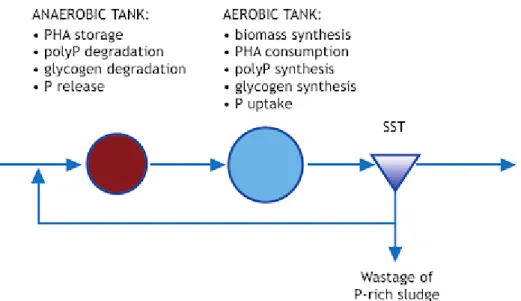
It is in the aerobic phase that phosphorus is removed from the wastewater, creating a biomass rich in phosphorus (Basu, et al., 2013). Some report high efficiency at higher temperatures (20-37○C), while others report better P removal at lower temperatures (5-15○C) (Mulkerrins, et al. , 2004). PAOs can use more carbon at lower DO levels and consequently take up more phosphate in the aerobic zone (Ye, et al., 2016).
However, if a deficiency of potassium develops, the EBPR process appears to be negatively affected (Mulkerrins, et al., 2004). The final size and structure of the crystals is determined in the crystal growth (Le Corre, et al., 2009). Most studies report struvite crystallization in the pH range of 8 to 9 (Tansel, et al., 2018).
Therefore, authors usually study struvite precipitation in the temperature range 25○C to 35○C (Le Corre, et al., 2009). This means that the potential for struvite potential is higher in the digester (Ohlinger, et al., 1998).

Materials and methods
- Fermentation
- SBR
- SBR Reactor
- Wastewater
- Feeding solution
- Dissolved oxygen
- Mixing
- Temperature
- CMBBR Pilot
- P-stripping Reactor
- Carbon source
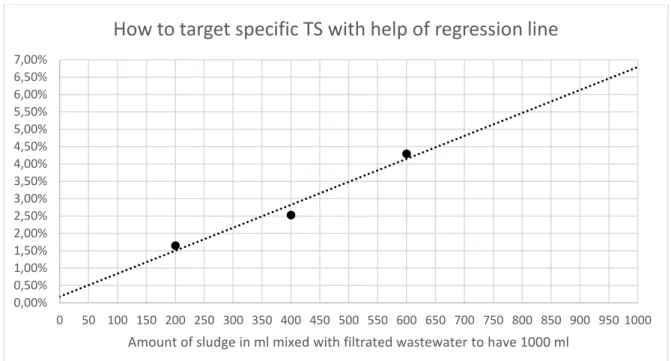
- Dilution adjustment
- Sampling processes
- Parameters
- Total Solids
- Volatile Solids
- Cuvette tests
- Conductivity
- pH
- Temperature
- Weight
- Sludge quality
- VFA Analyzes
To get new substrates for the bacteria in the digester, new sludge and waste water had to be added. A nutrient solution containing acetate (VFA) and phosphate is also pumped into the reactor to promote the growth of PAOs. A perforated tube ran at the top edge of the truncated cone to provide aeration in the reactor.
This reduces the risk of clogging in the reactor, as the filter removes part of the solids. In order to have good conditions for the PAOs in the reactor, a feed solution with a high concentration of acetate and phosphate was pumped in at the same time as the waste water. Mixing in the reactor was provided by blades attached to a rod that was connected to the motor at the top of the reactor.
In order to achieve cooler conditions in the mud, the reactor was placed in a cold water bath. Once the sCOD concentration in the FPSS was known, the dosage amount could be calculated. The COD concentration had to be high enough for the 16 ml dose to give the desired concentration in the reactor.
To have the desired concentration of sCOD in the P-stripping reactor, a larger volume of FPSS had to be added. This was done by multiplying the measured concentration by the volume in the reactor at the time of sample extraction. The sCOD and PO4-P content in the added FPSS had to be taken into account.
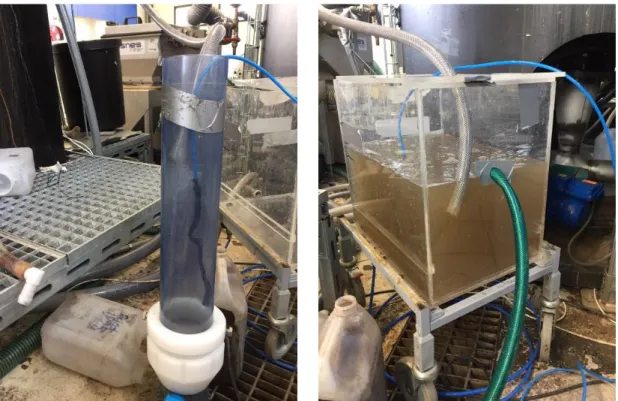
An aquarium air pump was also placed in the cylinder to have aeration, to prevent PAOs from releasing phosphate. The accumulation of in the cylinder was too low and the sludge was not concentrated enough to be used in experiments. The sludge left in the container was then collected with beakers and ready for experimentation.
Results and Discussion
Fermentation
- VFA Production
- Temperature
- HRT
- NH 4 -N and PO 4 -P Concentrations
- sCOD produced per TCOD
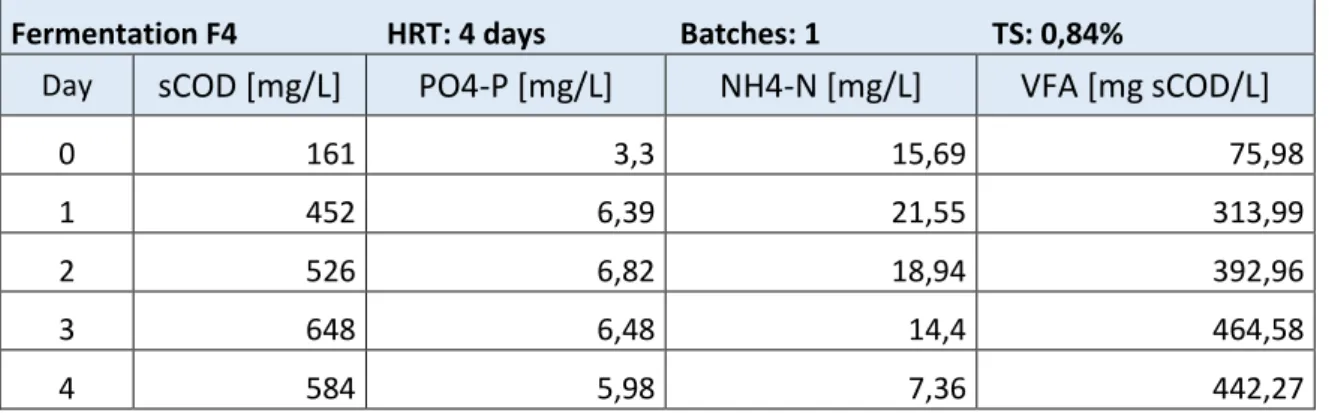
The production of VFA in percentage of the production of total sCOD is found using the numbers in Table 9. This means that 86.6% of the total sCOD production in fermentation F4 is in the form of VFA. This illustrates at what times during the fermentation the production of the VFAs is highest.
After a small decrease, there is a new increase in production, before falling in the last 24 hours. The production of the total acids is strongly influenced by the production of acetic and propionic acid as they account for almost 90% of the total VFAs. However, the ratio between acetic and propionic acid deteriorates after 48 hours, and the production of acetic acid and the total sum of acids decrease after this time.
The increase in butyric acid production may therefore be the increase in TS concentration. It shows similar trends as the F4 fermentation, where most of the production occurs in the first 24 hours of fermentation. Mass VFA production is higher in Svendby (2019), where the TS concentration was about 2%, compared to fermentation 4 with about 1% TS.
The production rate is also higher in the fermentation with the highest concentration of TS. A study by Crutchik et al. 2018) investigated VFA and propionate production in primary sludge fermentation. If high propionate production is the goal, a temperature of around 25-28 °C could be a good suggestion.
Looking at the VFA production in figure 18, the production is highest on the first day. In most fermentations there is a trend with decreasing concentrations for both NH4-N and PO4-P. Samples were always taken at the same time and the rectors were in the same water bath for the heated fermentations.
Sludge Characterization
- Sludge from SBR
- Sludge from CMBBR Pilot
At about 60 days the sludge quality is increasing, which is most likely caused by a 30% increase in acetate and phosphate in the nutrient solution. The purpose of this increase was to increase the quality of the sludge, to have more lux-P in the biomass, and it seems to have responded well. If the wastewater is diluted by rain, the TP may be lower since less phosphate is available to be absorbed by the PAO.
Lack of carbon and nutrients can also hinder biomass growth, which can affect TS. Diluted wastewater does not have the same effect on the SBR sludge because a nutrient solution containing both acetate and phosphate is pumped in.

P-stripping experiments
- SBR Sludge
- CMBBR Pilot sludge
- VFA consumption
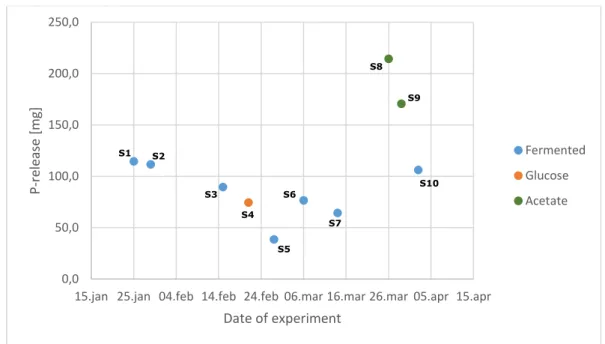
Although S2 was performed at low temperatures, the P release was 38% and thus not far behind the results at room temperature. Although acetate caused the highest mass P release, the percentage of luxury P release was not the highest. This could indicate that there are VFAs in FPSS that are preferred by PAOs over acetate.
The FPSS for S6 was taken out after 8 days of fermentation, and the P release is one of the highest. Glucose gave results in one of the lowest P releases, even though the experiment was performed at room temperature. The P-release was generally better in the P-stripping experiments carried out by Fiksdal (2018), than the experiments of this study.
In the experiment, the pulse doses were less than 100 mg/L*h, the P release was less. Adding the carbon over time improved the P release compared to adding all in one dose at the beginning of the experiment and the ideal dose is between 100 mg/L*h and 200 mg/L*h . This is not so different from the P release with SBR sludge, which had between 30 and 43% P release as the best results.
The biomass present in the pilot may not have such a great preference when it comes to the type of carbon source. The CMBBR Pilot biomass appears to release phosphorus in the presence of both acetate and FPSS. To see which type of VFA the PAOs prefer, consumption has been calculated as a percentage of the available VFA.
Iso-butyric acid and iso-valeric acid have negative consumption, which means that the concentrations of these acids are higher at the end of the experiment than at the beginning. Bacteria responsible for fermentation in SBR sludge may not be present in Pilot sludge. There is a fairly high consumption of propionic acid, butyric acid and valeric acid, with over 60% consumption of available acids.
Correlation with P-release
Butyric acid is the preferred VFA for the SBR sludge and valeric acid is similar to propionic acid. This is in good agreement with the observed P release in experiments with acetate, which was less than the observed P release with FPSS. There must be certain bacteria that produce these acids during the experiment, for example fermenting bacteria.
This is an expected observation, as fermenting bacteria have not previously been detected in the pilot. Biomass in the CMBBRpilot sludge appears to have fewer preferences when it comes to VFA carbon sources. There is less consumption of acetic acid, iso-butyric acid and iso-waelric acid, but still higher than the consumption in SBR sludges.
It is difficult to make a clear conclusion about the VFA consumption in the P-stripping experiments, as only samples from one experiment of each sludge were analyzed. With more VFA analysis to compare, a pattern or trend in VFA consumption could have been identified.

Conclusion
Future Work
Relating variations in ion concentration to conductivity variations in a batch reactor in sequence operated for enhanced biological phosphorus removal. The role of potassium, magnesium and calcium in the enhanced biological phosphorus removal treatment plants. Biorefining of primarily cellulosic sludge towards targeted recovery of short-chain fatty acids, phosphorus and methane.
Effects of pH on rates of aerobic metabolism of phosphate-accumulating and glycogen-accumulating organisms. The role of HRT and low temperature in acid phase anaerobic digestion of municipal and industrial wastewater. Effect of initial pH control on biological phosphorus removal induced by aerobic/extended-empty regime.
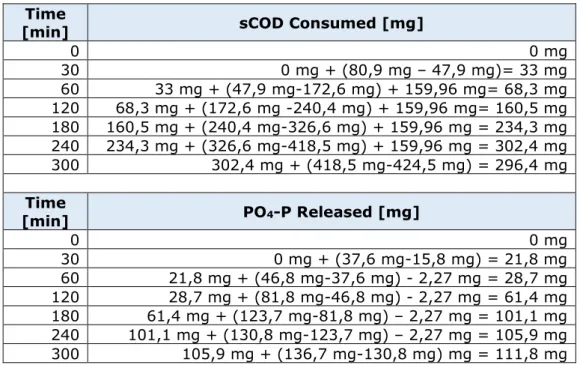
Effects of solids concentration, pH and carbon addition on production rate and composition of volatile fatty acids in preferrers using primary sludge. Removal and recovery of phosphorus from domestic wastewater in a new enhanced biological phosphorus removal process coupled with. This means that 6 doses were added and that the actual volume at the end of the experiment was 1470 mL.
![Table C-1: Measurements for TS and VS in fermented mix at start W_dish [g] W_sample [g]](https://thumb-eu.123doks.com/thumbv2/9pdfnet/19309597.0/85.1262.21.1219.208.421/table-measurements-ts-vs-fermented-start-dish-sample.webp)