Joint Nordic Report
Online pharmacy markets in the
Nordics
Joint Nordic Report: Online pharmacy markets in the Nordics April 2021
Contents
Summary ... 5
1 Introduction ... 7
2 Online pharmacy markets ... 9
2.1 Characteristics of pharmaceutical markets ... 9
2.2 What is an online pharmacy? ... 10
2.3 Competition and consumers in the online pharmacy markets ... 11
2.3.1 Online pharmacies and consumers ... 12
2.3.2 Competition issues in the online pharmacy markets ... 14
2.3.3 Online pharmacies and the benefits of competition ... 15
2.4 Online pharmacies and the breakout of Covid-19 ... 15
3 Denmark ... 17
3.1 Introduction ... 17
3.2 Overall pharmacy market regulation ... 17
3.2.1 Ownership of pharmacies ... 18
3.2.2 Geographical location of pharmacies ... 18
3.2.3 Prices of pharmaceuticals sold at pharmacies ... 18
3.2.4 Financial framework of the Danish pharmacy sector ... 19
3.3 Putting the online pharmacy market into context... 20
3.4 Challenges and future development ... 22
3.4.1 Challenges with the pharmacy sector ... 23
3.4.2 Developing a strong market for online pharmacies ... 24
4 Finland ... 26
4.1 The regulation of pharmacies and online pharmacies ... 26
4.2 Market outlook ... 27
4.2.1 Pharmaceutical markets overall ... 27
4.2.2 Online pharmacy markets ... 28
4.3 Challenges and future development ... 30
5 Iceland ... 31
5.1 Regulation of pharmacies ... 31
5.1.1 Traditional pharmacies ... 31
5.1.2 Online pharmacies ... 32
5.2 Current market outlook ... 32
5.3 Challenges and the future development ... 34
6 Norway ... 35
6.1 Introduction ... 35
6.2 Regulation of online pharmacies ... 35
6.3 Market outlook in Norway ... 36
6.3.1 Pharmaceutical markets in Norway ... 36
6.3.2 Online pharmacy markets in Norway ... 39
6.4 Challenges and future development ... 40
7 Sweden ... 42
7.1 Regulation of online pharmacies ... 42
7.1.1 Regulation of prices on prescribed pharmaceuticals. ... 42
7.2 Putting the online market into context ... 43
7.3 Market outlook ... 43
7.3.1 Deregulation in 2009 and market evolution ... 43
7.3.2 Current market situation ... 44
7.3.3 The development of e-commerce with pharmaceuticals ... 45
7.4 Challenges and future development ... 48
8 Comparison of online pharmacy markets in the Nordic countries ... 49
8.1 Summary of online pharmacy markets ... 49
8.2 Recap of main policy findings ... 54
9 Conclusions... 56
Summary
The Nordic countries (Denmark, Finland, Iceland, Norway and Sweden) are among the most digitalised countries in the world. For example, in the latest DESI-index (The Digital Economy and Society Index), Finland, Sweden and Denmark hold the top three ranks among the EU countries.1 Iceland2 and Norway3 have also scored highly in the recent DESI-rankings comparing the digitalisation of countries worldwide.
Although all Nordic countries have achieved a high level of digitalisation in their societies, there are also differences between the countries. One difference, the topic of this report, is observed in the e-commerce of pharmaceutical products. Pharmaceutical products are essential for the well- being of consumers. Traditionally, the distribution of medicines to consumers has been organised through heavily regulated networks of physical pharmacies. The strict regulation of market structure has been in place to ensure the safety, accessibility and affordability of medicines, but it has also limited competition in the pharmacy sector. As the regulation of pharmacies differs between the Nordic countries, this has also created different market conditions for online pharmacies to operate in these countries.
While consumers in all Nordic countries are active online shoppers,4 differences in sector-specific regulation have led to very different online pharmacy markets in these countries. The size of the online pharmacy market varies among the Nordic countries, partly due to the different level of liberalisation. The liberalisation of pharmacy markets in some countries has led to fast growth of online pharmacy markets, albeit from fairly small levels. The growth of online sales of medicines has emerged during recent years as consumers have become more accustomed to e-commerce.
Furthermore, the report is written during the time of the Covid-19 pandemic. The pandemic has dramatically shaped the e-commerce landscape, including in the pharmacy sector. Online pharmacies have proven to be a good alternative to physical pharmacies. Consumers that use online pharmacies can easily maintain social distance and have their medicines delivered to their home. Due to the pandemic, the demand for online services of pharmacies has increased significantly in many countries. It is also likely that this has changed preferences for some consumers permanently and demand should therefore remain at a higher level in the future.
Given that online pharmacy markets are experiencing a phase of rapid growth, the Nordic competition authorities believe that these markets should be examined more closely. This report describes the current state of the online pharmacy markets in the Nordic countries, the main challenges observed in these markets and potential ways to improve conditions in the market to serve consumers better. In addition, this report discusses how sector-specific regulation in the different Nordic countries might prevent or hinder competition within the online pharmacy market.
1 https://ec.europa.eu/digital-single-market/en/digital-economy-and-society-index-desi (accessed 26.11.2020)
2 https://eufordigital.eu/wp-content/uploads/2019/10/Digital-Economy-and-Society-Index-DESI-2018.pdf (accessed 26.11.2020)
3 https://ec.europa.eu/newsroom/dae/document.cfm?doc_id=66927 (accessed 26.11.2020)
4 See e.g. https://www.postnord.com/siteassets/documents/media/publications/e-commerce-in-europe-2020.pdf (accessed 26.11.2020)
Based on the experience in more liberalised markets, online pharmacies can increase competition in the sector and enhance accessibility of pharmacy services. In some markets, regulations that tie online pharmacies to the operations of physical pharmacies hinder the development of the online pharmacy market, as these regulations prevent the entry of pharmacies that operate only online (online-only pharmacies).
A good example of slow market development is Finland and Iceland, where pharmacies that only operate online are not allowed, thus limiting the size of the online market. According to one estimate, the overall e-commerce market in Finland is at least EUR 2.8 billion and EUR 92 million in Iceland.5 The online pharmacy market however is about EUR 10-20 million in Finland and less than one million euros in Iceland, accounting for less than one percent of the whole e-commerce market in both.6 In comparison, the Swedish e-commerce market overall has been approximated to at least EUR 9 billion.7 The e-commerce of pharmaceutical products is in the order of magnitude of EUR 500-600 million8, thus contributing around 5-6 percent of the overall e-commerce market.
Even accounting for the fact that Sweden has about twice the population of Finland, it is clear that the countries are at very different levels of development when it comes to the online sale of pharmaceuticals.
In addition, reforms to the overall regulation of pharmacy markets are needed to realise the benefits of online pharmacies. Possible important factors are reforms in terms of entry, ownership and price regulation, for example. Online pharmacies offer great potential in organizing pharmacy services more efficiently and regulation should facilitate this. As all Nordic countries already have high e-commerce penetration rates, the countries should also be well-equipped to develop online pharmacy markets further.
It is also evident that countries should learn from each other about best practices for developing the regulation of pharmacy markets. For example, the experiences of Sweden, a country which can be seen as having progressed furthest in its market liberalisation, can be valuable for other countries that are considering reforming their pharmacy markets. However, competition authorities alone cannot achieve reforms in pharmacy markets, as pharmacies are regulated by sector-specific regulators. Thus, this work and dialogue must reach beyond competition authorities.
5 https://www.postnord.fi/siteassets/raportit/verkkokauppa-pohjoismaissa/verkkokauppa-pohjoismaissa-2019.pdf (Finland, last accessed, 29.3.2021); http://px.rsv.is/PXWeb/pxweb/is/Greidslumidlun/-/Greidslumidlun.px/?rxid=a6840e68-872b- 44aa-92d3-6d6f9b4ae808 (Iceland)
6 This is the pre-corona estimate that we use in this report. See details in section 4 of this report.
7 https://www.postnord.fi/siteassets/raportit/verkkokauppa-pohjoismaissa/verkkokauppa-pohjoismaissa-2019.pdf (Last accessed, 29.3.2021)
8 See details in section 7 of this report.
1 Introduction
The tremendous growth of global online retail corporations such as Amazon, eBay, and Alibaba vividly illustrate how the retail landscape has been transformed. Overall, the online retail market has been one of the fastest growing sectors during the last two decades. However, while many segments of consumer products and services now see a significant share of their sales through online channels, pharmaceutical products have not yet followed suit to a similar extent.
Online sales of pharmaceuticals are, however, increasing in importance. Online pharmacies act as disruptors of the traditional brick-and-mortar distribution model of medicines.9 Online pharmacies can primarily benefit consumers and society via two channels.10 First, if pharmacies can compete on the price of pharmaceutical products, competitive pressure imposed by online pharmacies can bring prices down and reduce overall healthcare spending. Second, online pharmacies enlarge the service network as consumers become less dependent on physical pharmacies, thus improving the accessibility of services.11 In addition, at the time of writing this report, the Covid-19 pandemic has put a massive strain on the healthcare systems in many countries. As the pandemic has reduced the opportunities for visiting physical pharmacies, e- commerce of medicines has recently seen a significant surge. This can potentially change the structure of pharmaceutical distribution in favour of online channels on a more permanent basis.
The development of the online pharmacy sector is also interlinked with the overall pharmacy market regulation. The strict regulation traditionally imposed on pharmacies has also limited the scope for growth for online pharmacies. On the other hand, several countries have liberalised their pharmaceutical markets during the last two decades. However, countries are at very different stages in reforming their pharmacy markets. This also holds true for the Nordic countries, among which some have moved to more liberalised markets while others have not progressed with such reforms.
In this report we examine the online pharmacy markets from the Nordic perspective. In terms of overall worldwide pharmaceutical markets, the Nordic countries represent only a very small share. Consequently, the Nordic countries may need to cooperate to progress the development of online pharmacy markets. For this purpose, it is necessary to have a clear understanding of the state of the markets in the Nordic countries.
The discussion in this report is on a general level and the aim is to form a coherent picture of the state of the online pharmacy markets in the Nordic countries. The report may serve as background material for decision makers when designing future reforms. The report outlines some possible future developments and challenges of the markets which might need to be accounted for in the Nordic countries. The development of well-functioning pharmacy markets could be enhanced if organisations exploited the potential in sharing insights and benefitting from best practices.
9 By brick and mortal model we refer to physical pharmacies which have traditional taken care of the distribution of medicines.
10 Note that throughout this report we use the term consumers consistently instead of patients or customers although in many instances the latter terms could be more appropriate.
11 If online pharmacies result in diminishing number of physical pharmacies, service coverage might decrease for those who are not able to use online services.
We begin the report by defining the general characteristics of the online pharmacy markets. Here we also discuss some competition and consumer issues related to the online pharmaceutical markets. Next, we examine the markets and pharmacy-specific regulation in each of the respective Nordic countries. Finally, the report focuses on comparing markets in the different countries. Here we also outline how online pharmacy markets look in the context of overall e- commerce markets in each country. As our focus in this report is to cover the national aspects of online pharmacy markets in each Nordic country, we do not cover the relevant European regulation of online pharmacies in a detailed manner.12
12 See: https://www.ema.europa.eu/en/human-regulatory/overview/public-health-threats/falsified-medicines/buying- medicines-online (Last accessed: 24.3.2021)
2 Online pharmacy markets
In this section we first outline some basic characteristics of pharmacy markets to set the general context in which online pharmacy markets should be viewed. Second, we provide an informal definition of online pharmacies, in the sense that it does not require any market definition to be made. The third subsection focuses on certain specific consumer and competition-related issues that are potentially important for the online pharmacy markets. Furthermore, we discuss some benefits from competition that online pharmacies could introduce. Lastly, we briefly cover the impact of the Covid-19 pandemic on the online pharmacy markets.
2.1 Characteristics of pharmaceutical markets
As with many other healthcare services, pharmaceutical product markets and the distribution of pharmaceuticals are markets for which many of the concepts of typical well-functioning product markets do not easily fit.13 At least the following characteristics are seen in pharmaceutical markets.
• There is information asymmetry: Consumers are not in the best position to judge the suitability and quality of their medication. Consequently, the demand of (prescription) medicines is not driven by the preferences of the consumers but rather by the influence of prescribing doctors.
• Consumers are not fully paying the costs: Pharmaceutical costs are often heavily subsidised by society since medication should be affordable.
• Demand is inelastic: The demand of pharmaceutical products is very inelastic since medication is a necessity for most and consumers cannot adjust their medication use in response to changes in prices. This gives actors in the pharmaceutical sector a possibility to exercise market power over consumers.
• Externalities: There are obvious positive externalities from the correct use of medication.
Overuse of medication should be however avoided.
Healthcare and pharmaceutical markets are generally heavily regulated by governments. The aim of regulation is to take several healthcare and social issues into account, such as quality, transparency, easy access to pharmacies and ensuring that public expenditure on medical reimbursements and medicines is kept under control. The crucial question in this context is if some
13See e.g.
Dranove, D. (2012). Health Care Markets, Regulators, and Certifiers. Handbook of Health Economics, Volume 2, Elsevier B.V., ISSN: 1574-0064, DOI: 10.1016/B978-0-444-53592-4.00010-4.
Mankiw, G. N. (2017). The Economics of Healthcare. Available:
https://scholar.harvard.edu/files/mankiw/files/economics_of_healthcare.pdf (Last accessed: 24.3.2021)
of the regulations unnecessarily hinder the development of new market segments such as online pharmacy markets.
One obvious example of regulation is the pharmacy licensing system which limits free entry to the markets. Pharmacy licencing systems generally limit who can operate or own a pharmacy.
However, it is important to note that ownership and operational management can be regulated in various ways, as is the case among the Nordic countries. In some countries only pharmacists can both own and run a pharmacy, whereas other countries allow pharmacies to be owned by non-pharmacists. Another example is that some countries allow over-the-counter (OTC, medication sold without a prescription) medication to be sold in, for example, supermarkets, while other countries have restricted the sale of OTC medicines to pharmacies.14
2.2 What is an online pharmacy?
Before any detailed discussion of online pharmacy markets, it is necessary to briefly define what is meant by an online pharmacy. This is because there are multiple actors online that consumers could confuse as a pharmacy while not being one.
In general, we could categorise different actors in the online segment of health and wellness products as set out below. We stress that the categorisation provided should not be taken as a basis for any detailed market definition, since no comprehensive market investigation to define the relevant product markets has been done within this study.
1. Actors only selling cosmetics, beauty and wellness products
These types of market actors are not online pharmacies as no medical products are sold by them. However, from the perspective of consumers, it is possible to confuse these actors with pharmacies as they might, for example, sell similar vitamins and creams to those also sold in pharmacies. These actors are, however, potential entrants to the pharmacy markets in some countries.
2. Actors that in addition to selling cosmetics, beauty and wellness products, sell a selection of OTC medicines
Here the distinction between a pharmacy and some other retailers becomes especially unclear for consumers as some pharmaceutical products are sold by an actor that is not a pharmacy. Many countries, for example Denmark, Sweden and Norway, have liberalised the retail sales of OTC medicines beyond pharmacies, and grocery and cosmetics retailers have, for example, entered the pharmaceutical markets (both online and physical) with some selection of OTC medicines.15 Obviously, similar medical safety regulations to those that regulate pharmacies are generally also imposed on these
14 The rest of the report refers to over-the-counter medicines as OTC medicines.
15 Somewhat similarly to pharmacy licenses, these actors usually always need a license to sell certain OTC medicines outside of pharmacies. For example, in Denmark, these actors will have to receive a license to sell the so called non-pharmacy restricted OTC medicines outside of pharmacies.
retailers. Furthermore, these retailers are generally not permitted to sell prescription medicines.
3. Actors that besides selling cosmetics, beauty and wellness products and OTC medicines, also sell prescribed medicines
These actors are always pharmacies as the right to sell prescribed medicines is typically limited to qualified pharmacists. In this case there is no confusion for consumers regarding whether the actor is a pharmacy or not.
Although within this report we mostly use the term online pharmacy in the sense of the last definition, we must keep in mind the adjacent role of each product market described above. The wellness product, OTC medicine and prescribed medicine markets are highly related and can be considered as complementary markets. Furthermore, in this report we use the term online-only pharmacy to refer to a pharmacy that operates only online to separate it from a physical pharmacy that also sells medicine online through an online pharmacy.
Besides the above definitions, within this study we primarily view online pharmacies as traditional online stores rather than marketplaces or platforms, such as Amazon. We must keep in mind that online pharmacies do operate under stricter regulation than typical online stores, not least because online pharmacies have similar obligations to guide consumers in their medication use to those of traditional pharmacies. In general, the strict sector-specific regulation of (online) pharmacies probably alleviates some of the typical concerns related to e-commerce and platforms, such as issues related to product pricing, ranking and information.
Online pharmacies generally operate under national pharmaceutical sector-specific regulation.
Nevertheless, the EU Directive concerning consumer protection and rights on online platforms/marketplaces, which will for instance require platforms to inform consumers about the main criteria determining the ranking of the offers provided in response to a search query, might also have implications for the online pharmacy markets.16 However, at the moment the effect on online pharmacies of this directive is uncertain, as it is not yet clear to what extent these rules would regard online pharmacies as platforms that they aim to regulate. Thus, we do not discuss this Directive further within this report.
2.3 Competition and consumers in the online pharmacy markets
In the following subsections we examine what sort of competition issues might be related to online pharmacies and how consumer data and privacy are important features in the online pharmacy market. In addition, we briefly discuss some issues related to pharmaceutical safety and online markets.
Online pharmacies lie at the centre of a rather complex intersection of regulation. The primary legislation that regulates online pharmacies is generally sector-specific pharmacy regulation. In many countries, however, this legislation is still drafted to govern the distribution of medicines
16 See directive 2019/2161/EU (”Directive on better enforcement and modernization of EU consumer protection”), https://eur- lex.europa.eu/legal-content/EN/TXT/HTML/?uri=CELEX:32019L2161&from=FI
through traditional physical pharmacies. Online pharmacies are therefore often only seen as an extension of the physical operations of a pharmacy. Thus, the legislation might neglect the fact that the online sector is developing fast and that legislation is not necessarily up to date. This especially applies to countries where the liberalisation of the pharmacy sector has not yet occurred.
Besides sector-specific pharmacy regulation, two branches of regulation are relevant when we consider the regulation of online pharmacies. The first is legislation related to consumer data and privacy, and the other is competition law. There are also consumer protection laws that govern e- commerce in general, but we omit these in our discussion and concentrate on competition and data-related issues.
2.3.1 Online pharmacies and consumers
In this section we briefly cover two themes that are relevant from a consumer perspective when examining the online pharmacy markets. First are issues related to consumer data and privacy.
Second, we discuss the safety of pharmaceuticals in online markets.
The regulation related to consumer data and privacy is highly relevant in the (online) pharmacy sector since it deals with highly sensitive health-related data and medical information. Thus, it is evident that this sector needs regulation for the protection of consumer privacy and data. On the other hand, imposing too strict regulation, for example on technical requirements, may be at odds with the rapid competition and innovation environment of online markets. Given that the online pharmacy market is still in its developmental phase in many countries, imposing too rigid restrictions could potentially harm innovation and growth. Consequently, a balanced approach is needed where consumer protection and privacy issues are properly ensured, without harming the prospects for innovation and effective competition in the market. For example, national e- prescription initiatives can support both aims by offering secure storage of data and shared resources for pharmacies to utilise. For instance, in Sweden e-prescriptions are sent electronically by doctors, nurses or vets to the national prescription register that the Swedish eHealth Agency is responsible for. All pharmacies (including online pharmacies) in Sweden use this database to get the information they need to dispense a prescription.
Besides the stringency of regulation, another issue in terms of privacy/data is the differences in regulation between the countries. The lack of harmonisation of regulations concerning data can be one obstacle to developing cross-border online markets.17 While online pharmacy markets are mainly national in the Nordic countries, it is possible in future that some cross-border actors would like to enter the markets. For this, it should be guaranteed that the security of consumer (customer) information is at the same level in each of the countries. Countries with significantly different IT-security standards might find difficulties in coordinating regulation. Generally, the level of IT-infrastructure is quite good among the Nordic countries. Thus, the Nordic countries are in a good position to cooperate in developing IT and its regulation.
17 See for example OECD (2018): Implications of E-commerce for Competition Policy - Background Note, DAF/COMP(2018)3, available at: https://one.oecd.org/document/DAF/COMP(2018)3/en/pdf
Although not directly related to data or privacy issues, one prominent example of challenges related to harmonisation arises from the harmonisation of product information. Usually, each separate market requires that the instruction leaflets for pharmaceutical products are provided in the spoken languages of the corresponding market. However, this is likely to pose challenges for online pharmacies that aim for cross-market operations. A solution to this would be to harmonise the technical requirements of how the leaflets are to be presented. Some development is being made in this issue as the European Medicines Agency and European Commission are currently drafting outlines of how to establish common technical requirements for electronic product information of medicines.18
Besides data-related issues, one major challenge concerning online pharmacies is the secure distribution of pharmaceuticals to consumers. In a physical pharmacy it is, for example, very rare that prescriptions for different people are mixed up as they must personally pick up the medicines and identify themselves with some form of ID card. With online pharmacies, the strong identification of the buyer is generally also required when purchasing prescription medicines. But as people never physically visit the pharmacy when purchasing medicines online, there is a risk on delivery that people receive the wrong products. For example, in Sweden, there have been some cases where the wrong medicines have been delivered to consumers.19
In Sweden, which we use as an example here, the safety of online trade is regulated in the legislation for distance trade with pharmaceuticals, according to which the online pharmacies must fulfil the following obligations:20
• Control of subcontractors (for example delivery/courier services)
• Requirements of instructions for safe packaging, distribution and other handling of medicines and technical spirits
• Requirements of traceability instructions
• Instructions that ensure that the online pharmacy meets the special requirements for providing information and advice that distance selling entails.
Another threat to medication safety in the online market for pharmaceuticals is the possibility of obtaining fake medicines online. The approval processes of pharmaceutical products, however, generally guarantee that false medication is not available from any officially approved online pharmacy. Of course, it is a possibility that consumers purchase medication outside the approved online pharmacies, thus taking a risk in obtaining falsified medicines or other possibly harmful products. However, within the official pharmacy system, the safety is guaranteed in many ways.21 For example, certain regulations on packaging ensure that pharmacy staff have the means to check whether the packaging has been tampered with before delivery to the consumer. The EU verification system on medicines furthermore makes it difficult to introduce counterfeit medicines into the distribution system in the first place. In addition, the validity of online pharmacies can be verified using the standard EU-wide logo that all online pharmacies must use on their sites.
18 European Medicines Agency (2020); https://www.ema.europa.eu/en/documents/regulatory-procedural-
guideline/electronic-product-information-human-medicines-european-union-key-principles_en.pdf (accessed 2.12.2020)
19 https://www.aftonbladet.se/nyheter/a/50vMBW/lakemedelsverket-sa-har-far-det-inte-ga-till
20 https://www.lakemedelsverket.se/sv/handel-med-lakemedel/apotek/distans--och-e-handel-pa-apotek#hmainbody3
21See e.g. https://ec.europa.eu/health/human-use/falsified_medicines_en & https://www.lif.se/nyheter/fight-the-fakes-week/
2.3.2 Competition issues in the online pharmacy markets
Pharmaceutical distribution has a vertical distribution chain from manufacturers and wholesalers to the retail-level pharmacies. As online pharmacies can potentially affect this distribution chain radically, it can be argued that the most relevant competition concerns of online pharmacies are related to this vertical organisation of the market.22 It is, however, important to keep in mind that the pharmacy sector is characterised by strict regulation on accessibility and pricing of medicines.
Thus, many common vertical competition concerns of exclusive/selective distribution, refusals to supply and resale price maintenance, for example, might be less of a concern in the pharmacy sector. On the other hand, there are certain features in the distribution chain that might raise concerns over entry barriers. For example, in Denmark, wholesalers and pharmacies are in a very close collaboration which creates a high loyalty between the parties. This means that the entry barriers for a new wholesaler are quite high.
Besides these more traditional competition issues, there are some competition concerns that could be considered more specific to online pharmacies. The first relates to the technological solutions of e-commerce platforms. Nowadays an online store is relatively easy to set up. However, some specific technological solutions might become more accepted as an industry standard. For example, in the Finnish online pharmacy markets, the online pharmacy systems are not yet fully integrated with the relevant health and prescription records of consumers. Thus, in the future, a decisive factor in choosing a technical solution for an online store system or platform might be whether such integration is possible. Competition concerns arise if one actor in the market succeeds in acquiring or developing such a platform that is essential to run a successful online pharmacy (essential facility). Such an actor may gain a significant first-mover advantage.
Regulation can at least partly answer these concerns by requiring equal access to the necessary technical solutions and essential data. This is the case for instance in Sweden, where the Swedish eHealth Agency keeps the national prescription register of all inhabitants, and all the physical and online pharmacies are integrated with the prescription register.23
A second competition issue more specific to online pharmacies might arise in the context of product listings. Online platforms might make it easier to favour certain products over competing products in how the products are presented to the consumer.24 By listing such products that the pharmacy has some incentive to sell more of first, or limiting the access of competing products to the platform, online pharmacies with some market power could potentially distort competition between different pharmaceutical products. However, it is quite likely that the product variety and the presentation of products in online pharmacies is tightly regulated in medicines, limiting the importance of such concerns.25 Clearly, in cases where consumer choice is directed towards a more costly option or a product that is not medically suitable, product sorting and listing would
22 OECD (2018): Implications of E-commerce for Competition Policy - Background Note, DAF/COMP(2018)3, available at:
https://one.oecd.org/document/DAF/COMP(2018)3/en/pdf
23 https://www.ehalsomyndigheten.se/other-languages/english/
24 This of course mostly concerns OTC medicine and non-medical products as prescription medicine is not subject to a consumer choice to the same extent.
25 In non-medical products these concerns might be more relevant though.
not be acceptable. On the other hand, we must also see the potential in some sorting algorithms as they could perform tasks such as generic substitution flawlessly.26
2.3.3 Online pharmacies and the benefits of competition
While online pharmacy markets still face some challenges, they also bring some obvious benefits to society and consumers, mostly in terms of increased competition in the pharmacy markets.
If permitted by price regulation, online pharmacies have the potential to foster price competition among pharmacies and benefit consumers and society by lowering the costs of pharmaceuticals.
E-commerce also facilitates an easier way of comparing prices. Furthermore, online pharmacies can increase the accessibility of pharmacy services for people in rural areas and for those who otherwise cannot visit physical pharmacies or prefer online channel for other reasons.
Consequently, online pharmacies allow people in rural areas to enjoy the benefits of increased competition. In traditional markets based on physical pharmacies, these people would most likely have to rely on only single or very few monopolistic service providers. At the same time, we need to make sure that the enlargement of the online segment in the pharmacy markets does not entail diminished services for those who do not have the necessary technical means or capabilities to use online services.
Online pharmacies might also have the potential to promote communication among pharmacists, physicians and consumers. For example, the opportunity to send questions at any time of day about the adverse effects of medications may encourage consumers to send questions and engage with their pharmacists. In addition, the cloak of anonymity that the internet offers may encourage consumers to ask questions about some medications that they would be too embarrassed to ask in a busy pharmacy.
2.4 Online pharmacies and the breakout of Covid-19
2020 witnessed the outbreak of the Covid-19 pandemic. The Nordic countries have in some respects chosen different strategies to handle the crisis. One common factor among the Nordic countries, however, is the demand for social distancing. Many people work from home and attempt to avoid using public transportation. In some countries shops and restaurants have been at least partially closed and the gathering of large crowds of people has been restricted. Since many people have been infected by the virus, the demand for medicines and products related to the treatment and prevention of Covid-19 rapidly increased. In Sweden, for example, people started to hoard some OTC medicines, putting a significant strain on the medicine stock of pharmacies. Many pharmacies sold out stocks of paracetamol drugs, protective equipment and even vitamins, for example. This surge of demand also affected the prices of these products. For example, the price of face masks increased by several hundred percent. A similar phenomenon
26Pharmacists’ incentives may not be always aligned with the objectives of generic substitution. See e.g. Izhak, O. (2018). Essays on pharmaceutical policies and markets. Publications of the Helsinki Center of Economic Research, No. 2018:2, ISBN 978-952- 10-8745-5. Available: http://urn.fi/URN:ISBN:978-952-10-8745-5
was also observed in Denmark, Finland, Iceland, and Norway. In Finland, there was a temporary lack of supply of hand sanitizer products in both pharmacies and other retail stores.
The increase in demand combined with the necessity of social distancing shifted part of the demand for pharmaceutical products from physical stores to online pharmacies. For example, in Sweden the total market share (in packages sold) of online pharmacies was 12 percent in 2019.27 However, due to the Covid-19 crisis, many consumers realised that online pharmacies could act as a substitute for physical pharmacies.28 When the functions of online pharmacies are not tied to the limited stock of a physical pharmacy, they can generally hold far larger stocks of medicines than physical pharmacies.
The emergence of Covid-19 has aptly illustrated the huge potential with online pharmacies.
Online pharmacies improve the supply system of medicines by circumventing some of the limitations of the system based on physical pharmacies. If the crisis brings a permanent behavioural change among consumers, we can predict that the importance of online pharmacies will grow in the future. This is not to say that online pharmacies would completely substitute physical pharmacies, even in the long run. But online pharmacies widen consumer choice and may consequently improve welfare for those consumers who wish or need to obtain their medicines by other means than visiting a physical store. Obviously, the pharmaceutical distribution system must also be able to serve those consumers who are not able to use online services. Thus, although Covid-19 has clearly increased the importance of the online pharmacy markets, the development of these markets should not come at the cost of reduced service quality for those consumers not using online services. Nevertheless, the Covid-19 crisis has shown the importance of having multiple different types of distribution channels for medicines. Thus, besides fostering competition, online pharmacies can enhance the supply security of medicines.
27 https://www.market.se/nyhet/har-ar-branschen-som-vaxer-snabbast-online-och-krisen-gor-att-fler-borjar-e-handla
28 For example, the largest online pharmacy in Sweden, Apotea, recorded its’ all-time record sales in March 2020 due to the Covid-19.
3 Denmark
3.1 Introduction
The Danish pharmacy market is highly regulated. Besides EU regulation, trade with pharmaceuticals is regulated through the Danish Pharmacy Act29 and related government orders.
One of the aims of the regulations is to ensure easy access to pharmaceuticals, including in the rural areas of Denmark. This could – among other things – be achieved by the increased use of online pharmacies.
3.2 Overall pharmacy market regulation
In Denmark, the sale of pharmaceuticals is divided into two categories; the first category is prescription-only medicines (prescribed medicines) and a selection of OTC medicines, which pharmacies have the exclusive right to sell (pharmacy restricted OTC medicines). The other category is non-pharmacy restricted OTC medicines, which are suitable for sale outside the pharmacy sector as well. In order to be allowed to sell non-pharmacy restricted OTC medicines outside of pharmacies, one needs to be granted a license by the Danish Medicines Agency (Lægemiddelstyrelsen).
A selection of non-pharmaceutical products can also be sold at a pharmacy, including e.g.
nutritional supplements and different kinds of hygiene products such as shampoo and sunscreen.30 Online pharmacies are basically subject to the same regulation as physical pharmacies. Both online-only pharmacies and physical pharmacies selling pharmaceuticals online must comply with the requirements in The Act Regarding Pharmacies and Retailers’ Online Sale and Shipping of Pharmaceuticals.31
Running either a physical or an online pharmacy in Denmark entails the obligation to advise consumers about the medicines, for instance how to take and store them. All online pharmacies must offer an oral or written consultation to consumers regarding their medicines. Online-only pharmacies must have a pharmacist available for consultations at least 47 hours per week.32
29 The Danish Pharmacy Act (Lov om apoteksvirksomhed, LBK nr. 801 af 12/06/2018).
30 The Danish Medicine Agency (Lægemiddelstyrelsen) has made a positive and negative list of non-pharmaceutical products suitable for being sold at a pharmacy. See their website:
https://laegemiddelstyrelsen.dk/da/apoteker/apoteker/positivnegativlisten/~/media/6034DE40DA9A48F8A8A421C499 E1E38D.ashx
31 The Act Regarding Pharmacies and Retailers’ Online Sale and Shipping of Pharmaceuticals (Bekendtgørelse om apotekers og detailforhandleres onlineforhandling og forsendelse af lægemidler). This act applies to both online-only pharmacies and physical pharmacies selling pharmaceuticals online, article 1.
32 The Danish Medicine Agency’s website, https://laegemiddelstyrelsen.dk/da/nyheder/2015/ledig-bevilling-til-onlineapotek/
3.2.1 Ownership of pharmacies
The Danish Pharmacy Act regulates the authorisation and requirements to run a pharmacy in Denmark. Licenses to run a pharmacy are granted by the Danish Medicines Agency. A significant legislative requirement is that only a person holding a Danish pharmaceutic master’s degree, or a foreign equivalent and approved degree, can be granted a license to run a pharmacy in Denmark.33 This applies to online pharmacies as well.
3.2.2 Geographical location of pharmacies
The Danish Medicines Agency also regulates the total number of pharmacies and where the pharmacies can be geographically located. The regulation of the Danish pharmacy market was changed in 2015. The aim of the reform was to increase accessibility to pharmacies and to strengthen competition in the pharmacy market.
Since the reform, a pharmacist can now own a maximum of four pharmacies at a time and a maximum of eight prescription-handling units in total, which includes both pharmacies and branch pharmacies.34 In Denmark, pharmacies are able to establish branch pharmacies, pharmacy outlets, OTC outlets and medicine delivery facilities. There is no limit on the number of pharmacy outlets, OTC outlets and medicines delivery facilities a pharmacist can run.35
Both branch pharmacies and pharmacy outlets must be located within a radius of 75 km from the main pharmacy,36 which means that there is a geographical restriction on where a pharmacist can locate new branches and outlets.
Physical pharmacies can sell pharmaceuticals online after notifying the Danish Health Authority.37 Following the changes in regulation in 2015, it is now also possible to run online-only pharmacies. At present, there are only two online-only pharmacies in Denmark.38
3.2.3 Prices of pharmaceuticals sold at pharmacies
Every two weeks, pharmaceutical companies register prices at the Danish Medicines Agency at which they are willing to sell their pharmaceuticals to Danish pharmacies for the upcoming 14- day period. This means that the purchase price of the pharmaceuticals is identical for all pharmacies.
33 The Danish Pharmacy Act, article 15 (5) number 3.
34 The Danish Pharmacy Act, article 5 (2) and 15 (2).
35 At a pharmacy and a branch pharmacy you can buy prescription medicines, whereas at a pharmacy outlet, OTC outlet and medicine delivery facility you can only pick up prescription medicines pre-ordered from a pharmacy or a branch pharmacy.
36 The Danish Pharmacy Act, article 5 (1) and 6 (1).
37 The Danish Pharmacy Act, article 43 a (1).
38 A license to run an online-only pharmacy in Denmark entails that you are not allowed to establish a physical pharmacy, outlets etc., cf. the Danish Pharmacy Act, article 5 (4) and 6 (3).
Due to the financial framework in the Danish pharmacy sector, as elaborated below, the gross profit on prescribed medicines and pharmacy restricted OTC medicines is determined by the Ministry of Health and therefore fixed for all pharmacies in Denmark.
Given the identical purchase price and the fixed gross profit on prescribed medicines and pharmacy restricted OTC medicines, consumer prices on these types of medicines end up being fixed and identical across all physical and online pharmacies. This means that pharmacies (including online pharmacies) cannot compete on prices for prescribed medicines or pharmacy restricted OTC medicines. Pharmacies cannot compete on the range of products either, as they must be able to provide any prescribed medicines or pharmacy restricted OTC medicines upon receiving a request from a consumer.39
3.2.4 Financial framework of the Danish pharmacy sector
The financial framework of the Danish pharmacy sector is highly regulated. This report will focus on:
• The Gross Profit Agreement, and
• The Economic Equalisation Scheme
In general, the Danish Pharmacy Association and the Danish Ministry of Health agree on a gross profit range every second year, which regulates how much Danish pharmacies can earn per year in total from selling prescribed medicines, pharmacy restricted and non-pharmacy restricted OTC medicines, non-pharmaceutical products and other services provided by the pharmacies.40
The Gross Profit Agreement applies to the whole pharmacy sector in Denmark including both online and physical pharmacies. The aim of the Gross Profit Agreement is to ensure that the distribution of pharmaceuticals is achieved at a moderate socio-economic cost and that the pharmacies achieve a satisfactory operational economic result.41
According to the agreement, there is a maximum on the total gross profit that the pharmacies as a sector can earn per year. The gross profit on prescribed medicines and pharmacy restricted OTC medicines is determined by the Ministry of Health and is therefore fixed and identical for all pharmacies,42 whereas the pharmacies determine the gross profit on non-pharmacy restricted OTC medicines and non-pharmaceutical products themselves. The gross profit on these products is therefore flexible and can vary from pharmacy to pharmacy.
If the pharmacies exceed the total gross profit that they are allowed to earn according to the Gross Profit Agreement, then the Ministry of Health decreases the gross profit on sale of
39 The Danish Pharmacy Act, article 41 (2).
40 This is regulated in the Danish Pharmacy Act, article 45.
41 The Danish Ministry of Health, Report regarding liberalisation of the pharmacy sector, page 35.
42 The Danish Ministry of Health, Report regarding liberalisation of the pharmacy sector, page 35.
prescribed medicines and pharmacy restricted OTC medicines in order to balance out the total gross profit agreed upon. 43
In addition to the regulation concerning a maximum gross profit for the sector, the pharmacies are also subject to an equalisation scheme. According to the Economic Equalisation Scheme,44 pharmacies with an annual turnover exceeding a certain threshold must pay a fee to the Danish Medicines Agency, whereas pharmacies with an annual turnover lower than the threshold will receive compensation from the Danish Medicines Agency.45
Online-only pharmacies are obligated to pay fees to the Danish Medicines Agency if their annual turnover exceeds the threshold, however they will not receive compensation from the Danish Medicines Agency if their yearly turnover is lower than the threshold.46
The aim of the Economic Equalisation Scheme is to ensure a broad geographic coverage of pharmacies in Denmark, including in the rural areas of Denmark. Pharmacies located close to one another, e.g. in big cities, cannot receive compensation from the Economic Equalisation Scheme.47
3.3 Putting the online pharmacy market into context
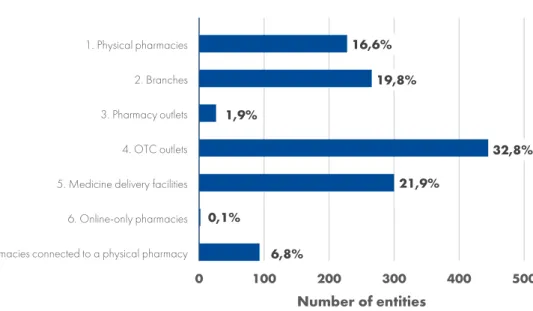
In June 2020, Denmark had 228 physical pharmacies, 271 branches, 26 pharmacy outlets, approximately 450 OTC outlets and about 300 medicine delivery facilities – all of which are connected to one of the physical pharmacies.48
There are two online-only pharmacies registered and 93 online pharmacies which are connected to one of the physical pharmacies.49 Many of the physical pharmacies sell online through the Danish e-commerce platform DinApoteker.dk.50
43 In 2018-2019, the gross profit on prescription medicines was approximately 11.5 percent of the retail price. The Danish Pharmacy Association, Pharmaceuticals in Denmark 2018-2019, page 12.
44 The Economic Equalisation Scheme between pharmacies in Denmark is regulated in the Danish Pharmacy Act article 49 and in the Act Regarding Calculation of Fees and Contributions to Pharmacies (Bekendtgørelse om beregning af afgift og ydelse af tilskud til apotekere m.v., BEK nr. 1635 af 27/12/2019).
45 The Act Regarding Calculation of Fees and Contributions to Pharmacies (Bekendtgørelse om beregning af afgift og ydelse af tilskud til apotekere m.v., BEK nr. 1635 af 27/12/2019), article 3. The threshold and rates are on an annual basis.
46 The Danish Medicine Agency’s website, https://laegemiddelstyrelsen.dk/da/nyheder/2015/ledig-bevilling-til-onlineapotek/
47 The Danish Ministry of Health, Report regarding liberalisation of the pharmacy sector, page 33.
48 The Danish Medicine Agency’s website, https://laegemiddelstyrelsen.dk/da/apoteker/apoteker/
49 On the Danish Medicine Agency’s website, there is a list of pharmacies legally selling pharmaceuticals online in Denmark. See https://laegemiddelstyrelsen.dk/da/apoteker/koeb-og-salg-af-medicin-paa-internettet/apoteker-der-lovligt-saelger-medicin- paa-nettet/
50 The Danish Medicine Agency’s website, https://laegemiddelstyrelsen.dk/da/apoteker/koeb-og-salg-af-medicin-paa- internettet/apoteker-der-lovligt-saelger-medicin-paa-nettet/ and the Danish e-commerce platform’s website,
https://www.dinapoteker.dk/info/om-dinapotekerdk. The e-commerce platform DinApoteker.dk is owned by a Danish private company. When you buy pharmaceuticals through the platform you buy the products from the specific pharmacy chosen at the platform and not the company owning the platform.
Figure 3.1 Allocation of different entities of pharmacies in Denmark 2020
Ten percent of Danes that shopped online in 2015 had bought pharmaceuticals online, whereas the number had increased to 25 percent by 2019. Especially young people, women and people living in the Copenhagen Metropolitan Area and Zealand buy pharmaceuticals online. Discreet and personal consultation and quick home delivery are some of the reasons why more Danes are choosing to buy pharmaceuticals online.51
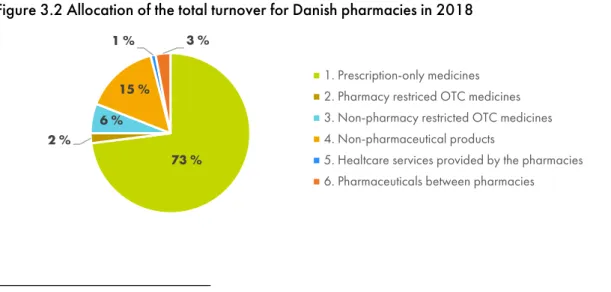
Looking at both physical and online pharmacies, Danish pharmacies had a total turnover of DKK 11.7 billion excluding VAT (approx. EUR 1.6 billion) in 2018. 73 percent of the turnover was related to the sale of prescribed medicines, 2 percent to the sale of pharmacy restricted OTC medicines, 6 percent to the sale of non-pharmacy restricted OTC medicines, 15 percent to the sale of non-pharmaceutical products, 1 percent to the sale of healthcare services provided by the pharmacies and 3 percent to the sale of pharmaceuticals sold between the pharmacies.52 This is illustrated in figure 3.2 below.
Figure 3.2 Allocation of the total turnover for Danish pharmacies in 2018
51 The Confederation of Danish Industry, More Danes buy pharmaceuticals online (2019), page 2.
52 The Danish Pharmacy Association, Pharmaceuticals in Denmark 2018-2019, page 18.
6,8%
0,1%
21,9%
32,8%
1,9%
19,8%
16,6%
7. Online pharmacies connected to a physical pharmacy 6. Online-only pharmacies 5. Medicine delivery facilities 4. OTC outlets 3. Pharmacy outlets 2. Branches 1. Physical pharmacies
0 100 200 300 400 500
Number of entities
73 % 2 %
6 % 15 %
1 % 3 %
1. Prescription-only medicines 2. Pharmacy restriced OTC medicines 3. Non-pharmacy restricted OTC medicines 4. Non-pharmaceutical products
5. Healtcare services provided by the pharmacies 6. Pharmaceuticals between pharmacies
According to information received from the online-only pharmacies, it appears that they sell a lot more non-pharmacy restricted OTC medicines and non-pharmaceutical products than prescribed medicines and pharmacy restricted OTC medicines. However, the share of the sale of prescribed medicines and pharmacy restricted OTC medicines has increased in recent years.53
In particular, the online sale of prescribed medicines and pharmacy restricted OTC medicines increased during the first six months of 2020 due to Covid-19. The online-only pharmacies have experienced a significant increase in the sale of these products, one of them experiencing an increase of approximately 2.5 times from February to March 2020.54
On average, a Danish pharmacy achieved a turnover of DKK 24 million (approx. EUR 3.2 million) in 2018. However, the turnover differs between pharmacies located in cities and pharmacies located in the rural areas of Denmark.55 This difference in turnover is among other things based on pharmacies located in cities selling more non-pharmaceutical products with a higher gross profit, compared to pharmacies in the rural areas of Denmark, which mainly sell prescribed medicines with a lower gross profit.56
In general, the online-only pharmacies have experienced an increase of approximately 50 percent in total turnover from 2018 to 2019. For the online-only pharmacies, turnover for the first six months of 2020 was higher than the total turnover for 2019.57
As mentioned above, online-only pharmacies also sell more non-pharmacy restricted OTC medicines and non-pharmaceutical products. However, they find it difficult to compete with other companies in the retail sector in particular on non-pharmaceutical products, as these companies are not subject to the same regulation as pharmacies, while online pharmacies are obligated to pay a fee to the Danish Ministry of Health for the sale of non-pharmaceutical products.58
3.4 Challenges and future development
The online pharmacy market is still developing in Denmark and online sales of pharmaceuticals have increased. According to the Confederation of Danish Industry (Dansk Industri), pharmaceuticals are the product category with the highest growth in the number of consumers, who have bought the product online, when looking at the past 5 years. The two online-only pharmacies entered the market approximately 4 years ago. However, there have been online sales of pharmaceuticals through physical pharmacies for a longer period of time.
53 Information received from online-only pharmacies, August 2020.
54 Information received from online-only pharmacies, August 2020.
55 The Danish Pharmacy Association, Pharmaceuticals in Denmark 2018-2019, page 21.
56 The Danish Pharmacy Association, Pharmaceuticals in Denmark 2018-2019, page 19.
57 Information received from online-only pharmacies, August 2020.
58 Information received from online-only pharmacies, August 2020.
3.4.1 Challenges with the pharmacy sector
As mentioned above, only a person holding a Danish pharmaceutic master’s degree or a foreign equivalent and approved degree can receive a license to run a pharmacy in Denmark.
This restriction on ownership excludes people and businesses with, for example, a business background from owning a pharmacy but who do not fulfil the above criteria, and thus limits the scope for new business models. The restriction creates a barrier to entry and may reduce innovation and access to capital. Some of the other Nordic countries only require that there must be a responsible pharmacist available at the pharmacy at any time.
The online-only pharmacies experience a lack of natural consumer flow compared to physical pharmacies. Unless they have a strong brand within the personal care segment, it is not likely that consumers will go directly to the pharmacy website. The online-only pharmacy therefore needs to build a strong brand to attract consumers, which requires significant financial resources and several years of building a customer base.59
Less far-reaching requirements on ownership could therefore also make it easier to establish online-only pharmacies in Denmark, for example if it became easier for them to attract foreign capital to be used for building a strong brand.
The geographical restriction still limits competition between pharmacies. The change in the regulation of the Danish pharmacy market in 2015 made it easier for pharmacies to establish branch pharmacies, pharmacy outlets, OTC outlets and medicine delivery facilities. This has strengthened the accessibility of pharmaceuticals in Denmark but has not necessarily strengthened competition.
The fact that a pharmacy can only establish a branch pharmacy or pharmacy outlet within a radius of 75 km from the main pharmacy limits competition as the branches and outlets will often
”compete” with the main pharmacy owned by the same pharmacist in the same area, thus putting no real competitive pressure on the main pharmacies.
Online pharmacies could also be a way to ensure a more effective competitive pressure on the pharmacy market in general, as they are present throughout Denmark.
In Denmark, there is no competition on price or the range of products between pharmacies when it comes to prescribed medicines and pharmacy restricted OTC medicines. This means that consumer prices for these types of pharmaceuticals are fixed and identical across all pharmacies in Denmark.
Online-only pharmacies are subject to the same purchase prices and gross profit ranges as physical pharmacies and therefore, online-only pharmacies are not allowed to compete on prices for these pharmaceuticals either. This is in particular a challenge for online-only pharmacies, as price is typically the main parameter of competition for online companies.
59 Cf. information received from Apopro Online Pharmacy, August 2020.
As mentioned earlier, all pharmacies in Denmark are included in the Gross Profit Agreement, which covers the sale of all pharmaceuticals, sale of non-pharmaceutical products and other services provided by the pharmacies.
As a consequence of the Gross Profit Agreement, when some pharmacies sell more non- pharmacy restricted OTC medicines or non-pharmaceutical products, all pharmacies earn less money on selling prescribed medicines and pharmacy restricted OTC medicines. This is to ensure that the annual agreed gross profit is not exceeded. However, this may also give pharmacies an incentive to focus more on selling non-pharmacy restricted OTC medicines and non- pharmaceutical products. The share of these products has increased over the years, which means that the gross profit on the sale of prescribed medicines and pharmacy restricted OTC medicines has decreased.60
This mainly affects pharmacies located in the rural areas of Denmark negatively, as they sell less non-pharmacy restricted OTC medicines and non-pharmaceutical products and are therefore more dependent on the gross profit related to the sale of prescribed medicines and pharmacy restricted OTC medicines.
As a result of the Economic Equalisation Scheme, which aims to ensure a broad geographic coverage of pharmacies in Denmark, pharmacies with an annual turnover lower than the threshold have less of an incentive to increase their annual turnover, as they are compensated for their low turnover.
This is also the case for pharmacies with an annual turnover higher than the threshold. They also have less of an incentive to increase their annual turnover, as they will have to pay a higher fee to the Danish Medicines Agency.
The overall compensation system therefore to some extent reduces the incentives for pharmacies to compete effectively, as pharmacies with higher turnover end up paying more compensation to pharmacies with lower turnover.
3.4.2 Developing a strong market for online pharmacies
Despite the changes in the regulation of the pharmacy sector in 2015, regulation continues to limit the scope for competing on a number of parameters.
Developing a strong market for online pharmacies in Denmark can help ensure that citizens in the rural areas of the country will have easy access to pharmaceuticals, while the dependence on local, subsidised physical pharmacies can be reduced.
Developing the market for online pharmacies could thus improve efficiency and benefit consumers, compared to the current situation where the pharmacies that obtain the highest turnover subsidise the pharmacies in rural areas with low turnover, while the economic incentives to develop new business models still remain rather limited.
60 The Danish Pharmacy Association, Pharmaceuticals in Denmark 2018-2019, page 18.
One way to improve access for online pharmacies could be to modify the abovementioned regulation regarding The Gross Profit Agreement in order to ensure that both physical and online pharmacies have better economic incentives to keep focusing on their main task: selling prescribed medicines and pharmacy restricted OTC medicines.
Furthermore, the efficiency gains of online pharmacies can be hard to achieve without some level of price competition, which is not possible in Denmark at present. One route would be to introduce maximum prices on pharmacy restricted OTC medicines and prescription medicines rather than fixed prices. Additionally, a relaxation of ownership restrictions could enhance the ability to develop these new business models and attract consumers.
The abovementioned suggestions to modify the regulation of the pharmacy sector will generally promote stronger competition in the pharmacy market to the benefit of consumers. The Danish Competition Council has published similar recommendations in the report Konkurrence om distribution af medicin from 2016.61
61 The Competition Council’s report: Konkurrence om distribtuion af medicin, 2016, https://www.kfst.dk/media/2738/analyse- konkurrence-om-distribution-af-medicin.pdf
4 Finland
The online pharmacy market in Finland is still very underdeveloped when compared to many other countries. In terms of the liberalisation of pharmacy markets, Finland lags behind many of its Nordic peers. As Finland must cope with ever increasing challenges of accessible health and social care services in rural areas, it is evident that health related e-services, online pharmacies among them, will be one answer to these challenges. Consequently, regulation should be redesigned to support this development.
4.1 The regulation of pharmacies and online pharmacies
In Finland, The Finnish Medicine Agency (“Fimea”) is the corresponding regulatory authority supervising pharmacies. Fimea regulates the number and location of pharmacies by granting licences to run pharmacies based on a needs assessment of a certain area. Licences are only granted for qualified pharmacists that meet certain education requirements. Pharmacy ownership is restricted to pharmacists. This means that no vertical (i.e. manufacturer or wholesale ownership) or horizontal integration (pharmacy chains) is allowed for pharmacies. Besides the main pharmacy, a pharmacist can have at most three subsidiary pharmacies. In order to be granted a pharmacy permit for a larger pharmacy in a city, a pharmacist is generally expected to have run a pharmacy somewhere in more rural areas of Finland. In this way, it is guaranteed that the provision of pharmacy services is adequate everywhere in Finland. The prices of medicines are fixed in all pharmacies so pharmacies cannot compete on prices. This also applies to online pharmacies.
The online pharmacies in Finland are regulated by the Medicine Act (395/1987) and the associated guidelines and orders set out by Fimea.62 In addition, online pharmacies are regulated by the consumer protection law concerning distance sales.
The Medicine Act defines online services of a pharmacy as an act of selling medicines to the consumer based on the order the consumer has placed through the internet. The Act stipulates that only pharmacies with a valid physical pharmacy license can operate an online pharmacy. That is, the permit to operate an online pharmacy is connected to the license to operate a physical pharmacy. Regulations also dictate some specific requirements for online operations, for example in terms of safe distribution of medicines to consumers. The regulations particularly aim to guarantee that consumers receive appropriate medical guidance when purchasing medicines online, especially when prescription medicines are purchased. Guidance can be in many forms, such as phone, email and internet-based chat. Purchasing prescribed medicines online is only possible using an e-prescription. E-prescriptions have been mandatory as of 1 January 2017 and
62Medicine Act 395/1987, Unofficial translation; Amendments up to 1340/2010 included
https://www.fimea.fi/documents/160140/765540/18580_Laakelaki_englanniksi_paivitetty_5_2011.pdf
Relevant EU legislation is: Directive 2011/62/EU of the European Parliament and of the Council of 8 June 2011 amending Directive 2001/83/EC on the Community code relating to medicinal products for human use, as regards the prevention of the entry into the legal supply chain of falsified medicinal products. Text with EEA relevance (https://eur-lex.europa.eu/legal- content/en/TXT/?uri=CELEX:32011L0062);
Fimea decree on online pharmacies, 2/2011 (10.5.2011);
https://www.fimea.fi/documents/160140/743657/18533_Apteekin_verkkopalvelu_-maarays_2011-05-10.pdf (in Finnish).
only in some exceptional situations can prescriptions be given by other means such as physical paper or over the phone. For certain medicines, there are also limitations on the maximum package size that can be purchased through an online pharmacy.
All pharmacists with a pharmacy licence wishing to operate an online pharmacy must make a pre-notification to Fimea about their plans to launch an online pharmacy. Fimea evaluates this pre-notification and either accepts or rejects it. After the pre-notification period, pharmacists must also notify Fimea when the actual operation of online services has started. Furthermore, significant changes to the operations and the closing of an online pharmacy must be reported to Fimea.
Fimea has the authority to cancel the online pharmacy permit if it notices shortcomings in the operations of the pharmacy.
Based on the pre-notifications, Fimea keeps a list of all authorised online pharmacies on its website.63 All online pharmacies are required to have a link to this list so that consumers have an opportunity to check the authorisation of the pharmacy. In addition, online pharmacies are required to have the common EU logo for online pharmacies on their webpages.64
4.2 Market outlook
654.2.1 Pharmaceutical markets overall
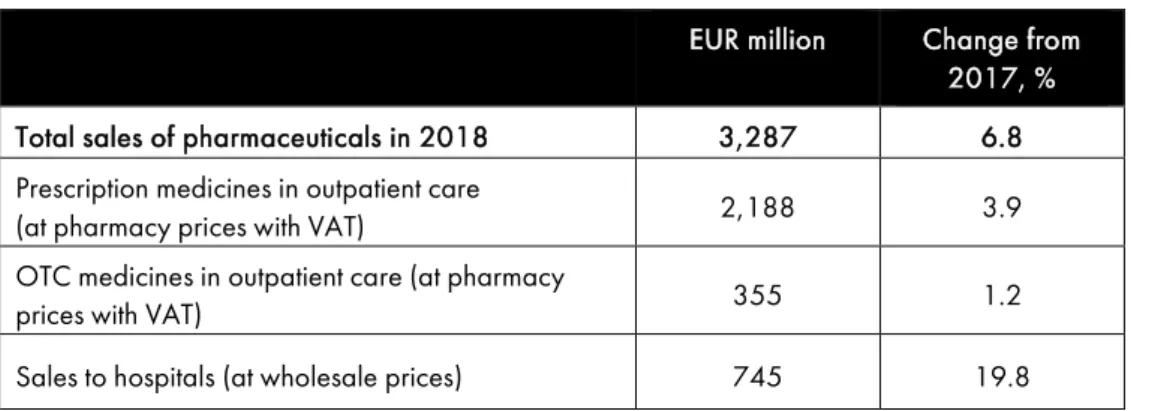
The size of the pharmacy market in Finland was about EUR 3.3 billion in 2018. More specifically the sales of medicines in Finland was distributed as follows (Table 4.1).66
Table 4.1 Size of the pharmaceutical market in Finland, 2018
EUR million Change from 2017, %
Total sales of pharmaceuticals in 2018 3,287 6.8
Prescription medicines in outpatient care
(at pharmacy prices with VAT) 2,188 3.9
OTC medicines in outpatient care (at pharmacy
prices with VAT) 355 1.2
Sales to hospitals (at wholesale prices) 745 19.8
63 https://www.fimea.fi/apteekit/verkkopalvelutoiminta/lailliset_apteekin_verkkopalvelut
64 Fimea decree on Common EU logo for online pharmacies, 1/2015 (17.5.2015);
https://www.fimea.fi/documents/160140/764653/29505_Maarays_1_2015_FI.pdf (in Finnish) Common EU logo for online pharmacies/retailers; https://ec.europa.eu/health//sites/health/files/files/eu- logo/logo