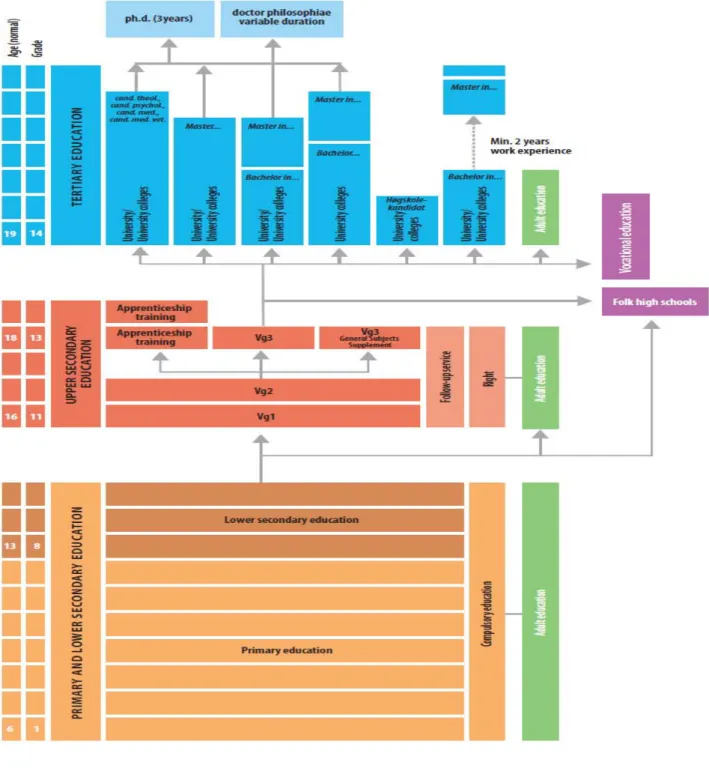
In 1994, a major reform was introduced in the Norwegian education system, which provided a statutory right to a minimum of three years of higher secondary education.3 The 19 provinces are responsible for the provision of higher secondary education, including VET. The analysis focuses on the impact of ethnic background, and distinguishes between non-Western immigrants and the majority population.9 The results show that VET-educated immigrants and native children of immigrants experience an earnings disadvantage immediately after graduation.
Benefits for society
In other words, the insufficient supply of care providers is considered a disadvantage of the VET system. These arguments point towards a more general problem of a mismatch between demand and supply of skills in the Norwegian VET system.
Conclusions and implications for further research
Social inequalities in participation in the education system and learning outcomes are present in all countries. Finally, gender-related topics appear to have been largely overlooked in research on the benefits of VET.
In summary, based on the relatively small amount of research on the benefits of vocational training, a number of topics seem relevant for future research. Based on recent Norwegian research, further studies of the impact of policy measures in relation to economic cycles and the apprenticeship market seem fruitful.
Effectiveness and quality assurance
- Introduction
- Quality and effectiveness in schools
- Quality in apprenticeship training
- Institutional framework
With the implementation of the Education Promotion Reform, new measures have been introduced to improve student choice. However, there is a great demand for competence development for teachers in upper secondary education as well as in other parts of the education system. An important aim was to prepare teachers and trainers for the implementation of the Knowledge Promotion Reform.
In upper secondary education, approximately 18 percent of teachers participated in formal further education in 2008. In 2006, as part of the Knowledge Promotion Reform, the Depth Study Project was in all vocational programs in high schools. An important part of the explanation is that the two groups have different English language skills when they enter high school.
To achieve this goal, a key feature of the reform was to make the apprenticeship system an integrated part of upper secondary education. These findings reflect that the status of VET and the apprenticeship system varies considerably in different parts of the Norwegian labor market. A related issue concerns the status of VET as part of the education system and in the labor market, and how this status is affected by different institutional frameworks.
Final report from the evaluation of the project "Alternative forms of evaluations and tests in vocational education.].
VET and employment-related mobility and migration
Motives for VET and employment-related mobility and migration
This is approximately twice the number granted in the other Nordic countries combined (Dølvik et al. 2006). Even if wage levels in sending countries have increased rapidly in recent years, nominal wage differentials are still significant, and many years, or even decades, are likely to pass before the forces driving this type of economically motivated migration diminish in importance. . This applies especially to unskilled and low-skilled labour, for which wage growth in the sending countries is slower and the wage levels in the Nordic countries are particularly favourable.
Nevertheless, even though wages in the Nordic countries are higher than in Poland and the Baltic states, more people have migrated to Norway than, for example, to Sweden and Finland. Dølvik and Friberg (2008) state that the demand for labor in Norway and Denmark is higher than in the other Scandinavian countries. They also emphasize that the networks of immigrants from Poland and the Baltic states in Norway are more developed.
In summary, the vast majority of immigrants who arrived in Norway after EU enlargement are employed in building and construction, and many have vocational training. The relatively high wage level in Norway in this sector is important, but not the only reason to migrate to Norway.
Consequences of VET and employment-related mobility and migration
As a result, factors other than wages probably contributed to the relatively high migration to Norway. Furthermore, after the abolition of transitional arrangements and labor regulations, there is an increased need for statistics and data regarding the development of wages, employment and working conditions for migrant workers (Dølvik and Eldring 2005). Tariff wages for migrant workers, the possibility to claim social benefits as well as established networks and contacts with other immigrants from Poland and the Baltic countries are other factors that attract migrant workers from these countries to Norway.
However, certain areas and sectors with high labor demand experience negative pressure on national norms and standards regarding wages and working conditions. In general, people from the new Member States move to Norway with plans to stay for a limited period. A survey of Polish immigrants in Oslo shows that as many as 40 percent of respondents indicate that their spouses, currently living in Poland, plan to move to Norway (Friberg and Tyldum, 2007b).
For example, the survey reveals that the skills and qualifications of many Polish immigrants are not recognized in Norway. The research also addresses the negative consequences in terms of skills shortages in migrants' countries of origin.
Non-western immigrants, their descendants and VET
Based on this, foreign education seems to have a much lower value in the Norwegian labor market than education from Norway. Bratsberg, Raaum and Røed (2006) studied labor market participation among people who immigrated to Norway in the 1970s. The authors argue that part of the explanation lies in the disincentives to work in the Norwegian social security system.
After the EU enlargement in 2004, however, a large part of the labor migrants to Norway have a vocational education from their home countries. On the other hand, labor migration has led to an increasing number of low-wage jobs and contributed to the establishment of new dividing lines in the Norwegian labor market. For some of the countries of origin, such as Poland, increased emigration has led to a shortage of skills and labor supply.
Differences between immigrants and ethnic Norwegians in the education system and the labor market are well documented. Ethnicity and the transition from vocational education to work: a multilevel analysis of differences in labor market outcomes.
Transition
Transition from lower secondary school to VET
As noted above, the vast majority of junior high school graduates go on directly to senior high school. Over the same time period, there has been a steady increase in the proportion of 16-18-year-olds with an immigrant background attending secondary education. Pupils' motivation for education is complex, and so are the reasons for choosing one of a total of nine career paths in upper secondary education in Norway.
One of the recommendations of a recent OECD policy study on vocational education and training in Norway is to improve vocational guidance in lower and upper secondary schools to improve the match between vocational education and training provision and labor market needs (Kuczera et al. 2008). With the reform, new measures were adopted aimed at strengthening the foundations of students for the appropriate selection of an educational program in secondary education. The aim is to improve progression and prevent dropouts from upper secondary education.
The introduction of the optional program presupposes good cooperation between primary and upper secondary schools and between schools and local employers. However, it is still far too early to draw conclusions about the effect of this measure on progress and dropout in upper secondary education (Lødding and Borgen 2008).
Completion, drop-out and attainment of qualifications in VET
2007) is the final report from a study of the progression and degree of qualification of students who started a youth education in and 2001. In other words, there has been an increasing tendency for students to switch from vocational education to academic education in upper secondary education. In another project, researchers from NIFU STEP have investigated completion, dropout and attainment of qualifications in upper secondary education among almost 10,000 students in the south-eastern part of Norway over a five-year period from 2002 to 2007.
The project followed young people after their final year in lower secondary education and in upper secondary education (Markussen et al. 2008a). The findings show that two out of three (65.8%) who completed lower secondary school in 2002 had achieved formal qualifications from upper secondary education five years later. Those who become apprentices are a select group with better grades and fewer absences in upper secondary education.
In 2003, an action plan to combat dropout in upper secondary education was launched as part of the government's poverty action plan. Several studies referred to in this section show that progress and attainment of qualifications in upper secondary education are strongly linked to academic performance in lower secondary education.
Transition from VET to work
Frøseth (2008) followed the cohort that graduated from youth education in Østfold county in 2003. In section 3, larger results from a longitudinal study of students at youth education in the south-eastern part of Norway were summarized (Markussen et al. al. 2008a, 2008b) . A number of studies have shown that the transition from VET to work has been successful for a majority of those who complete their education with formal qualifications at upper secondary level.
The dropout problem in upper secondary education is considered a major challenge for the education system in Norway. A study of the transition from. further education and working life among persons who completed upper secondary education in Østfold county in the spring of 2003.]. The transition from upper secondary education to working life for the 1st cohort from R94.].
Oslo: NIFU STEP Report 13. 2008b): Completion, dropout and attainment of qualifications in upper secondary vocational education in Norway. Throughput of students at upper secondary school for classes starting upper secondary education in and 2001.] Oslo: NIFU STEP Report 14.