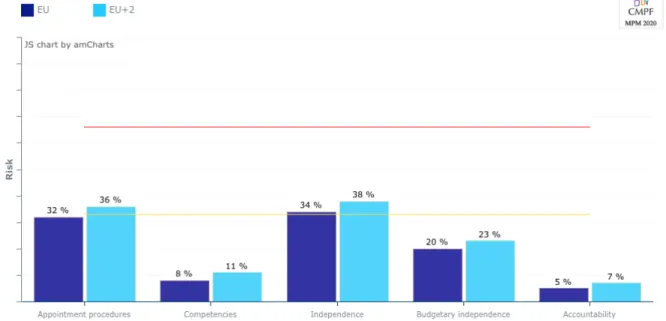
This report presents the results and methodology of the Media Pluralism Monitor (MPM2020), a tool aimed at assessing risks to media pluralism in EU member states and selected candidate countries (30 European countries in total). The average digital variables score for the Market Plurality area is 61%, (ie medium risk).
Political
Independence
Turkey remains the only country to score high risks across all five indicators in the area of political independence. Two-thirds of the countries (22) have a medium risk (Austria, Belgium, Croatia, the Czech Republic, Denmark, Estonia, Finland, Germany, Greece, Hungary, Ireland, Italy, Latvia, Lithuania, Luxembourg, Malta, the Netherlands, Poland, Portugal, Slovakia, Slovenia, Spain), 5 countries (Albania, Bulgaria, Cyprus, Romania and Turkey) have a high risk, while only 3 countries (France, Sweden and the UK) are in the low risk band for social inclusion.
Social
The area of Social Inclusion takes into account access to media by different social and cultural groups, such as minorities, local/regional communities, people with disabilities and women. Access to media for minorities, and Access to media for women, are the two highest indicators in this area.
Inclusiveness
The novelty of the MPM2020 Social Inclusivity area is a new component of the Media Literacy Indicator: Protection against hate speech. As mentioned above, MPM2020 devotes a special focus to the evaluation of the specific risks for media pluralism in the digital environment.
Media Pluralism in a digital
In terms of market plurality, the risk score for the digital market is slightly lower than the overall risk. However, the digital score on the market concentration indicators is equal to or higher than the total score.
Introduction
Freedom of expression and the freedom and pluralism of the media are enshrined in the Charter of Fundamental Rights of the European Union (Article 11). In Hungary, the creation of the Central European Press and Media Foundation (KESMA), a conglomerate of nearly five hundred media organizations, represents a huge and unprecedented concentration of media in the hands of oligarchs friendly to the ruling party (CMPF 2019) .

Analysis
The first and fundamental component of the field is the level of 'protection of freedom of expression', which is a basic prerequisite for any functioning democracy. Impartiality and independence of the institutions that control the media market are other basic elements of a pluralistic media environment.
Basic
It is of the utmost importance that the effective transparency of public administration is ensured and that information that is in the public interest can circulate to feed the political debate and ultimately democracy. 15 Council of the EU, EU Human Rights Guidelines on Freedom of Expression Online and Offline, 12 May 2014, http://www.
Protection
Protection of freedom of expression
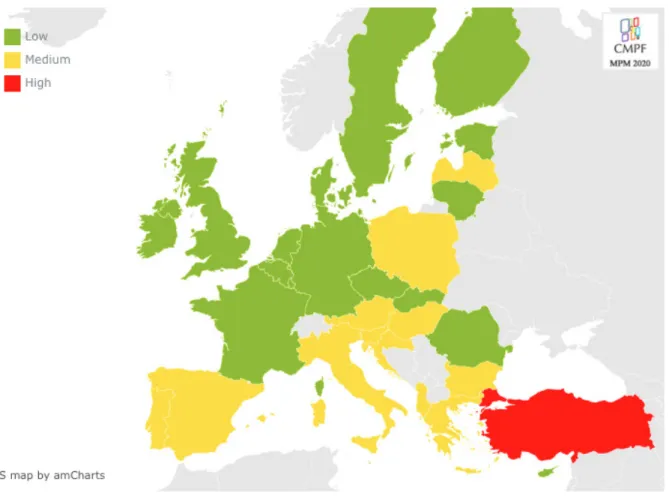
In general, the indicator for the Protection of freedom of expression marks a low risk in 17 countries (5 countries less, compared to MPM2017) namely, Belgium, Czech Republic, Cyprus, Denmark, France, Finland, Estonia, Germany, Ireland, Lithuania . - Ukraine, Luxembourg, Malta, the Netherlands, Romania, Slovakia, Sweden and the United Kingdom; and as medium risk in 12 countries - 4 more in connection with MPM2017 (Albania, Austria, Bulgaria, Croatia, Greece, Hungary, Italy, Latvia, Poland, Portugal, Spain and Slovenia) and, as in previous rounds of MPM , Turkey is the only country that scores as at high risk for this indicator (88%). Turkey is the only country that is assessed as being at high risk for this very basic indicator for the protection of freedom of expression (88%).
Protection of the right to information
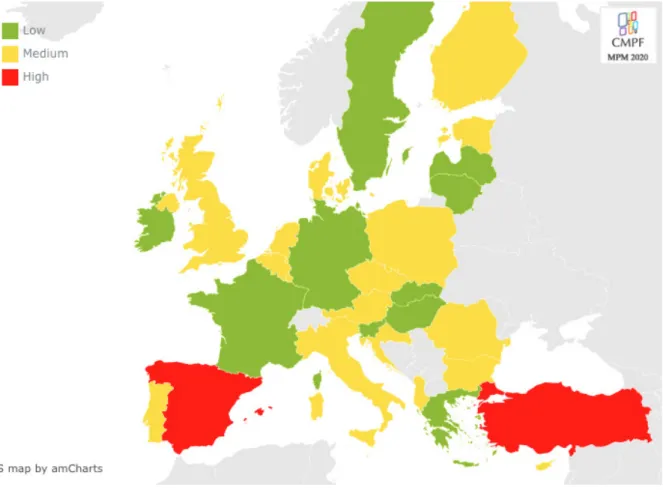
The indicator of the protection of the right to information reaches an average of 39% and reaches a problematic medium level of risk in the area of Basic Protection. The sub-indicator Legal protection of the right to information is now in the zone of medium risk (34%), which is a 2% increase compared to MPM2017 (a similar increase applies if we consider only the EU28 - from 30 to 32%).
Journalistic profession, standards and protection Journalists and other media actors are those who, in a functioning democratic society, feed
Threats to the physical safety of female journalists are monitored as a separate component of the sub-indicator. Once again, Turkey scores a high risk on the Protection of Journalists sub-indicator in light of the imprisonment of many journalists.
Independence and effectiveness of the media authority Media authorities are key actors in regulating media in Europe and are increasingly be-
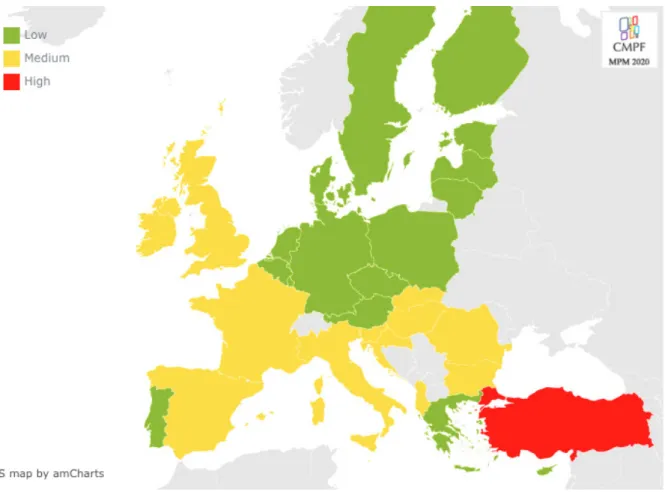
Independence and effectiveness of the media authority Media authorities are and increasingly are key actors in regulating the media in Europe. According to the Media Authority's Indicator of Independence and Effectiveness, Turkey is the only country rated as high risk.
Universal reach of traditional media and access to the Internet
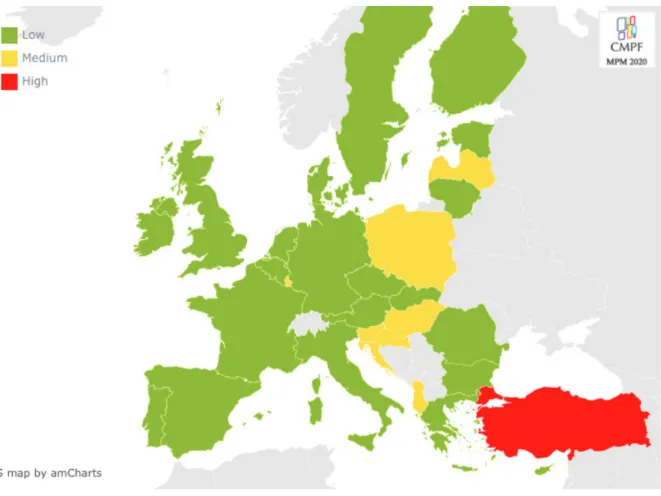
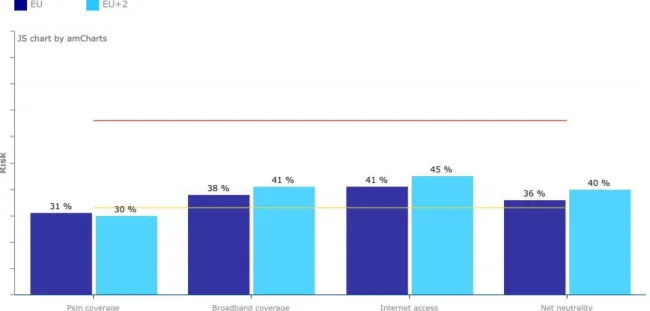
Luxembourg scores as a high risk due to the lack of a regulation requiring full coverage of local public radio and the effective, reportedly low, coverage (90%) of the country's (small) territory. MPM2020 again has a very high threshold for assessing this risk, which is calculated by taking the median of existing (good) access levels to the Internet in EU countries as a benchmark.
Market
Plurality
Transparency of media ownership
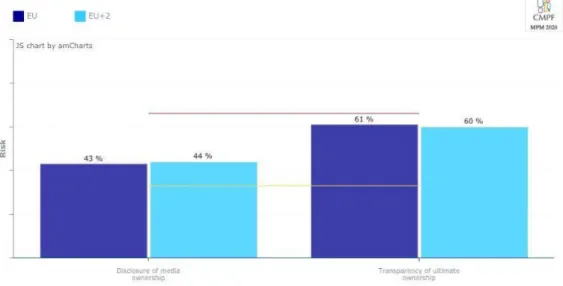
This indicator aims to assess the existence and implementation of regulatory safeguards regarding the transparency of news media ownership, and also asks for the effectiveness of these safeguards when it comes to the ultimate and beneficial owner. The two sub-indicators related to transparency of media ownership both register medium risk, but the one on the transparency of ultimate ownership is higher, close to the threshold of high risk in average value, both in the EU and EU+2 .
News media concentration
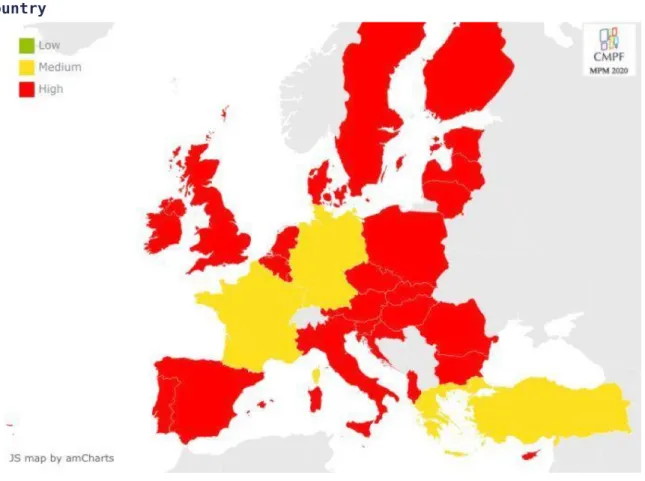
Even if some countries have a regulatory framework with media-specific laws against horizontal and/or cross-media concentration, economic data point to a highly concentrated market, especially in the audiovisual services sector. In the newspaper sector, 25 countries are assessed as high risk, 3 as medium risk (Bulgaria, Germany and Spain) and 2 as low risk (Latvia and Lithuania).
Online platforms concentration and competition enforcement
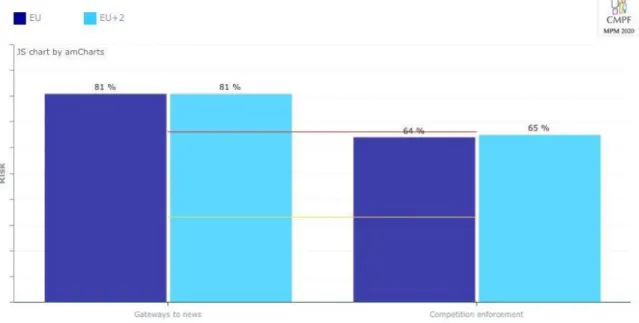
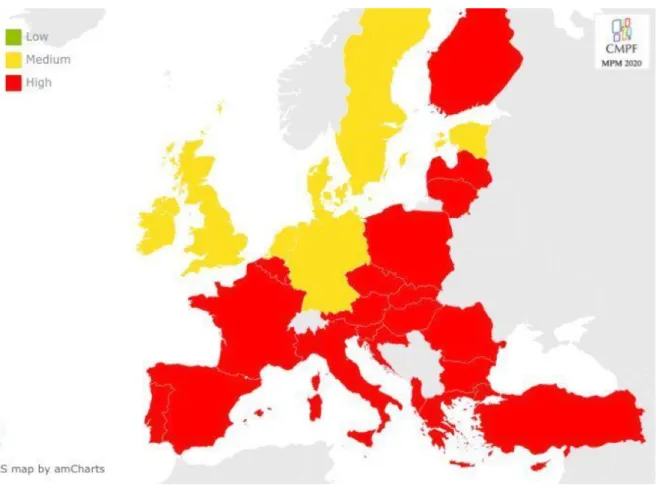
As can be seen on the map, no country scores a low risk in this indicator. In the sub-indicator on Gateways to news, 22 countries achieve high risk, while only 8 countries achieve medium risk (Denmark, Estonia, Finland, Lithuania, Luxembourg, the Netherlands, Sweden, the United Kingdom).
Media viability
No sector of the news media industry has recorded an increase in the past two years (no sector is therefore at low risk); the sectors with medium risk (stationary income and employment) are AVMS (42%), radio (47%) and digital native (47%). The newspaper sub-indicator (aggregate comprising the press industry, including the resources from the digital version of print copies) scores a high risk assessment of 80%: in 24 of the countries monitored by the MPM, newspaper turnover and employment trends have actually declined in recent two years.

Commercial & owner influence over editorial content This indicator seeks to assess the risks to media pluralism that arise from the qualitative
In implementing MPM2020, additional variables have been introduced to assess the extent and effectiveness of the same safeguards in the online environment. The risks related to media independence from commercial influence are assessed by analyzing the legal and regulatory framework, as well as its effectiveness.
Political independence of the media
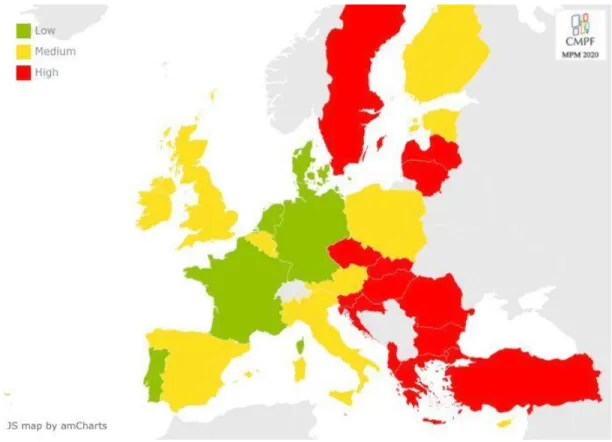
In particular, lower risks of political control in the form of direct or indirect ownership have been observed with regard to radio and, in particular, indigenous digital media. The Conflicts of Interest Act has been amended in direct response to the unprecedented conspiracy of political and media power at the hands of Prime Minister Andrej Babiš (Stetka & Hajek 2020).
Editorial autonomy
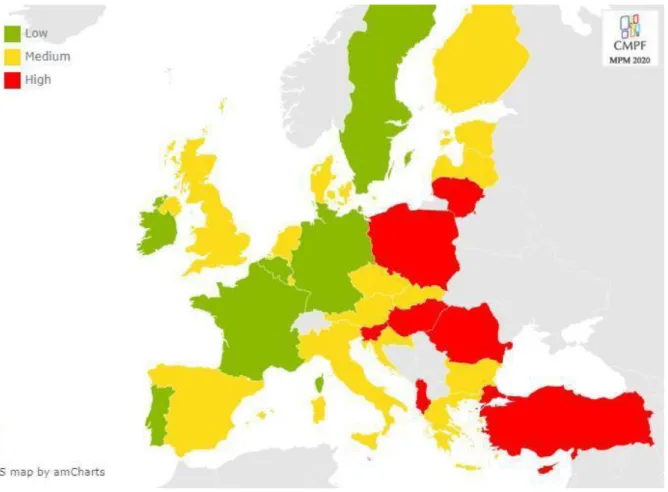
The 2017 amendment explicitly prohibits politicians (including local politicians) from owning interests in the media. In the suit against Cumhuriyet, the allegations include “changing the editorial policy of the newspaper” (Inceoglu et al. 2020).
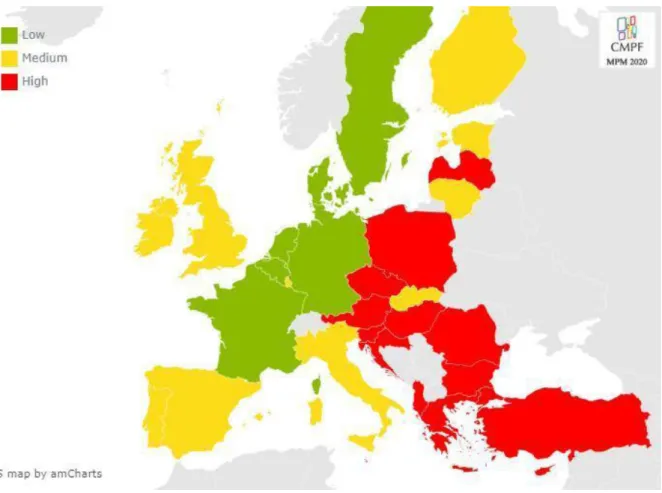
Audiovisual media, online platforms and elections The indicator on Audiovisual media, online platforms and elections assesses the existence
Audiovisual media, online platforms and elections The Audiovisual media, online platforms and elections indicator assesses existence. However, in MPM2020 the risk is significantly higher than in previous years, mainly due to the new Rules for Online Political Advertising sub-indicator.
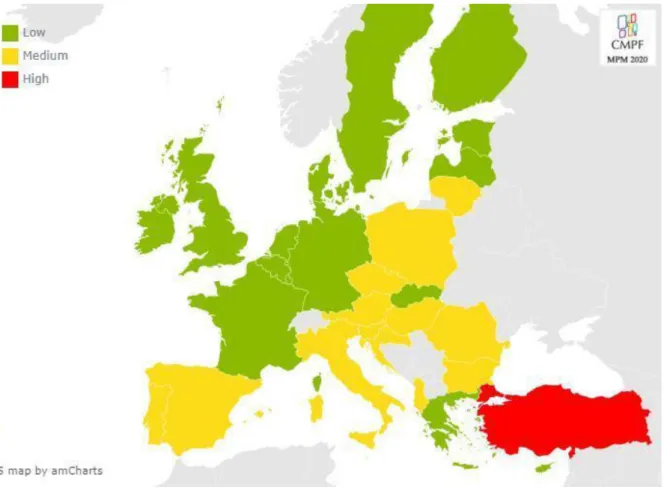
State regulation of resources and support to the media sector
Indicator for state regulation of resources and support for the media sector - Risk map by state. Indicator of state regulation of resources and support for the media sector - Average for sub-indicators.
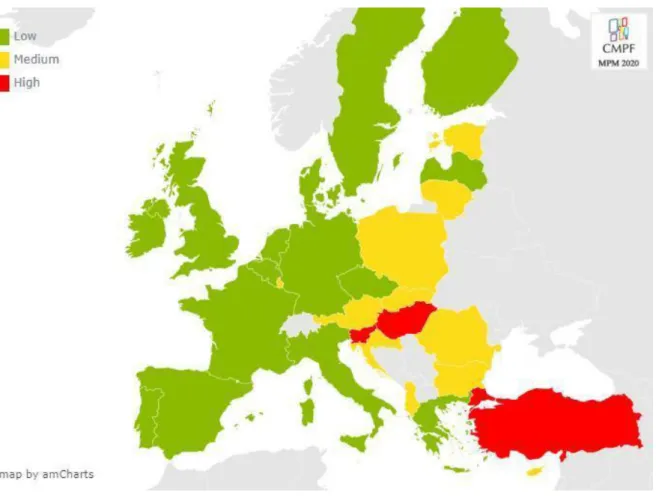
Independence of public service media governance and funding
In Sweden, the appointment procedures are well defined by law and ensure the independence of PSM boards and management, while allowing for political control. In the field of social inclusion, more than two-thirds of countries (22) are in the medium risk class; 5 countries were given a high risk (Albania, Bulgaria, Cyprus, Romania and Turkey) and 3 countries are in the low risk group (Sweden, France and the United Kingdom).

Access to media for minorities
The media access indicator for minorities contains two sub-indicators: one examines whether minorities (both legally recognized and not recognized by law) have access to private TV and radio channels; while the other assesses the situation with regard to public media: whether the law guarantees access to broadcasting time on the PSM channels to legally recognized minorities, and whether minorities (both those legally recognized and minorities not recognized by law) have access to for them in practice. The Netherlands scores a very low risk of 4% on the indicator Access to the media for minorities.
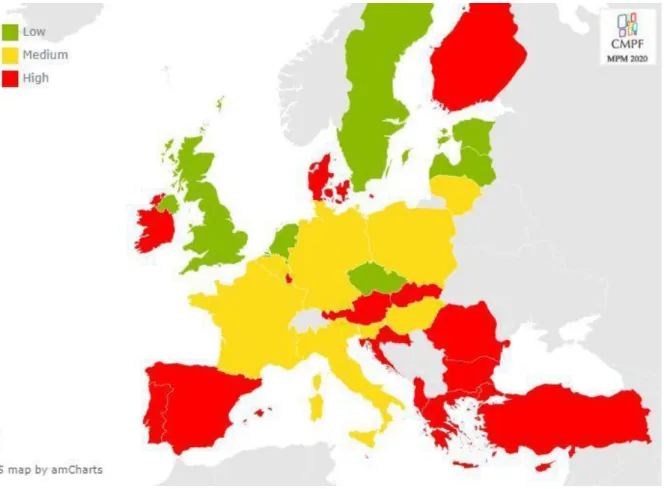
Access to media for local/regional communities and for community media
Indicator of access to media for local/regional communities and for community media - Map of risks per country. Indicator of access to media for local/regional communities and for community media - Average per sub-indicator.
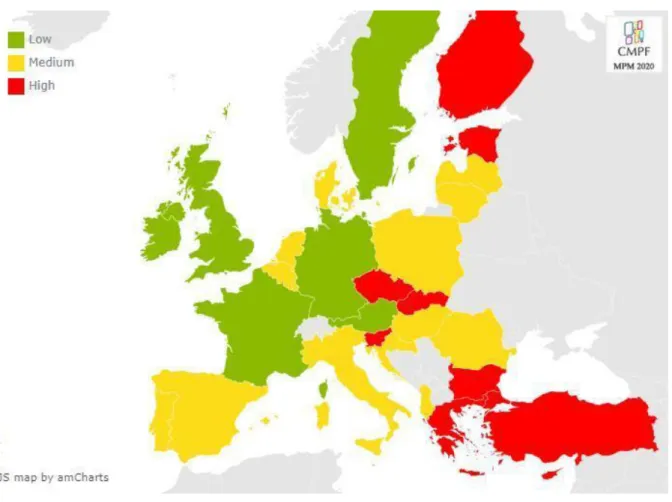
Access to media for people with disabilities
The MPM indicator assesses the regulatory framework, including policies and laws on access to media content for people with disabilities, and the availability of support services for people with hearing and visual impairments. All countries, with the exception of Luxembourg, have legislation in place requiring access services for people with disabilities.
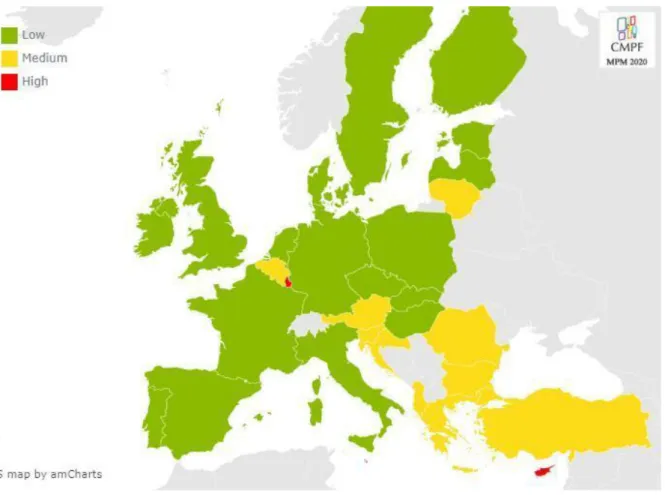
Access to media for women
Access to the media for women is the second highest scoring indicator in the social inclusiveness area. The share of women among editors-in-chief in the leading news media in the country - Map of risks by country (variable).
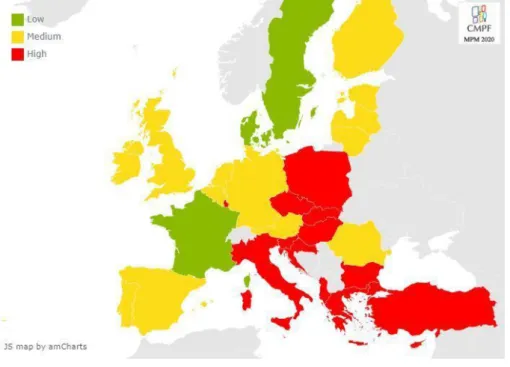
Media literacy
According to the media literacy indicator, almost two-thirds of the countries (19) register an average risk, while 7 countries mark a low risk (Belgium, Denmark, France, Finland, Germany, the Netherlands and Sweden) and 4 countries are found to be at high risk (Albania, Cyprus, Romania and Turkey). Media education policies are assessed as comprehensive in 6 countries (Belgium, Finland, France, Germany, the Netherlands and Sweden).
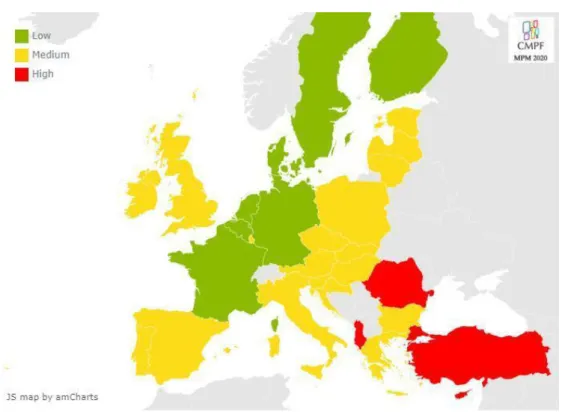
Media
Pluralism in a digital
Basic
Protection - digital
Market plurality -
In each of the five indicators of the Market Plurality area, the digital score is in the same risk class as the overall score, but with different percentage scores. In the media viability indicator, the average score of the digital variables is lower compared to the overall score: 50% for EU+2, 49% for EU.
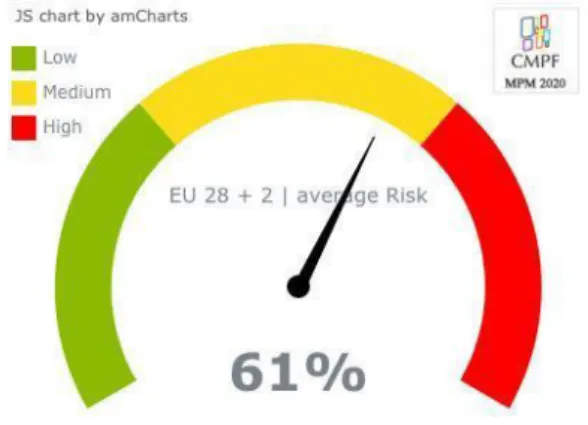
Political Independence
This is shown in Figure 4.3.b below and should be interpreted in relation to the specific issues addressed in the digital part of the political independence space. There are seven digital-specific social inclusion variables, all of the socio-political type (the purpose of which is to evaluate the situation on the ground).
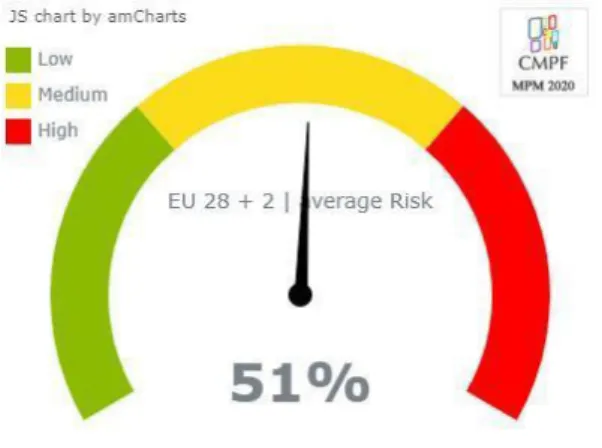
Social
Inclusiveness - digital
Methodology
The MPM research design is based on a questionnaire compiled by national country teams consisting of media pluralism and media freedom experts. The questionnaire consists of legal, economic and socio-political questions, in order to allow an assessment of the risks of media pluralism in any given country, taking into account the legal framework, its implementation and the effective conditions of the media landscape.
The research design
Research and fine-tuning of the
The main changes in basic protection were the inclusion of new variables and a new sub-indicator used to address the potential challenges to freedom of expression online. The most significant update in this area has been in the Media Literacy indicator, which has been amended to include the sub-indicator 'Protection against hate speech'.
MPM2020 structure and
Assessing the risk of lack of
MPM2020
Data
Conclusions
Although the two MPM exercises (MPM2017 and MPM2020) are not fully comparable due to the changes in the MPM questionnaires and the different candidate countries analyzed, it is interesting to see that the trends are similar. Below we provide a brief summary of the main findings of MPM2020 and some recommendations based on the analysis.
Basic Protection
It must be emphasized that the effectiveness of the self-regulatory instruments in place depends on the good will and practice of the signatories. Media authorities should also be able to coordinate with other independent authorities relevant to the governance of the online media sector, such as communications authorities, competition authorities and data protection authorities.
Market Plurality
In the digital environment, the threats to market plurality risk outstripping the opportunities of the new media ecosystem. Editorial autonomy is still the highest scoring indicator in the Political independence area of the Monitor.
Use of the Media Pluralism Monitor in the European Union, Albania and Turkey in 2018-2019. Use of the Media Pluralism Monitor in the European Union, Albania and Turkey in 2018-2019.