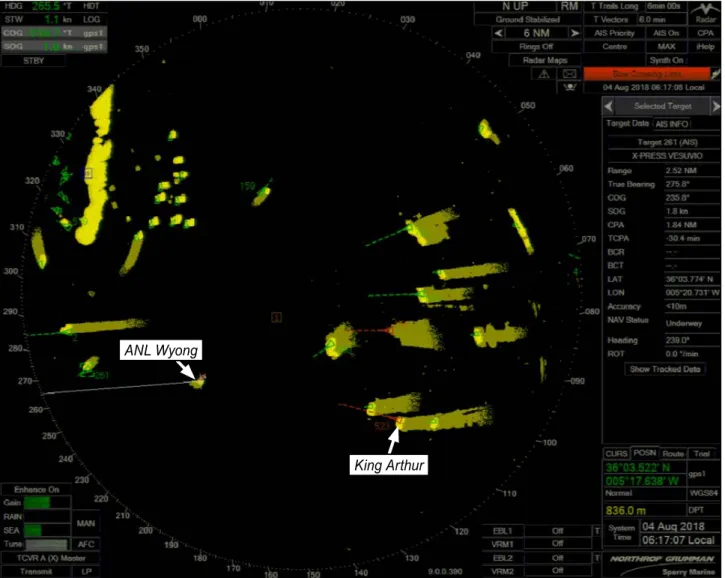
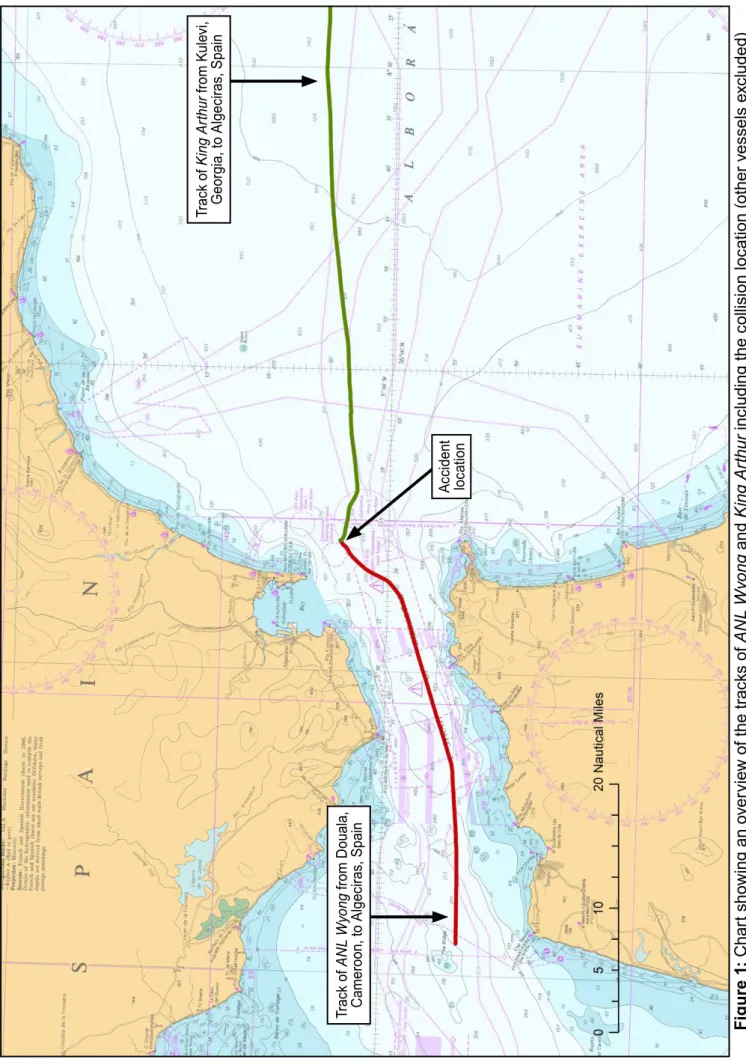
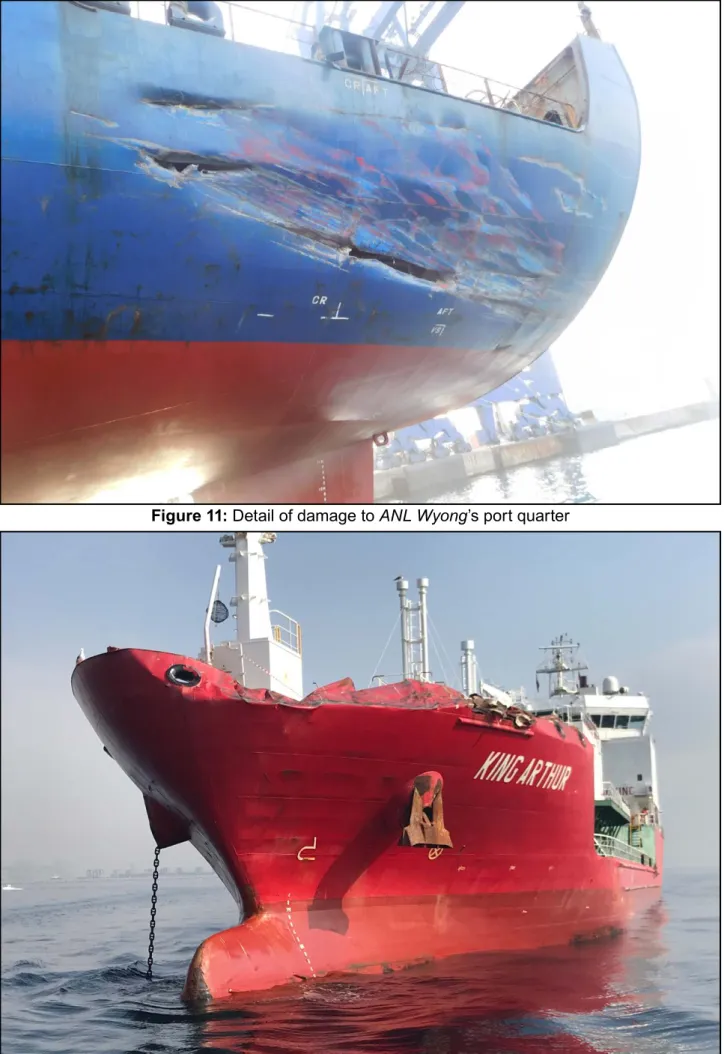
At 0636 on 4 August 2018, the British registered container ship ANL Wyong and the Italian registered gas carrier King Arthur collided 4 nautical miles south east of Europa Point, Gibraltar. King Arthur's master was lurking and altered course to starboard with the aim of passing astern of ANL Wyong. Although King Arthur's master could not see ANL Wyong, his assessment of the situation was based primarily on automatic identification system data.
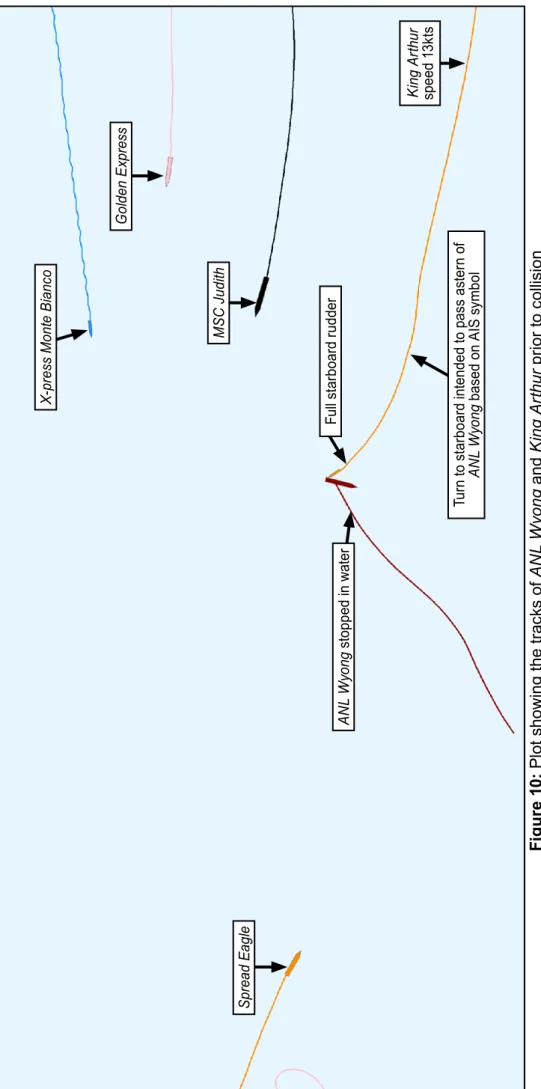
However, ANL Wyong was stopped in the water and did not make way as King Arthur's master saw. Consequently, the decision to turn King Arthur to starboard actually had the effect of putting the vessels on a collision course. When King Arthur's master realized that a dangerous situation was developing, full starboard rudder was applied; however, this action came too late to prevent the collision.
ANL Wyong's officer of the watch watched the situation but took no action when it became apparent that a multiple close situation was unfolding. The investigation also identified that very high frequency radio conversations were a significant distraction aboard King Arthur.
NARRATIVE
Events prior to the collision
Due to the shipping density, ANL Wyong's master took the deception of the OOW for the passage to the guard position. At 0600, King Arthur's chief officer, who was the OOW, called the master and informed him that there was 1 hour left before the planned boat transfer in Gibraltar Bay. King Arthur's master came to the bridge and, after a handover order from the OOW, took the disadvantage for the approach to the boat transfer position.
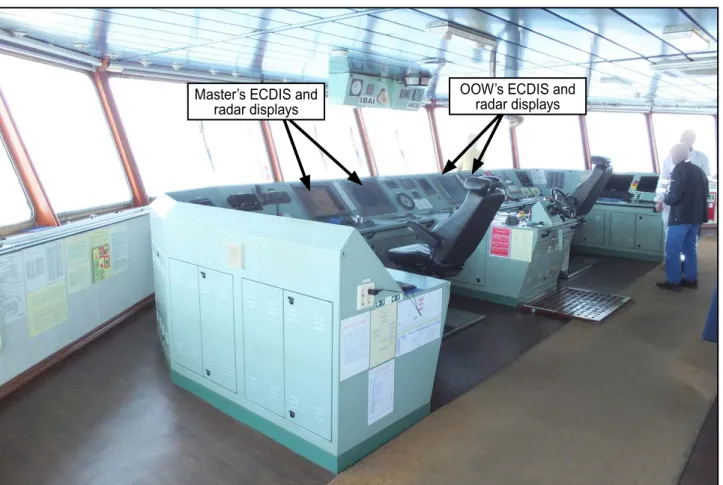
When mooring, King Arthur's master was on the port horseshoe side of the bridge (Figure 5) where she had access to the radars and ECDIS displays. At the same time, ANL Wyong's OOW was monitoring multiple shipping contacts approaching from the east with two indicating a closest point of approach (CPA) less than the alert1 setting (Figure 7). MSC Judith called King Arthur at 0621 using VHF radio; King Arthur's chief officer answered the call, with the master also listening in on the exchange.
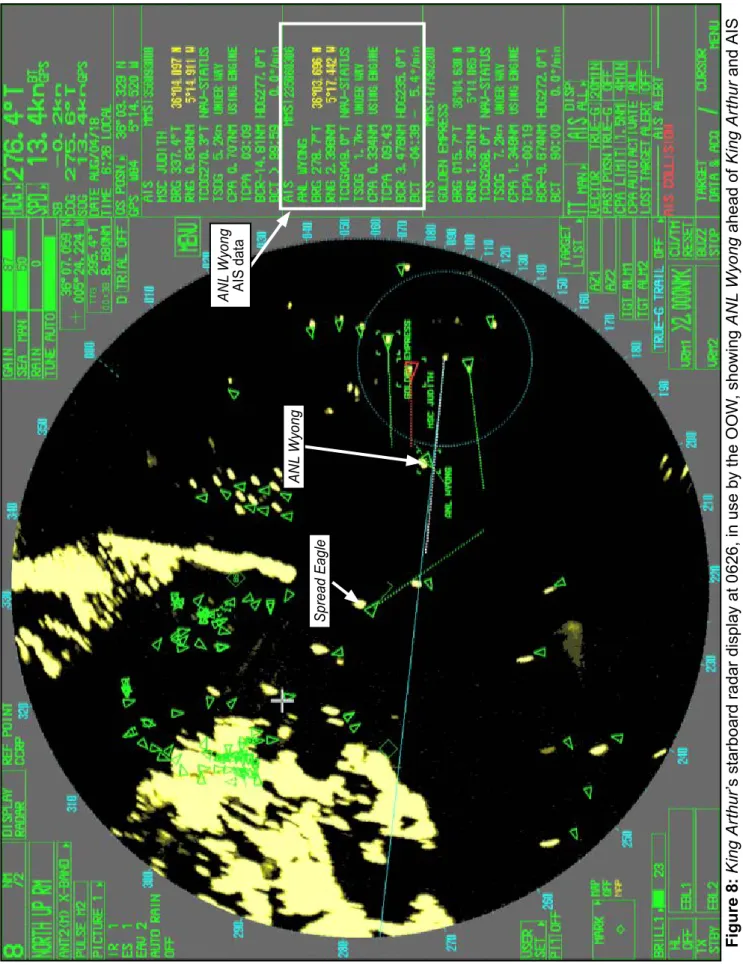
During this conversation, King Arthur's captain began a slow turn to port, putting the ship on a new course of 275 degrees; The purpose of this change was to steer clear of MSC Judith (Figure 6). Between 06:26 and 06:29, King Arthur's Chief Officer made VHF radio calls to the Algeciras Traffic and Tarifa Traffic stations, relaying ship details and navigational intentions. After completing the turn to port, King Arthur's captain observed a new radar contact about 2.4 nautical miles away (Figure 8).
From Automatic Identification System (AIS) data, King Arthur's master determined that the new contact was ANL Wyong and, from the orientation of the AIS symbol, that it was heading in a south-westerly direction. The master also observed from AIS information that ANL Wyong's navigation status was 'in progress with engine'. At the same time, King Arthur's Chief Officer was monitoring the situation and noticed that ANL Wyong's predicted CPA was 0.3nm on King Arthur's starboard side.
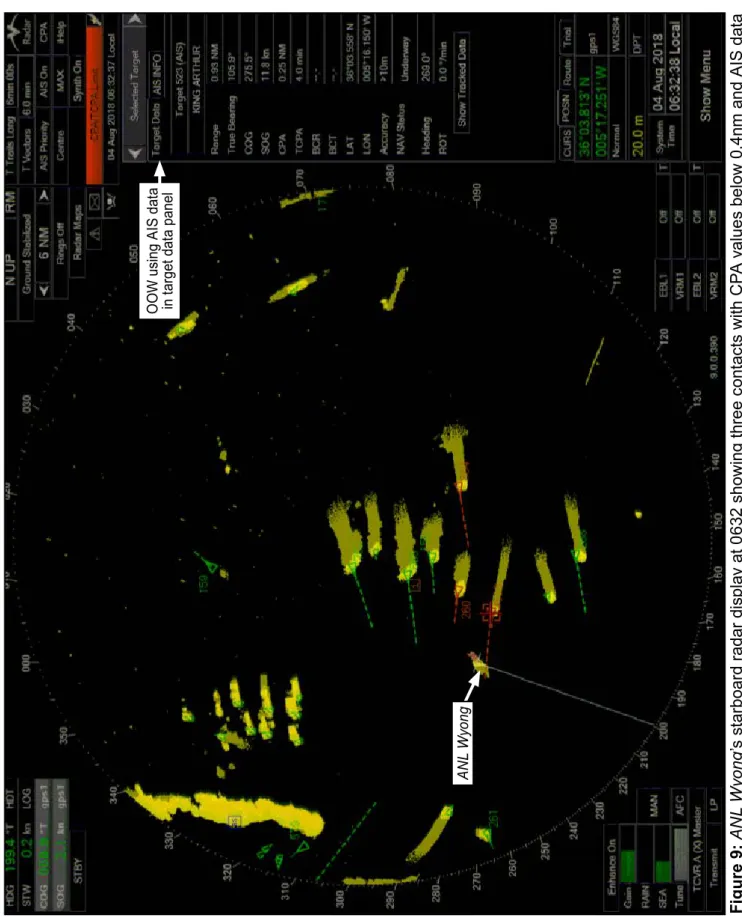
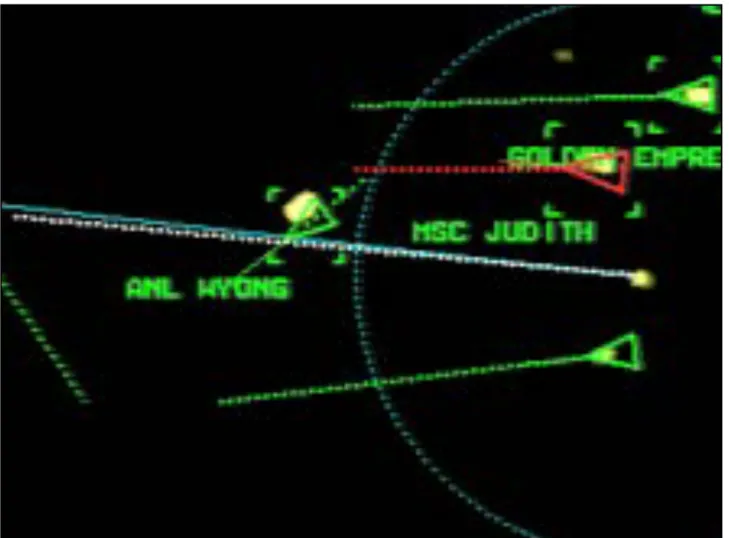
ANL Wyong's OOW continued to monitor the situation and the radar screen was still showing numerous contacts approaching from the east with three CPAs, including the King Arthur, below the alert value and shown in red (Figure 9). At 0633, King Arthur's boss responded to a VHF radio call from the tanker Spread Eagle (Figure 8); a transcript of the conversation is in Table 3. 0634:11 Spread the Eagle “King Arthur…um…vessel..ah…so, right in front of you, this, I tell you, what's your purpose sir”.
The collision
Full starboard rudder Turn to starboard intended to pass astern of ANL Wyong based on AIS symbol.
Post-collision
ENVIRONMENTAL CONDITIONS
ANL WYONG .1 General
- Crew
- Navigation
- Standing and night orders
- Safety management
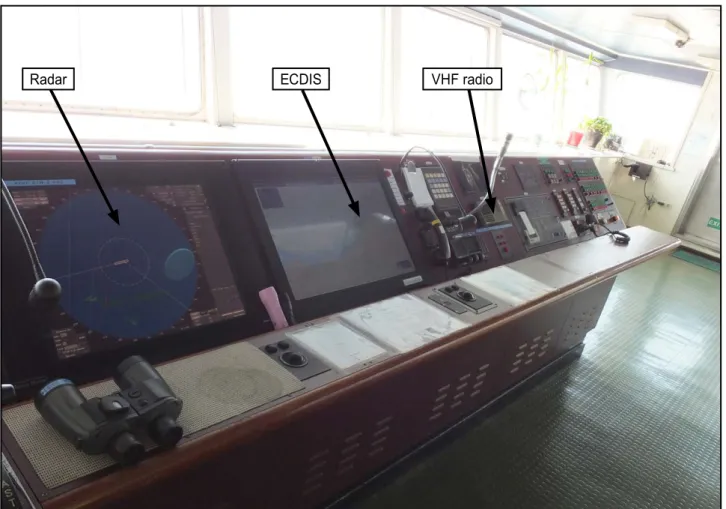
ANL Wyong's primary navigational aid was ECDIS, and all deck officers had completed general and type specific training. At the time of the accident, the OOW was monitoring the situation from the starboard side of the main console (Figure 4). The radar system was capable of analyzing target data using AIS information and Automatic Radar Charting Aid (ARPA) information; The OOW's radar screen was set to prioritize AIS information.
The master's standing instructions stated that the OOW should follow the International Regulations for the Prevention of Collisions at Sea (IRPCS) and that the master should be called in heavy traffic or if movements of other vessels caused concern or any circumstances in which the OOW required assistance. The commander's night orders (Figure 13) required the OOW to follow standing orders and call the commander when in doubt. The night orders also required the OOW to keep a good lookout, follow IRPCS and achieve the scheduled arrival time of 0600 at Algeciras Air Station.
ANL Wyong was one of 509 vessels operated by the CMA CGM Group and was managed by CMA CGM International Shipping Company Pte. The company operated a fully integrated safety management system (SMS) that ensured compliance with the International Maritime Organization's (IMO) International Safety Management Code (ISM Code). ANL Wyong's safety management certificate (SMC) was issued by Bureau Veritas (BV) and was valid until 6 March 2023.
CCISC had a Document of Compliance (DOC), valid until November 16, 2019, certifying the company's compliance with the ISM Code. The CCISC bridge manual stated that the safe passing distance (minimum CPA) was 2 nautical miles in open seas or 0.4 nautical miles in restricted waters. The bridge manual also stated that 'VHF radio must not be used for collision avoidance.
Although the use of VHF radio may sometimes be justified as a collision avoidance aid, the provision of the Collision Regulations should remain the best'.
KING ARTHUR .1 General
Crew
King Arthur's crew of 18 complied with the flag state's minimum safe manning requirements and was composed of Italian, Romanian and Filipino nationals. King Arthur's master was a 64-year-old Italian national who had been with the company as a master for 14 years. He was well regarded and this was his fourth contract under the command of King Arthur.
The Chief Mate, who was the OOW at the time of the accident, was a 31-year-old Romanian national who had been with the company for 8 years and had worked his way up from Deck Cadet to Chief Mate. At the time of the accident, the master was in the act of luring, the chief mate was OOW;.
Navigation
The VDR data indicated that the OOW target data section on the starboard radar screen was giving preference to the AIS data for selected tracks. King Arthur's primary means of navigation were paper charts, but he also carried the appropriate equipment of charts and nautical publications. The chart table was on the starboard side of the horseshoe bridge and was easily accessible by the OOW.
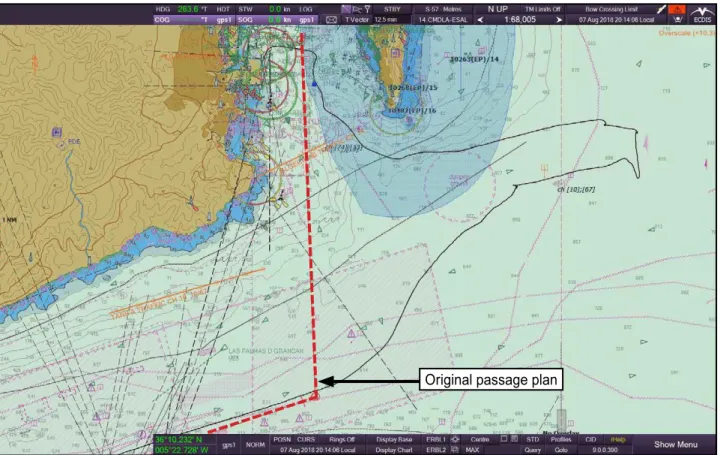
An image of the chart in use at the time is on Figure 14 and shows the intended passage to the boat transfer position in Gibraltar Bay. Although not the primary method of navigation, ECDIS was fitted on board and was used by the vessel's bridge officers, all of whom had completed ECDIS training courses.
Safety management
AUTOMATIC IDENTIFICATION SYSTEM INFORMATION
These values used 155 of the 16 data fields available in the system; one channel (15) was not assigned. Guidance for the operational use of AIS can be found in IMO Resolution A.1106(29) which stated that 'the potential of AIS as an aid to anti-collision equipment is recognized and that AIS may be recommended as such in due course. It does not replace navigation systems such as radar target tracking and VTS, but supports them; And.
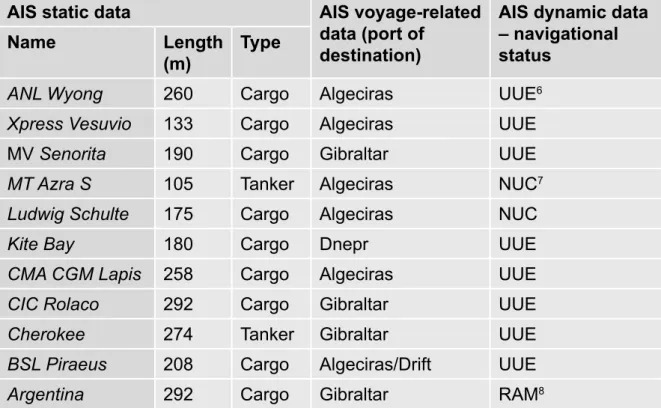
At the time of the accident, AIS data indicated that there were 11 vessels outside the Bay of Gibraltar waiting to enter Algeciras or Gibraltar (Figure 15). Most of these vessels were between 8nm and 16nm east of Gibraltar and one vessel, the container ship Xpress Vesuvio, was in the vicinity of ANL Wyong.
USE OF AIS AND VHF RADIO FOR COLLISION AVOIDANCE The Bridge Procedures Guide (Fifth Edition) published by the International
VESSEL TRAFFIC SERVICES
SHIP REPORTING SYSTEMS
REGIONAL MARITIME SAFETY AUTHORITIES .1 Vicinity of the collision
Tarifa Traffic
Algeciras Bay Port Authority
Port of Algeciras Pilots’ Corporation
Gibraltar Port Authority
COLLISION REGULATIONS
PREVIOUS SIMILAR ACCIDENT
ANALYSIS
- OVERVIEW
- THE COLLISION .1 ANL Wyong
- SAFE SPEED
- ACTION TAKEN TO AVOID COLLISION
- USE OF AIS AND ARPA
- USE OF VHF RADIO
- VESSEL TRAFFIC SERVICES
When King Arthur's master analyzed ANL Wyong, he determined from AIS data that the ship was heading south-west (Figure 17) and underway using the engine. In dense fog and heavy shipping, it would have been prudent for King Arthur's captain to reduce speed considerably so that he had more time to assess the situation and avoid collision. As King Arthur approached ANL Wyong, the bridge team managed a multi-ship situation with little sea space to maneuver to avoid collision, therefore slowing down would have been prudent.
However, the situational awareness and subsequent decision-making on King Arthur's Bridge was derived from radar, AIS and VHF radio information. The OOWs in both ANL Wyong and King Arthur set their radar screens to prioritize AIS data when selecting targets for analysis (Figures 8 and 9). Although the master's radar display on the port side of King Arthur's bridge was reported to show ARPA-derived data in the target data section, there is no doubt that her decision to turn to starboard was heavily influenced by the AIS information .
When King Arthur's Chief Officer responded to the VHF radio call from Spread Eagle, it was not immediately clear to him which vessel / radar contact was calling. When King Arthur's chief officer asked to clarify the situation by repeating the name of the vessel, Spread Eagle responded by describing himself as 'the vessel right in front of you'. At that moment Spread Eagle was one of three vessels that could be described as 'fore' for King Arthur (Figure 18).
This VHF radio call was unnecessary as the IRPCS should have been followed to avoid collision, but, just as significantly, it wasted time and was a distraction for King Arthur's chief officer. This event occurred just a few minutes before the collision, at a time when the chief officer's support to King Arthur's master was critical. While the chief officer did not initiate the VHF radio call with Spread Eagle and had no obligation to answer, it would have been unusual to ignore another vessel coming on Figure 18: Detail of King Arthur's radar when called by Spread Eagle showing that there was.
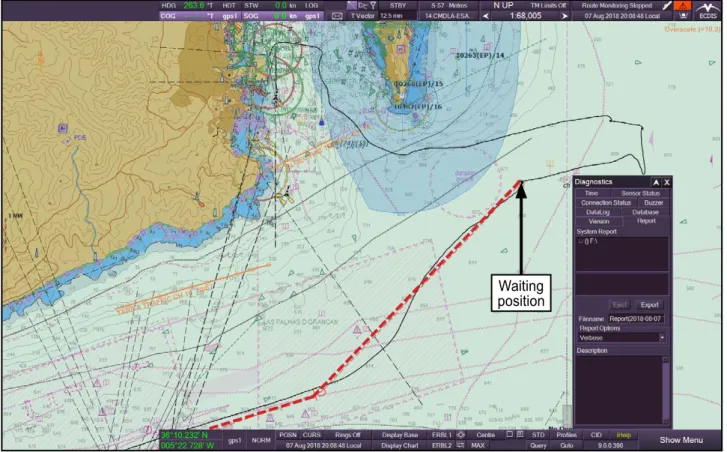
The ANL Wyong and the King Arthur were both bound for Algeciras and the Algeciras pilots had given the container ship instructions to wait outside the bay.
CONCLUSIONS
SAFETY ISSUES DIRECTLY CONTRIBUTING TO THE
OTHER SAFETY ISSUES NOT DIRECTLY CONTRIBUTING TO THE ACCIDENT
ACTION TAKEN
ACTIONS TAKEN BY OTHER ORGANISATIONS CMA CGM International Shipping Company Pte. Ltd has
RECOMMENDATIONS