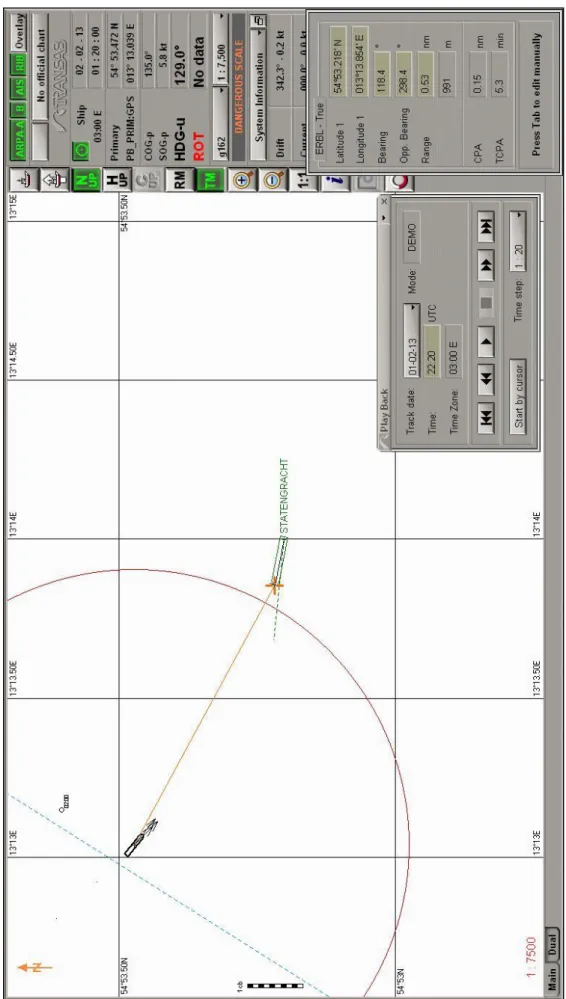
The position was near the Northwest entrance of the TSS North of Rugen in the Baltic Sea. Statengracht was on a westerly course to the entrance of the TSS north of Rugen.
Vessel, Voyage and Marine Casualty Particulars
Description of Vessels
MV Katre
MV Statengracht
Crew Members
Crew members on board Katre
In accordance with the Minimum Safe Manning Certificate, Katre's deck officers consisted of the master and chief mate. At the time of the accident, the vessel's flag state administration was still in the process of issuing the "endorsement attesting the recognition of a certificate" to him.
Crew members on board Statengracht
Weather Conditions
Narrative
Events on board Katre
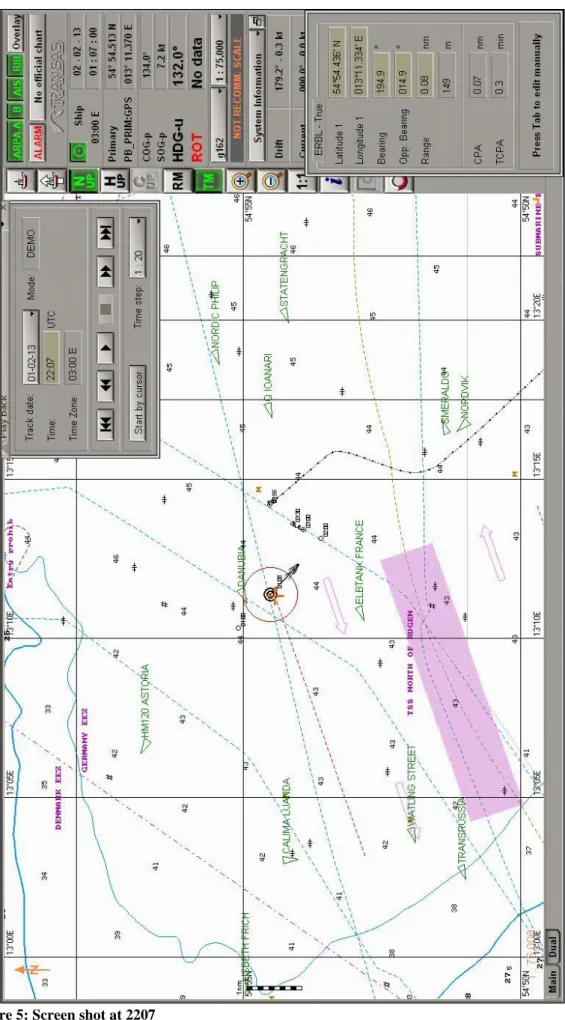
The boss at Four was fully aware of this critical situation, which was developing with the Statengracht, although there was also Q Ioanari to be seen. A few minutes before the crash, the lead mate decided to switch to manual steering and instructed his caretaker to take the wheel. According to the chief, when Statengracht was about 1 nm away and with CPA less than 0.4 nm6, he switched to manual steering and ordered the helm to change course to port by a few degrees to 134° (T).
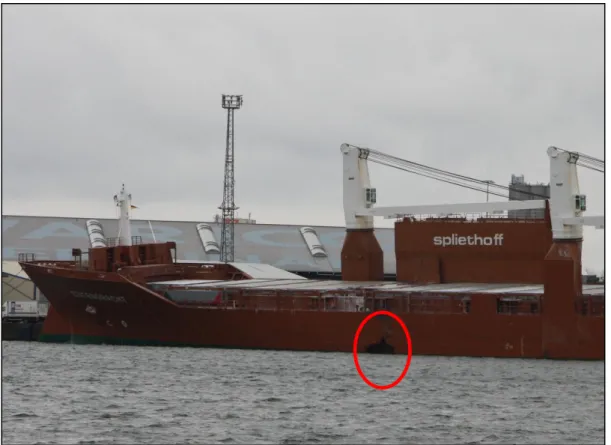
At this time the chief mate instructed the helmsman to put the rudder hard to port while announcing this on the VHF radio. The chief mate further noticed that the Statengracht was continuing to change her course to starboard and immediately ordered his helmsman to put the rudder hard. At 2321, the bow of the Quatre collided with the port side of the Statengracht in the latter's cargo path no.
Events on board Statengracht
At 11:13 p.m., the captain on board the Statengracht was heard to warn the OOW not to let Katre come too close. This prompted the captain to order the OOW to make a wider starboard change so that Katre would better understand his intentions. The captain continued to refer to Nordvik, which had just made a major change to starboard to Statengracht a few minutes earlier.
At 2320, while the Statengracht's course was 275º(T) and Katre was still on the starboard bow within a range of only 0.7 nm, the previous ship's commander was twice heard to order the OOW to "Go more starboard" and then changes to manual control. Immediately afterwards, at 2321, when Katre was only 0.5 nm away and still on the starboard bow, the captain ordered the OOW to switch to manual steering and depart. The master also directed the question to the chief engineer, who first asked him if he smelled alcohol on the OOW, and later ordered him to sniff.
Reported Damages
Immediately after the collision, the master on Statengracht was heard to be very upset about the OOW and told him that it was his first collision in a career of 35 years. The master then made a series of two questions about what he referred to as the smell of alcohol. The chief engineer was not clear in his answer, but documentary evidence made available during the safety investigation indicated that the chief engineer did not smell alcohol.
Purpose
Potential Influence of Alcohol and Actions Taken
Moreover, at no time did the VDR data indicate that the master expressed concern during the navigational watch that he was on. To this effect, the safety investigation could not establish whether alcohol had an influence on the cognitive ability of the OOW. What was certain, however, is that the points above suggest that the OOW lacks a clear situational awareness, regardless of whether this was the result of alcohol abuse or not.
The OOW aboard the Statengracht reported to the bridge for his sailing watch just three minutes before the vessel sailed (at full speed) through a very busy shipping area near the TSS entrance. Furthermore, it should also be noted that the handover of the sailing watch from the third mate to the second mate took only four minutes, ie. The OOW kept the vessel on autopilot until the last minute when the master appeared to have assumed the sailing watch and ordered the OOW to switch to hand steering and set the rudder hard to starboard.
Conduct of Vessels
Katre
In fact, Q Ioanari had steered clear of Katre when the boat changed course to starboard and went around Katre's stern. When Q Ioanari was away from Katre, the situation between Katre and the Statengracht became clearer. He also realized that although his ship's speed was only seven knots at the time, the situation at close range was still developing very quickly due to the speed of the Statengracht.
This rapidly developing situation at close range made it appear that the first mate was seriously concerned and decided to alter course to port to increase the CPA between the two vessels (Figure 17). Regardless of the fact that at the time of this change to port by Katre, the Statengracht had not yet given a clear indication to Katre that the course would change to starboard, Katre could still have changed her course to starboard, as there was nothing to hold back . to dissuade her from this. Once this maneuver was carried out and the fact that at the same time the Statengracht changed its course.
Statengracht
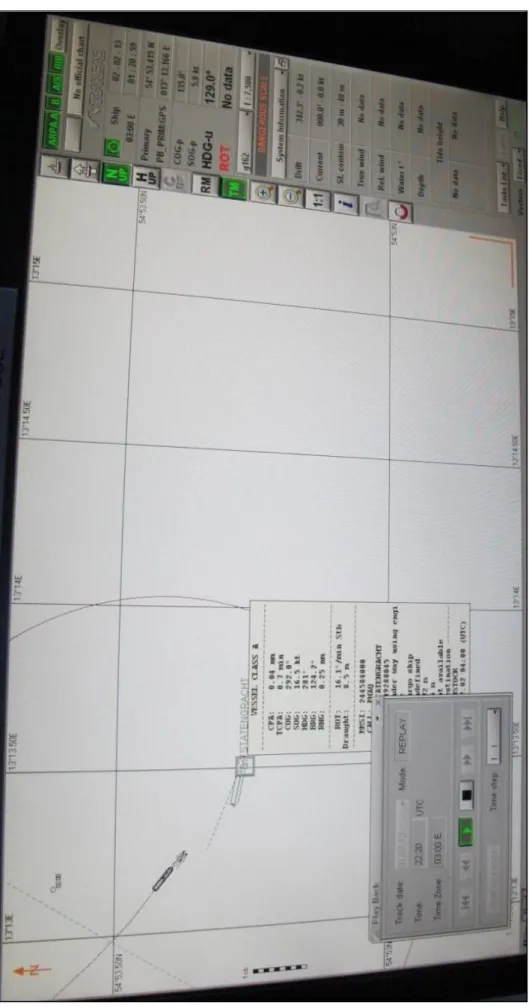
At 0016 (ship's time), with the vessel still on autopilot, the OOW began to slowly change course to starboard using the autopilot12. The VDR data indicated that no maneuver signals were sounded at this time. Course change using the autopilot is a slow process because the autopilot tends to apply counter rudder as soon as the vessel starts to turn so as not to overshoot the new course.
From the VDR data, there was no evidence that the OOW at any time took visual bearings of any of the ships close to the Statengracht, including the approaching Katre. It was clear to the master that the actions taken by the OOW were not directed at the situation developing around the Statengracht.
Decision making in complex environments
It was clear that regardless of the OOWs' experience on both ships, the situation was unfamiliar to them, being unique. The master's approach on board the Statengracht in the minutes before the collision was also analyzed. Although the VDR analysis seems to suggest that the master and OOW spent their time looking down at the radar screens located on opposite sides of the bridge, the master had the opportunity to physically approach the OOW during the navigation watch.
Furthermore, the master's actions, which were taken as a result of what were perceived as insufficient actions by the OOW to navigate the ship free from the risk of a. Regardless of the possible influence that the consumption of alcohol (if any) may have had on the dynamics of the random events, it thus seems obvious that the uncertainty of OOW was twofold, i.e. evidence suggested that the data observed by the OOW did not lead to an identification of the status of the system and therefore the interpretation of the circumstances outside the bridge windows may have been made under some degree of obscurity.
Hours of Work and Rest
The above factors influenced the OOW's potential to make projections and expectations of how the situation developed (given that the environment was dynamic) and how these developments eventually took both ships on a collision course. other duties), both the master and the chief mate had to be on duty during the vessel's arrival and departure. The demand on the two officers would have varied depending on the duration of the sea passage. Evidence indicated that during the seven days prior to the accident, the chief mate did not get the required 77 hours of rest.
In addition, on cross-checking the timesheet/rest timesheet for the days mentioned in the logbook entries, several discrepancies relating to the master and chief officer were found. Furthermore, when the ship arrived at Helsingborg harbor at 11:30 on 29 January 2013, the records show that the first officer was stationary. Then on January 30th, while in Helsingborg harbour, both the master and first officer were idle from 1700 onwards, while the master actually entered the logbook at 2400.
Other Considerations - Navigation Operational Procedures
Look-out
In fact, it took the ship more than an hour to clear the harbor and disembark the pilot. Therefore, bearing in mind the above, it cannot be excluded that fatigue on board the Four may have had an impact on this victim and, in particular, on the way the chief reacted in cases where critical decisions had to be made14. Evidence from the Statengracht suggested that both the master and the OOW referred to a lookout on the bridge, who was also about to take the wheel.
However, the VDR data shows that at no time did the CO and OOW include observation. While the safety investigation had no evidence to suggest that there was no lookout on the bridge, the VDR data clearly showed that the master was constantly addressing the OOW during course changes to starboard and then during the change to manual control, seconds before impact.
Use of radar and other information
Immediate Safety Factor
Latent Conditions and other Safety Factors
Other Findings
Safety actions taken during the course of the safety investigation
Based on the conclusions reached and taking into account the security measures taken during the course of the security investigation,. 04/2014_R1 performs an occupancy analysis of the Katre vessel to ensure that the vessel fully complies with the prescribed working and rest hours at all times. 04/2014_R2 disseminates the findings of this safety investigation and emphasizes to crew members working on its ships the importance of maintaining an up-to-date assessment of evolving situations outside the bridge windows.