Four in five (82%) people in the UK say they use a search engine at least weekly. Mail volume in the UK fell by 1.5% in 2014, the slowest rate of decline among our European comparators.
The UK in context 1
Introduction
The UK consumer in context (Section 1.2): We compare the uptake and use of different services and devices at a broad level across our comparator countries. Smartphone companies (Section 1.5): We compare 4G connections in terms of coverage, usage and consumer satisfaction in our comparison countries.
Putting the UK communications industry into context
The UK communications industry in context (Section 1.1): We compare the size of the UK communications sector with that of other countries and look at the corresponding headline revenues in our comparison countries. Prices of communication services (Section 1.3): In this section, we compare the prices of communication services in six of our comparison countries and look at how consumers in different countries decide to buy communication services.
Communications sector revenues
The US also achieved the highest revenues among our comparison countries in the other sectors we consider in this report – television (£103 billion), mail (£29 billion) and radio (£13 billion). Although telecommunications revenues were the highest of the four sectors in the US, it was television revenues that set this market apart from the others.
Introduction
Take-up and use of communications services, devices and media activities
People in the United Kingdom reported the highest reception of digital radios by a significant margin. Claimed ownership of audiovisual technologies in the UK is among the highest in our comparator countries.
Introduction
Stand-alone service pricing
In contrast, the UK had the highest 'lowest available' detached fixed voice prices among the six countries included in our analysis in 2015, 5% higher than in France (the country with the second highest prices). Our analysis found that, excluding the TV license fee, the UK had the third highest 'lowest available' price for pay TV services, after the US and Spain (Italy had the cheapest 'lowest available' pay TV services had).
Bundled services pricing
We will now take a closer look at the 'lowest available' prices (including packages) for two of the five household types included in the analysis in the international price comparison section of this report (Chapter 2). Italy experienced the largest increase in 'lowest available' prices for households with basic needs in 2015, at 22%.
Summary of international pricing
Note: Green circle indicates the lowest prices in all six countries included in this analysis. The UK is second in price across the five household types used in our analysis, although its average ranking across all baskets and measures was unchanged. Figure 1.20 below shows an overall pricing for our comparison countries, combining their 'weighted average' standalone and bundled as well as 'lowest available'. including bundles) price ranking, across all five of the household usage profiles shown in Figure 1.19. In 2015, the UK ranked second among our comparison countries in terms of prices, down one place compared to 2014.
Introduction
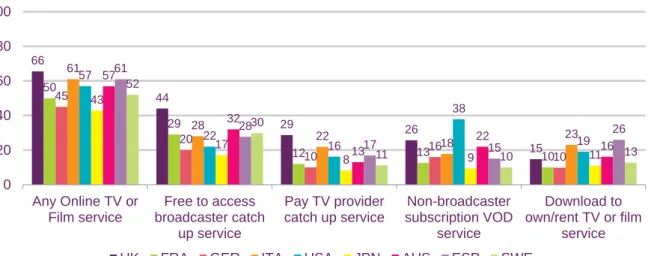
Eighty-two per cent of UK respondents had used a catch-up service from a free-to-air broadcaster in the past year, the highest percentage of any country surveyed. More than half of respondents in the US accessed content via an SVoD service in the past year.
Introduction
According to IHS, at the end of the year, the UK ranked ninth out of our 18 benchmark countries and second among EU5 countries for population 4G coverage (Figure 1.33). Among the EU5 countries, the UK had the highest proportion of mobile connections that were 4G at the end of 2014.
Reasons for choosing 4G, and satisfaction with the service
In most of our comparison countries, over eight in ten 4G users were satisfied with their overall 4G mobile phone service, with only Sweden having lower levels of satisfaction (at 70%). In other comparator countries, over 60% of 4G users were satisfied with the price paid, with the exception of Sweden at 46%.
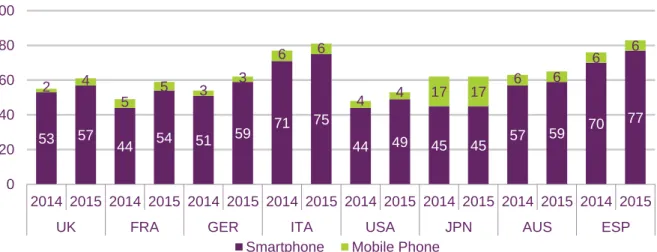
Smartphone take-up Background
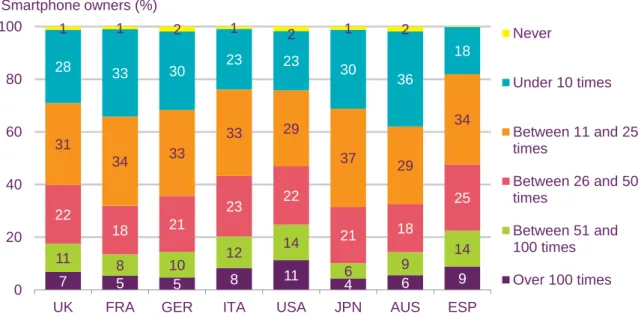
In Japan and Spain, the proportion of respondents who chose text messaging was 3% and 6% respectively. Only 36% of respondents in France stopped checking their smartphones within the 15-minute period before preparing to sleep (with an average time of 56 minutes overall).
Smartphone activities
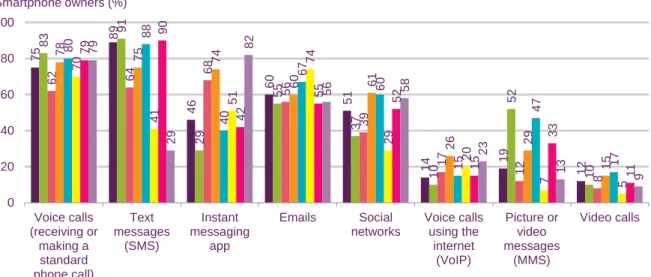
UK smartphone owners in the EU5 are the most likely to use their smartphone to pay a bill. WhatsApp was in the top five most downloaded apps in all EU5 countries.
Introduction
Digital news consumption – a comparative study
Question 5b: Which of the following options have you used in the past week to access news? Question 3: Which of the following have you used as a news source in the past week?
Main sources for news
In the UK, TV is the main source of international news for 43% of respondents and the internet for 30%. 80 One in three UK respondents name the internet as their main source of national news.
Introduction
Online access, awareness and concerns
Between 2% and 3% of respondents in most countries say they don't use search engines, rising to 5% in the US and 6% in Japan. Online users in the US are more likely than in other countries to agree with the statement, "I'm happy to give personal information to companies online as long as I get what I want" (13%).
Introduction
Key developments in the European regulatory and legislative framework The Digital Single Market strategy
The EC believes that now is the time to reflect on the appropriateness of the rules and update them if necessary. One of these is the European Regulators Group for Audio-visual Media Services (ERGA)37, a group of European audiovisual regulators, set up to advise the EC on the application of the AVMSD.
Helping communications markets work for consumers International mobile roaming
Israel expanded its 2011 net neutrality requirements for mobile broadband services to include fixed-line services. Net neutrality is also being considered in India50, where the regulator has issued a consultation on over-the-top services (OTTs) and net neutrality.
Promoting effective and sustainable competition Next-generation access (NGA) 52 and broadband roll-out
Should access to the incumbent's passive network infrastructure (ducts, cabinets) be more explicitly stated as a regulatory objective, which would lead to more innovation and (end-to-end) competition. These include fiber to the home (FTTH), fiber to buildings (FTTP), fiber to the building (FTTB), fiber to the node (FTTN), and fiber to the cabinet (FTTC).
Providing appropriate assurances to audiences on standards Convergence and the future of content regulation
Since the scheme was announced, Ofcom has published two reports on protecting children online. 65 The term 'child protection on the Internet' in this case relates to the protection of minors (traditionally meaning, in regulatory terms, content broadcasting rules for the protection of young viewers) in the online space.
Radio spectrum: Promoting the efficient use of public assets
It calls for action to meet the objectives of EU policies; for example to contribute to the functioning of the internal market for wireless technologies and services. For WRC-15, we have engaged in the European preparation process leading to the establishment of.
Comparative international pricing 2
Introduction
The United Kingdom had the lowest weighted average stand-alone prices for three of the five household usage profiles included in the 2015 analysis. The cheapest standalone prices for fixed broadband and mobile phones were both found in Britain in 2015.
Methodology
Incoming calls to mobile phones were included, in recognition of the different charging mechanism in the US. This is the average of the lowest stand-alone price for each individual service offered by each operator in each country, weighted by their market shares.
Stand-alone pricing, by service Fixed voice summary
In the UK, the combined 'lowest available' price for all four connections increased by 12% over the year. In the UK, the overall 'lowest available' price fell by 4% in 2015, a slightly lower rate than the 5% fall in Italy.
Analysis of basket prices
Note: Basic pay-TV is defined as the minimum price required to purchase a pay-TV package which includes channels not available via free-to-air; premium TV is defined as the best package in top league football (NFL in the US) and a movie/entertainment package at top prices; lowest rate available for the pay-TV component of each household usage profile from any of the largest operators by market share in each country, July 2014 and July 2015; PPP adjusted.
120 The 'weighted average price' of the fixed vote item in this household's basket ranged from £26 per month in the UK and Spain at £29 per month in Italy among our comparator countries in 2015. The 'weighted average' stand-alone fixed voice price increased in all our comparator countries in 2015, ranging from a <1% increase in the US to a 13% increase in the UK, due to BT increasing the price on his Home Phone Saver Friends & Family.
France and the US were the only comparator countries in which the 'weighted average' cost of meeting this household's mobile requirements increased in 2015 (by 13% and 4% respectively). Since Household 1 includes only free TV services, the main driver of the cost of the TV component of the basket is the TV license fee (although not in Spain and the USA, where there is no license fee).
A broadband household with basic needs
Across the other comparator countries, the change in the 'weighted average' stand-alone price for the fixed broadband element of the basket in 2015 ranged from a fall of £11 per month (31%) in Germany at 11 GBP per month (36%) increase in Spain. The UK had the lowest 'weighted average' standalone price for the mobile element of the household basket (two handsets with low talk, text and data usage) at £19 per month, an increase of 1% compared to 2014.
The largest proportional drop in the 'lowest available' price for Household 2 in 2015 was in Germany, by 12%, as Base introduced a new mobile tariff (Smart T-Mobile Flat) and Kabel Deutschland tariffs were included in the prices . In contrast, Italy experienced the largest increase in the 'lowest available' price for this household in 2015, at 10% due to the increase in the 'lowest available' price of the mobile element of use in the household.
A mobile ‘power user’
126 change in our comparator countries in 2015, starting with a 15% drop in Italy (mainly due to a 57% drop in the 'weighted average' price of a household mobile broadband connection, to £12 per month) in an increase of 2% in France. Italy had the lowest 'weighted average' price of mobile broadband among our comparison countries and the US again had the highest.
The mobile phone element of the basket accounted for over half of the household total. There were large differences in the cost of the mobile phone connection required by this household (which had the highest usage of the eight mobile connections we use in our analysis), resulting in large variations in the total independent 'weighted average' price '. of this family's basket.
A family household with multiple needs
Great Britain had the lowest 'weighted average' stand-alone price for this household in 2015. The UK had the lowest 'weighted average' fixed broadband price for this basket in 2015.
The difference between the 'lowest available' price of basket 4, including bundles, and the lowest price available using stand-alone services ranged from 4% (£11 per month) in the US to 47% (£107 per month) in USA. Spain. In the UK it was 23% or £28 per month). In all other comparator countries, except the US (where RCN's fixed broadband and dual-play pay-TV package was the "lowest available" option), the cheapest price to meet Household 4 requirements included a triple-play package.
This was due to Numericable withdrawing its Start 4 10M with HD Box Memory leased service during the year, leaving a more expensive combination of services including an Orange quad-play package of fixed voice, fixed broadband, pay TV and mobile services (Orange Open Jet 4G/H+) as the 'lowest available' price option. Mobile services were the largest component of the total 'lowest available' price in those countries where the package in the 'lowest available' combination of services did not include mobile services.
An affluent two-person household with high use of mobile, internet and HD premium TV
The lowest 'weighted average' standalone cost to meet mobile requirements in this basket was also in the UK in 2015, at £89 per month. As was the case in 2014, the highest "weighted average price" for this package, which includes major league football (NFL in the US) and movie/entertainment channels, in the US in 2015 was £95 per month.
This is difficult to make because NFL viewing packages are marketed in many different ways98 and are offered through a combination of pay-per-view and subscriptions, and the pricing of the pay-TV element of this package is largely a result depends on how which channels (and related services) are bundled.
- Conclusion
The UK and France performed similarly in terms of "lowest available" prices (including bundled services), each with the lowest price in two of the five households (UK in households 2 and 4, France in households 3 and 5). France overtook the UK in the 'weighted average' group prices, and also had the 'lowest available' price (including bundles).
Television and audio-3
Industry metrics and summary
The TV and audiovisual chapter focuses on three topics: key market developments in the sector, industry revenues and trends among TV and audiovisual consumers. Key Market Developments detail some of the key trends in the TV and audiovisual sector over the past year, with analysis of global revenue and trends in value-added services such as high-definition TV (HDTV), digital video recorders (DVRs) and 3D TVs .
Global TV revenues
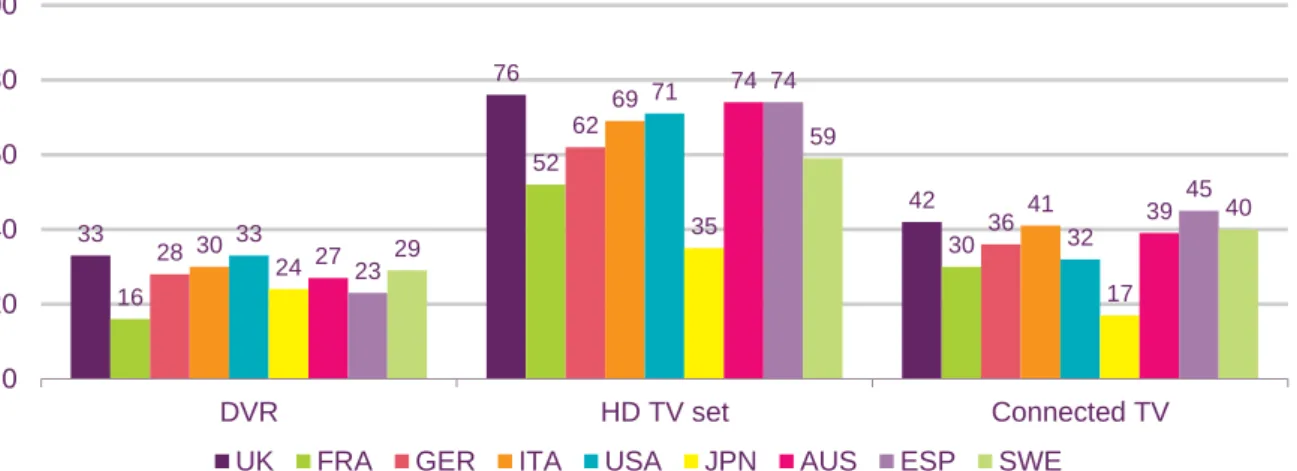
The UK had the highest percentage of households with an HD television set of all the countries included in our research, with 76% of respondents claiming to own one. DVR ownership in 2015 was highest in the UK and US, with 33% of respondents claiming to own a DVR.
Consumers continue to embrace value-added services
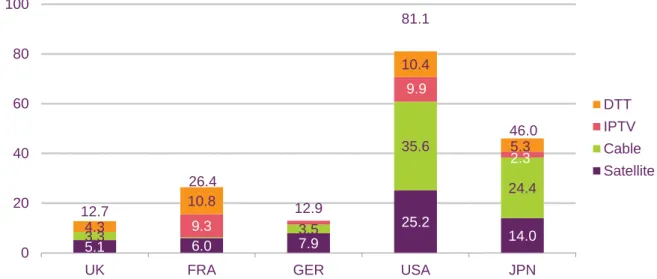
Satellite is the second largest platform for accessing HD services in the US and Japan (25.2 million homes and 14.0 million homes respectively). In the UK, satellite TV offers the most HD services (88 channels), followed by cable (58 channels).
Summary
Television revenues among comparator countries
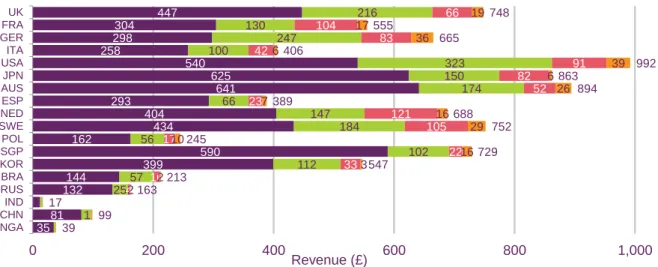
Over the five-year period since 2009, US incomes have grown by an average of 4.0% per year, more than double that of European comparators (1.9%). Television revenue increased in 2014 for every BRIC country and Nigeria, with total revenues up 11.3% year-on-year and more than doubling since 2009 to reach £43 billion.
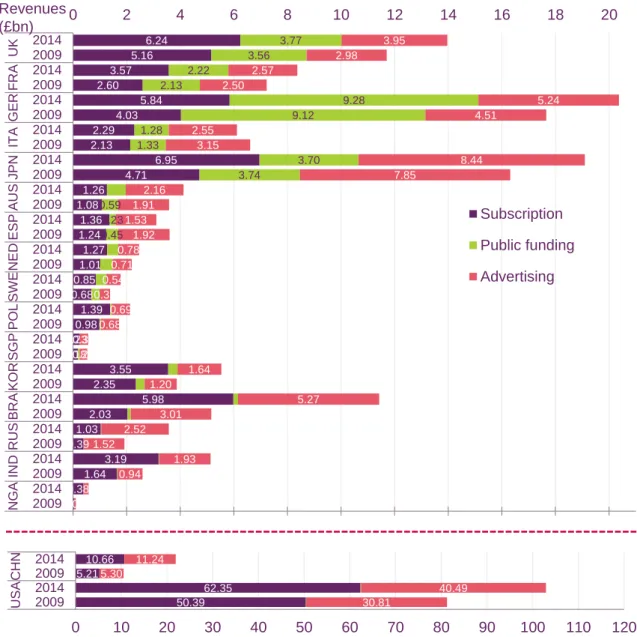
Note: Revenue includes only advertisements, subscriptions and sources of public funding; Figures within the bars represent revenue per capita by source. The rise in UK subscription revenue per capita was greater than per capita advertising revenue in 2014.
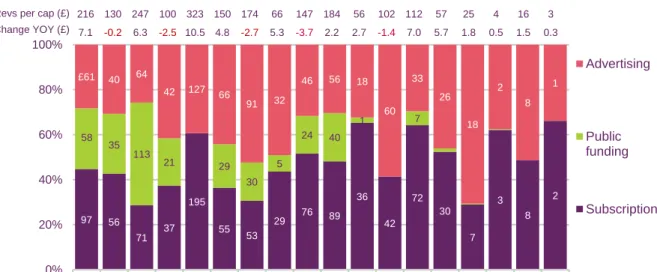
TV licence fee in the UK third highest among comparator countries Public funding, in the form of TV licence fees paid by viewers, is an important element of TV
Varied results for advertising revenue among free-to-view broadcasters Figure 3.17 shows the reported advertising revenues of selected free-to-view TV operators
The biggest year-on-year increase in advertising revenue came from Spain's Mediaset Espana, which grew by 10.9% in 2014, despite falling by 0.3% in the five-year period between 2009 and 2014. This is illustrated by falling advertising revenue for broadcasters programs in 2014, with Italy's Mediaset and Rai recording drops by 3.8% and 4.0%, respectively, and French TF1 and FT by 0.8% and 1.6%, respectively.
Increasing compound annual growth among most pay-TV operators The three pay-TV operators with the highest subscription revenues among our comparator
Average revenue per user (ARPU) can provide insight into the relative performance of pay-TV operators by country. Most of our comparison countries saw an increase in pay-TV ARPU from 2009 and 2014, despite a flattening of subscription numbers over this period.
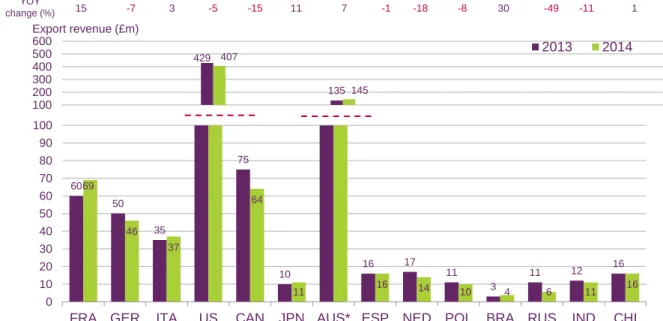
The largest source of television revenue is in the form of completed television content, which generated £689 million in 2014; 5% lower than in 2013. The biggest growth in the year was the sale of digital rights, which increased by 47% compared to 2013.
Summary
Digital television take-up on main sets
Many countries completed digital switchover in 2012 and 2013, and Brazil and Nigeria are the next two comparator countries scheduled to complete digital switchover - in 2018. Singapore is the other comparator country not shown in Figure 3.25; although it has an official switchover deadline of 2020, all TV services have been provided digitally since 2013.
TV platform mix across comparator countries
164 In 2014, digital satellite was the most popular TV platform in seven of the eighteen comparison countries: Great Britain, Germany, Poland, Brazil, Russia, India and Nigeria. Digital satellite is the only other platform to dominate the main television sets in any of the comparison countries: in Nigeria (69%), Brazil (52%) and Poland (50%), while digital cable has a 50% share of the main sets. the most popular platform in Japan.
Pay-TV take-up
Between 2009 and 2014, Brazil and Nigeria recorded the largest average annual increase in pay-TV usage. In Italy, from 2009 to 2014, the number of households with pay TV decreased by an average of 4% each year.
Broadcast television viewing
Viewing in Australia refers to Australian Regional, which is calculated by regions: Queensland, Northern NSW, Southern NSW, Victoria and Tasmania, and the Western Regional. Viewing in Australia refers to Australian Regional, which is calculated for the Queensland, Northern NSW, Southern NSW, Victoria and Tasmania regions and the Western Regional.
Radio and audio 4
Industry metrics and summary
This section provides a global overview and a country-level analysis of radio and audio markets in the 18 comparison countries. The section on key market developments looks at the growth of radio revenues among our comparison countries.
The largest absolute increase in revenue among our European comparators was in Germany (£99.0m), driven by a 3.5% increase in public radio license fees. Germany had the biggest absolute growth in revenue among these countries, with £99m growth driven by £80.6m increase in public radio license fees.
Introduction
Global radio revenue
Revenues among our comparator countries
Public radio license fees contribute the bulk of revenue in Germany, Sweden and the United Kingdom. Public radio license fees make up the bulk of radio revenue in three of these countries: Germany, Sweden and the United Kingdom.
Availability of broadcast radio
The number of radio stations broadcasting in China and Nigeria more than tripled between 2009 and 2014. Of the two comparator countries that recorded a decrease in the number of stations between 2009 and 2014, the largest decrease was in Singapore at -5%, followed by Japan of -2 per cent.
Introduction
Radio set ownership
Across all comparison countries in our consumer surveys, ownership of FM-only radios is higher than ownership of any other type of radio set. The UK had the lowest claimed ownership of FM-only radios among radio listeners, at 60%, significantly lower than all comparator countries.
Regular listening to radio and other audio content
Receiving any radio, only FM, WiFi and satellite radios, Figure 4.17. 122 The results in Figure 4.18 and Figure 4.19 are not comparable due to the different methodologies used in the collection of each set of data.
Audio consumption on a mobile phone
Increased use of audio streaming services among adult mobile phone owners As Figure 4.23 shows, since 2013 there has been an increase in the proportion of adult mobile phone owners who use their mobile phone for audio streaming in all countries in our research. Listening to music I own Listening to the radio Listening to streaming audio Respondents with a mobile phone.