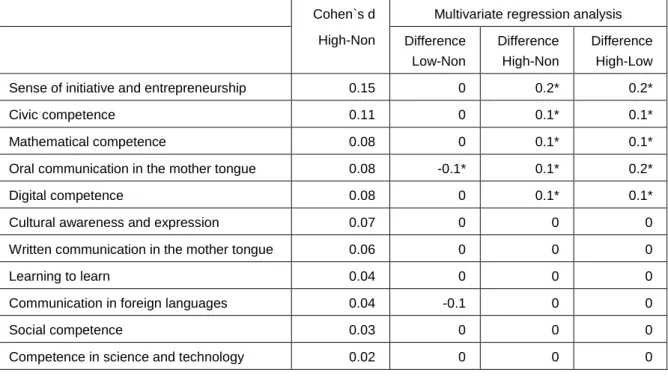
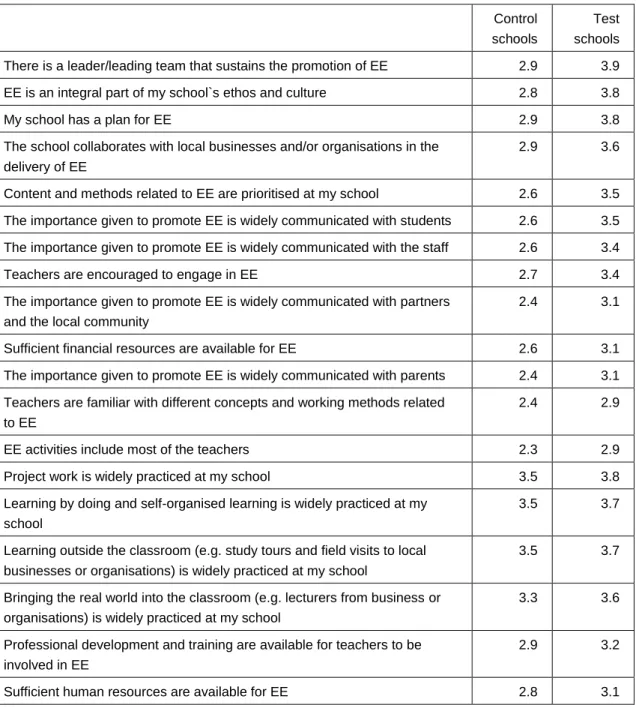
This research report summarizes some of the findings from the research, including findings in the ICEE clusters where relevant to the research. The group with low CP activity was not positively affected on any of the dimensions in the study. After ICEE, most teachers in the test schools (both mini-enterprise teachers and non-mini-enterprise teachers) agreed that their school "had a plan for EE", that "EE was an integral part of the school's ethos and culture", that "there was a leading team that maintained the promotion of EE”, that “the school collaborated with local businesses and/or organizations in the delivery of EE”, and that “content and methods related to EE were a priority”.
Quantitative research
Survey development
16. program), and the online questionnaires were tested by academics, teachers and students in all the countries. These letters explained the main purpose of the study, and they also included contact information for the project leader, including an email address and telephone number.
Research challenges and solutions
The study was also approved by the Ministries of Education in the five countries and by the management of the schools where it took place. A major problem would be the possible existence of a correlation between the factors that led to assignment to the test or control group and the dependent variable (Wooldridge 2006).
Data collection and sample size
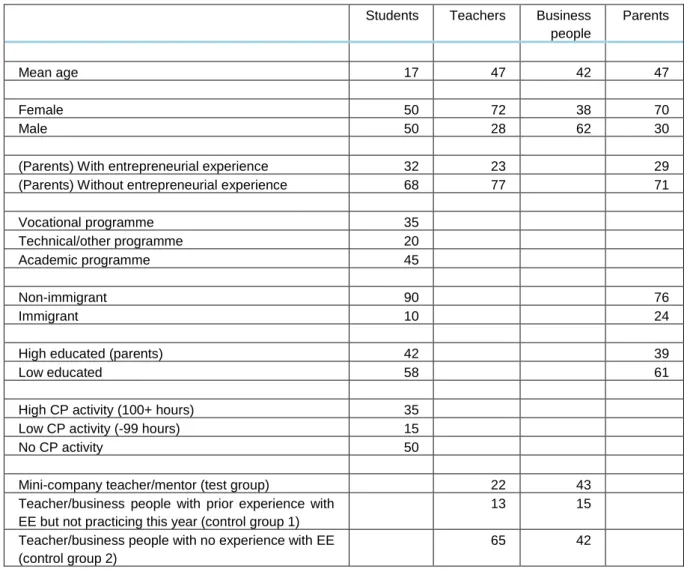
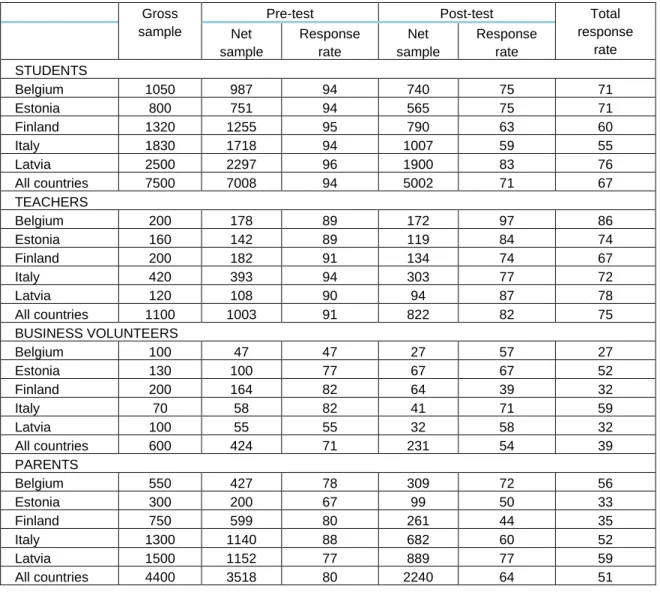
Although we managed to "isolate" the impact of participation in the KP and (to some extent) control for self-selection, estimates of the influence of KP participation will still be uncertain if the distribution of students, teachers, parents in the test group and in the control group were skewed. The response rate at 94% was a credit to the national JA organizations and the school contact persons who managed to include the filling in of questionnaires at schools and during school time. The response rate of 91% was a credit to the national JA organizations and the school contact persons.
We were able to combine the responses of 822 teachers who participated in the pre-test and post-test. For the business people survey, the response rate for the pre-test was good at 71%. We were able to combine the answers of 231 business people who took part in the pre-test and the post-test.
The highest overall response rate was found in Italy (59%), while Finland and Latvia had very low response rates (32%). The response rate for the pretest of the parent survey was very good at 80%.
Qualitative research
The informants
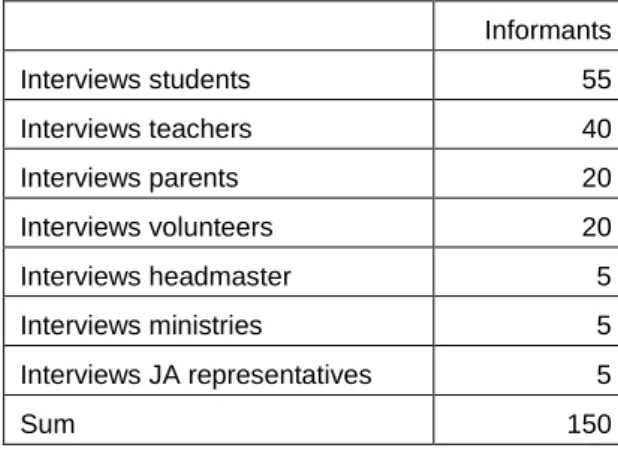
Most excursions took place over three days and consisted of interviews, observations and informal conversations. The beginning of the visits often consisted of a walk through the school building and informal conversations with the school contact person, and sometimes also with the director and the JA coordinator. These observations varied in length and were done to get a sense of where mini-enterprises worked and how the students worked together.
All group interviews were conducted in a separate room (meeting room), and most often within the school premises. There were also five participants in most of the focus group interviews with teachers and we met teachers from different educational programs (vocational, technical, academic) and subjects (economics/business and non-economics/business). Group interviews of mentors and parents were conducted with three to five participants, and we had the opportunity to talk to parents whose sons/daughters were in different mini-companies.
We also conducted individual interviews with several informants: two students with special needs, five principals, five ministry representatives and five JA representatives. It should be noted that informants who participated in this study were selected by the schools (and their contact person).
The interviews
Quantitative data tell us that some students (the minority) do not master it well and do not like this way of working very much. The working language in the interviews was English, the second language of both researchers and informants. In some interviews we used an interpreter, but in others no interpretation was necessary, as the informants spoke English fluently.
During the first excursion we learned that it was an advantage if the interpreter had not only linguistic skills, but also in-depth knowledge of EE. This chapter presents a selection of the findings from the quantitative studies, the qualitative studies and the innovation clusters.
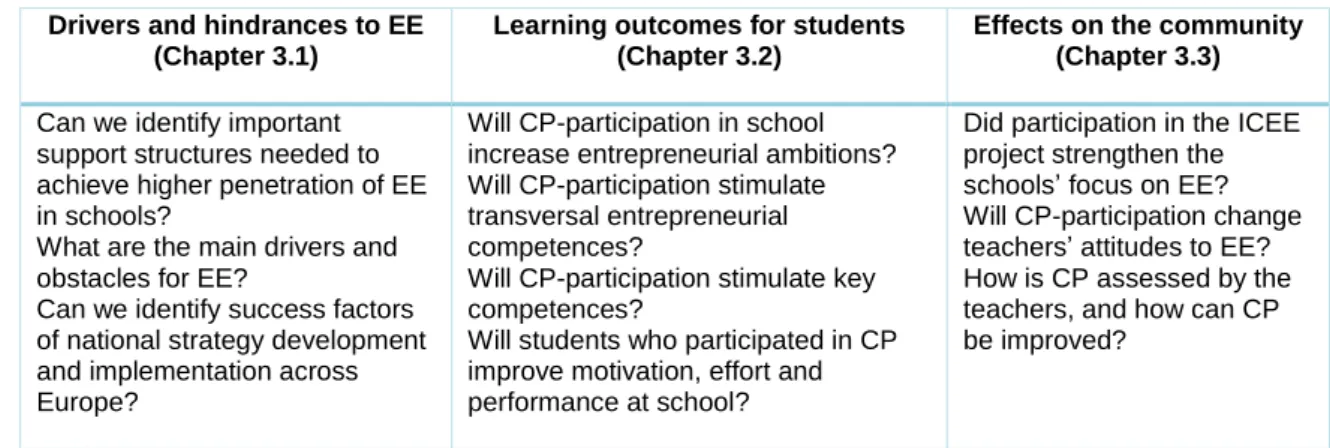
Drivers and hindrances to entrepreneurship education
- Quantitative studies on support structures to increase EE participation
- Quantitative studies on drivers and obstacles for EE
- Qualitative findings about drivers and hindrances
- Drivers and hindrances identified by the working group on National strategies . 31
- Self-employment
- Transversal competences
- Key competences
- Motivation and performance
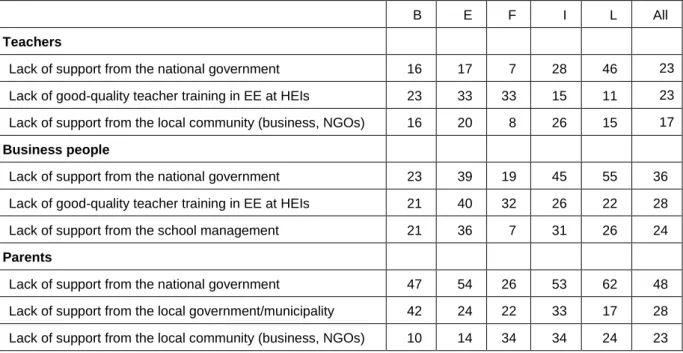
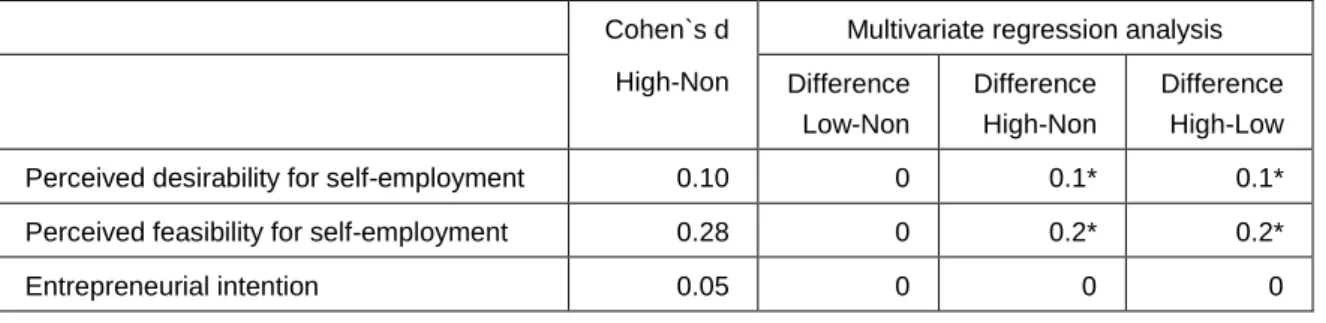
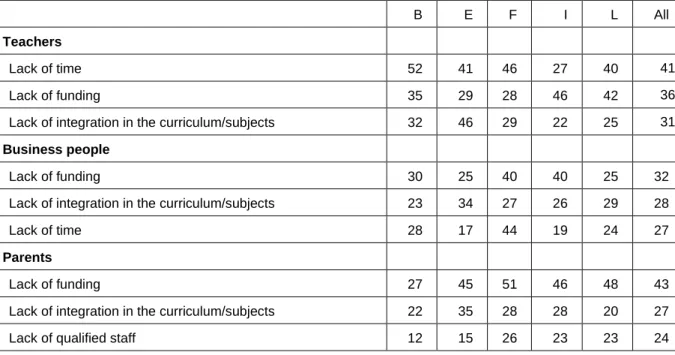
On political support: A majority of business people, half of parents and not many parents agreed that "the government has not made EE a priority" and that "the local government/municipality has not made EE a priority". Binomial logistic regression is suitable for predicting the outcome of a categorical criterion variable that can take only two possible outcomes, and in those cases adjusted odds ratio (OR) values are shown (when OR is close to 1, there is no effect particular; the higher it is above 1 (eg 3), the stronger the positive effect; and the closer to 0, the stronger the negative effect). The business skills indicator was the question: 'Do you have the necessary knowledge and skills to start a new business?' The indicator of career preferences was the question: 'If you could choose between being self-employed and being an employee, which would you prefer?' Compared to those without CP, a significantly higher proportion of those with high CP activity reported having business skills (OR = 1.7, considered small but significant).
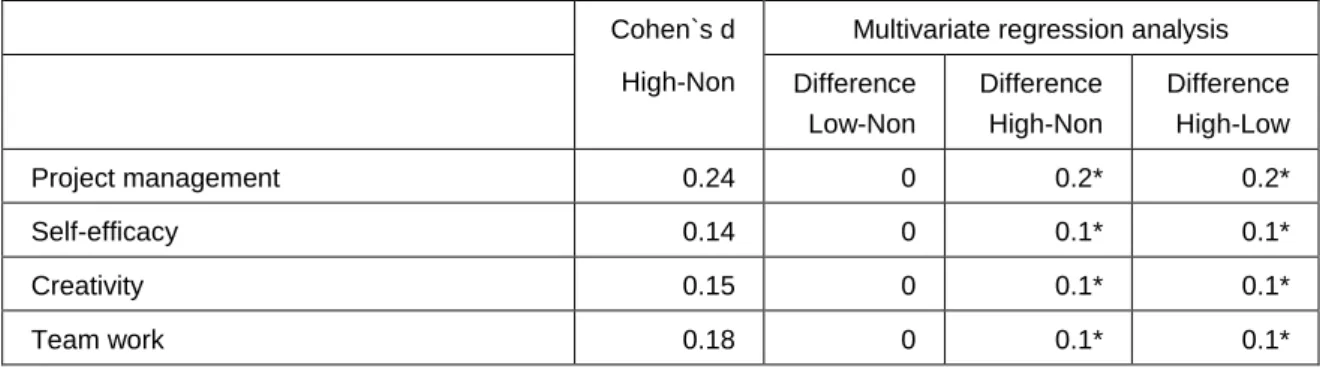
Those with high CP activity had significantly higher scores compared to those with no CP activity or low CP activity in project management. Those with high CP activity had significantly higher scores on perceived self-efficacy compared to those with low CP activity. Those with high CP activity had significantly higher creativity scores compared to those with low CP activity.
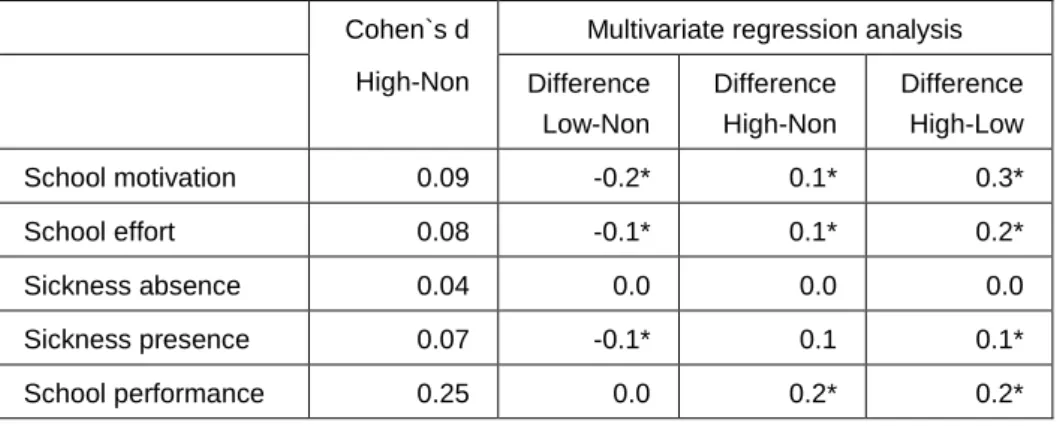
Those with high CP activity had significantly higher scores compared to those with low CP activity on teamwork. Those with high CP activity had significantly higher intrinsic motivation scores compared to those with low CP activity. Those with high CP activity had significantly higher exercise scores compared to those with low CP activity.
But those with low CP activity also had lower scores on exertion compared to those with no CP activity.
Community effects (CP and schools, teachers and business people)
- Entrepreneurship education at the school
- Teachers` attitudes to entrepreneurship education
- Business peoples` attitudes to entrepreneurship education
- Assessment of the JA Company Programme
After ICEE, most teachers at the test schools agreed that their school “has a plan for EE,” that “EE is an integral part of the school's ethos and culture,” and that “there is a plan for EE ”. Furthermore, most teachers in the test schools agreed that “the school collaborates with local companies and/or organizations in delivering EE”, that “content and methods related to EE are prioritised”, that “the importance given to promoting EE is widely recognised”. communicated with staff and with students” and that “teachers are encouraged to participate in EE”. After ICEE, half of the teachers in the test schools agreed that “the importance given to promoting EE is communicated widely with partners and the local community”.
Almost half of the teachers in the test schools agreed that "teachers are familiar with various concepts and working methods related to EE" and that "EE activities involve most teachers". A few teachers in both control and test schools agreed that "there are enough human resources available for EE" and yes. Looking at the means, we find that the three statements with the highest scores are: “EE should focus on methods based on real experiences (eg mini-companies, project work with real companies)”; "EE must have a high priority in vocational education"; and “EE is very important in high school”.
CP teachers more often felt that “EE is very relevant for primary school”, that “EE should focus on methods based on real experience”, that “EE should be a mandatory part of teacher training”, that “teachers who advanced training in EE should be offered”, and that “EE should be embedded as a subject in compulsory education”. This includes: “entrepreneurship must be embedded as an explicit goal in the curricula of compulsory education”; “EE should be a high priority in general/academic education”; “EE should be embedded as.
Innovation Clusters
Research reports
The study consisted of a three-day field study in five different schools in five countries: Belgium, Estonia, Finland, Italy and Latvia. The second research paper was Johansen, Aae, Elder and Valle (2017): A Multinational Study of Mini-Company Experiences. Researcher Memon presented empirical findings from the qualitative study at the ICEE project in 2017.
The research consisted of a 15-day field study in five schools in five countries; Belgium, Estonia, Finland, Italy and Latvia. The field research was conducted from January to May 2017 and focused on students and teachers and their experiences with the JA Company Program (CP). We had the opportunity to select a few areas that we wanted to learn more about, and they were: teachers' reflections on their role as teachers in mini-companies, whether participation in mini-companies can increase students' self-efficacy, and whether mini-businesses are a suitable method for students with special needs.
Two research memos based on the quantitative studies were presented but not published during the project. The second memo was a summary of results from the entire sample presented at the closing conference in ICEE in Tallinn in November 2017.
Key messages
Participation in a mini-company improves self-efficacy and school performance of students in special education. The business sector wants to be involved in education and schools want to collaborate with businesses: Let's make it happen. Sick and still at school: An empirical study of the presence of illness among Norwegian secondary school students.