Executive Summary Introduction URBAN-EU-CHINA Project Cities working together EU-China Urbanization Partnership &. Matching of cities in URBAN-EU-CHINA Selection criteria Matching of European and Chinese cities Cooperation between European and Chinese cities. URBAN-EU-CHINA is a Horizon 2020 project aimed at creating an EU-China innovation platform for sustainable urbanisation.
URBAN-EU-CHINA is working on a systematic approach that will help cities, industry and academia from Europe and China to connect and create new projects.
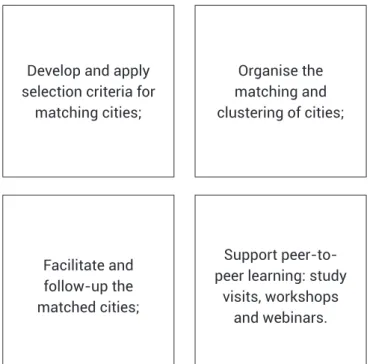
CITIES WORkING
President of the European Commission José Manuel Barroso signed a joint declaration on the partnership between the EU and China on urbanization3. The EU-China Policy Dialogues Support Facility4 (PDSF) was an initiative co-financed by the European Union and China to facilitate and support current and future implementation of policy dialogues between the EU and China on a wide range of key sectors and issues, with the overall objective of strengthen the strategic relations between the EU and China. The second phase of the EU-China Policy Dialogue Support Facility (PDSF II) started in March 2012 and ran for 4 years.
At the end of 2011, in Chengdu and within the framework of the 3rd ICT Dialogue Meeting between the Ministry of Industry and Information Technology (MIIT) and the Directorate General of Information Society and Media of the European Commission (now DG CONNECT) , Deputy Minister Yang Xueshan and Deputy Director General Zoran Stančič together decided to develop "Green Smart City" cooperation, to create an expert framework for promoting EU-China Smart Cities cooperation, to select pilot cities from China and the EU and to create a group of technical experts to carry out related research and cooperation.
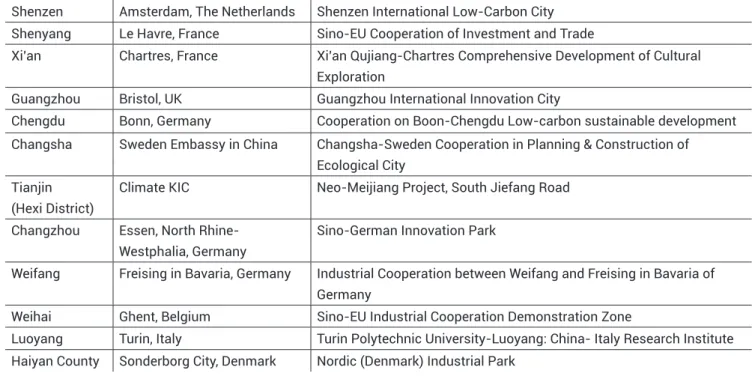
MATCHING CITIEs IN
URBAN- EU-CHINA
How to make a match that will maximize the possibility of successful cooperation and the creation of joint projects between the cities and their triple helix stakeholders. URBAN-EU-CHINA proposes a set of selection criteria that cities or organizations belonging to those cities' triple helix ecosystems can use to determine a good matching city to work with. Likewise, the set of criteria can be used as a road map of steps to be taken by cities (or organizations / entities) from Europe or China when embarking on EU-China cooperation.
At least one of the two cities wants to host a joint sustainable urban development project. The city's triple helix ecosystem has the critical mass (alone or through collaborations) to achieve and pursue desired goals and objectives; Both cities and their triple helix ecosystems share common goals and objectives in specific areas of sustainable urban development.
These goals and objectives are part of the research and innovation agenda that URBAN-BE-CHINA is developing. At least one of the two cities can be used for reference and learning in sustainable urban development. In addition, a small number of European and Chinese cities have already expressed their interest in using URBAN-EU-CHINA to find suitable cities and develop joint projects.
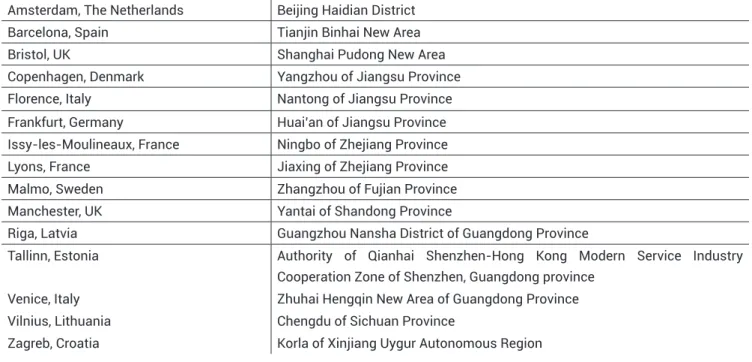
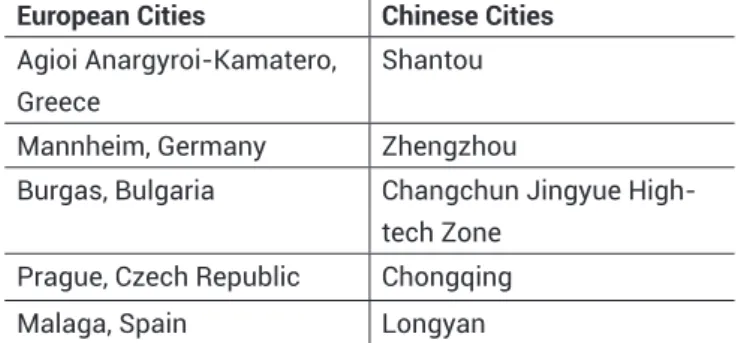
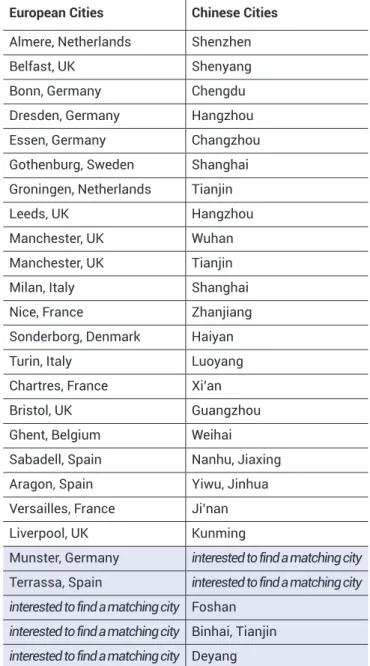
Thirteen cities responded and provided evidence of what they are doing, planning or willing to do regarding the EU-China Urbanization Partnership. Munster, Germany interested in finding a matching city Terrassa, Spain interested in finding a matching city interested in finding a matching city Foshan.
COOPERATION BETWEEN
On the one hand, this will help cities that are already working in EU-China cooperation to improve and bring their achievements. The 'triple helix' model of university, industry and local government relations has become one of the most popular innovation and collaboration models over the last two decades. Sustainability of cooperation: One of the usual challenges in EU-China cooperation is the lengthy discussions and exchanges required before a new project or activity can start.
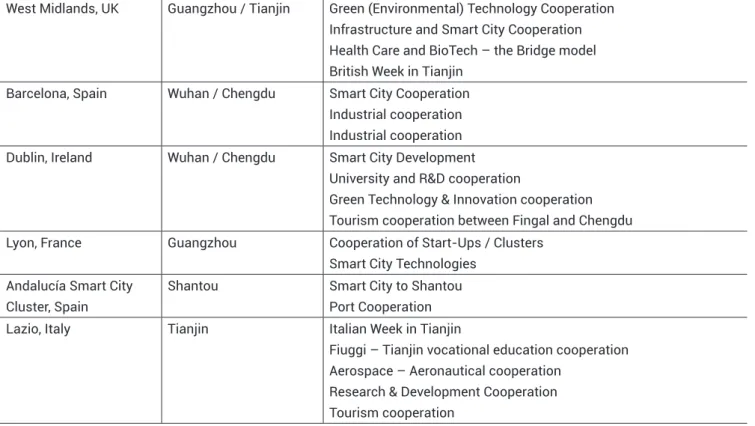
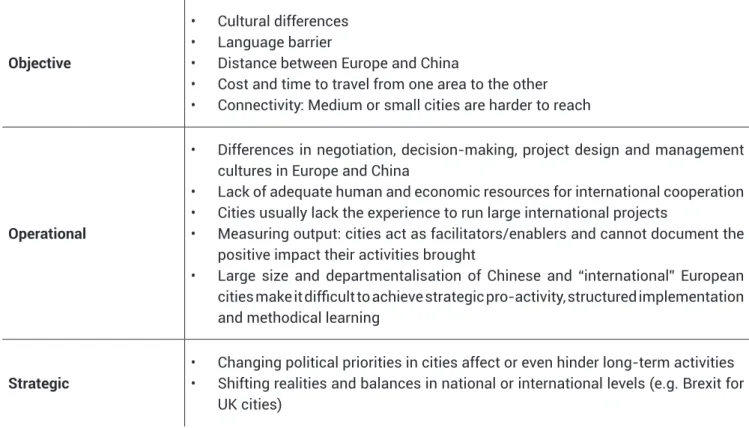
Milan and Shanghai: besides the municipality, many Milanese stakeholders are involved in EU-China activities: academic (such as Politecnico di Milano), associations (such as Fondazione Italia-Cina), business world (e.g. Milan Chamber of Commerce), but also citizens, who are increasingly interested in Chinese culture and actively participate in various Italian-Chinese initiatives;. Nice and Zhanjiang: Both cities work with different stakeholders as part of their cooperation. Some of them are objective (e.g. the distance between Europe and China), some may be inherent to the structure of cities (e.g. insufficient staff for international cooperation), and some may be the result of a combination of other reasons (e.g. citizens' reactions to long-term cooperation with high costs).
Furthermore, while dimensions (1) and (2) imply a rather one-way relationship, dimensions (3) and (4) have benefits for both sides of the collaboration. Some real-life examples of the priorities, goals and expectations that cities have for their EU-China cooperation strategies and activities can shed some light on these ideas. It also aims to attract significant investment in the city's infrastructure and business opportunities with Chinese companies.
The Office of European and International Affairs continuously examines the coherence of the international measures taken and offers ongoing consultation. These activities are collected once a year in the "Dresdner Europabericht" (Dresden European Report) and submitted to the city council for examination. Usually the standard reporting (annual or more frequent) from the department for international cooperation is used.
They differ in terms of the number of cities evaluated and how performance is measured.
EUROPEAN CHINEsE CITIEsANd
The objective of the "Bon-Chengdu Partnership for Sustainable Low-Carbon Development" was to strengthen cooperation in low-carbon development and promote and accelerate a low-carbon development path in the two cities. Furthermore, the partnership aims to provide a framework to share relevant knowledge, experience and good practices on effective and efficient low-carbon city strategies. The program contributed to the goal of creating a low carbon partnership by initiating and supporting.
Mutual learning and sharing of experience and expertise on low carbon development through a dialogue program and expert workshops in Bonn and Chengdu;. Implementation of small-scale demonstration projects for low carbon development by the initiative and participating partner organizations. The dialogue forum took place in January and October 2013 and created the basis to identify the main challenges and opportunities for cooperation facing the two cities in various areas of low carbon development.
In March 2017, Koschany + Zimmer Architekten KZA and China Design Group (CDG) from the city of Nanjing founded the joint venture SINO.GERMAN.DESIGN.STUDIO. The cooperation between them is a result of the China-EU Urbanization Partnership, which was agreed in 2012 and aims to provide solutions for the rapid growth of Chinese cities. The laboratory will support and strengthen cooperation on urbanization between China and the EU and explore solutions to the challenges faced by the partners.
It falls under the work of the China-EU Urbanization Partnership Management Committee, which consists of the China National Development & Reform Commission and the European Commission. From the Chinese side, include Zhanjiang City, Guangdong Province, Zhanjiang and Guangzhou Sun Yat Sen University and Zhanjiang Tourism Bureau.
PEER- TO-PEER
An invitation to a peer city to participate in projects where joint learning can be achieved (as an observer city, a follower city, a learning city, etc.). Specific trainings on how cooperation between Europe and China can be designed, managed and implemented; addressing cultural, economic and political differences and barriers. Organization of academic or business events (e.g. political conferences, scientific conferences, fairs, etc.) in thematic areas of common interest and cooperation.
According to cooperation agreements, Zhejiang University cooperates with the University of Leeds and Zhejiang University of Technology cooperates with Leeds Beckett University. Queens University Belfast and China Medical University have jointly built a pharmaceutical campus to carry out income-generating activities. 19 Source: China Europe Urbanization Cooperation Partnership Essen – Changzhou, Objectives and Results, City of Essen (internal report).
20 Source: China Europe Urbanization Cooperation Partnership Essen – Changzhou, Objectives and results, city of Essen (internal report).
WHERE sHOULd A
What are the positive results that the city expects from the cooperation? What are the areas of cooperation with which the city wants or can cooperate. Identify a comparable city and start the exchange: Matching cities for international cooperation activities should ideally be based on criteria that maximize the compatibility of cities and their mutual benefit.
As evidenced by the material collected from European and Chinese cities, all important projects between European and Chinese cities involve local universities and/or local industry and/or civil society and the city's cultural organizations. In July 2017, leaders from across the public and private sectors have come together to officially launch the Greater Manchester (GM) Internationalization Strategy, a three-year framework for action aimed at taking the city-region global. The city's strong research and higher education ecosystem works closely with the city administration and shares a large part of its efforts when it comes to international cooperation.
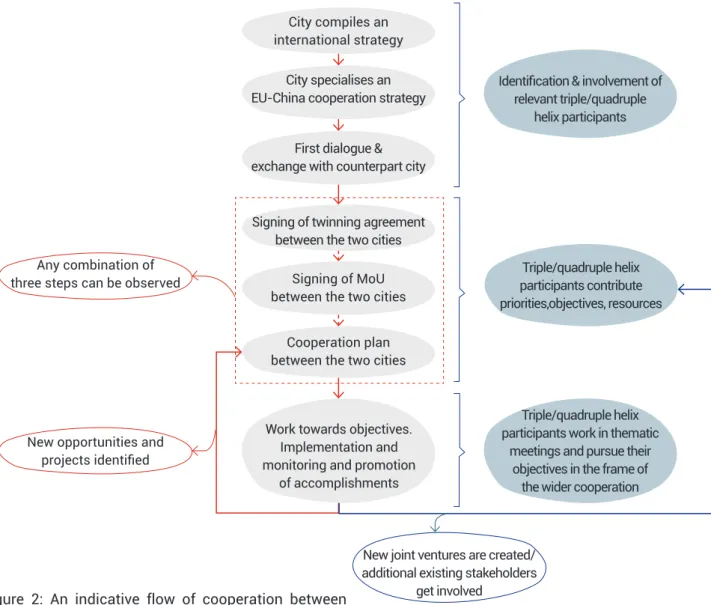
The city of Groningen has an international cooperation strategy29, which defines priorities, strengths and opportunities, as well as the city's four helix scheme. Agreement31 on the establishment of the University of Groningen Yantai between the China Agricultural University, the University of Groningen and the city of Yantai;. A memorandum of understanding is a common and recommended tool for signaling the beginning of collaboration between two or more stakeholders.
A collaboration plan describes the results of this collaboration and, more importantly, puts a date next to each of the deliverables or results. A closing section on the operationalization of the plan, possible future meetings and activities between the stakeholders (next steps) and any disclaimers or caveats that should be included in the plan.