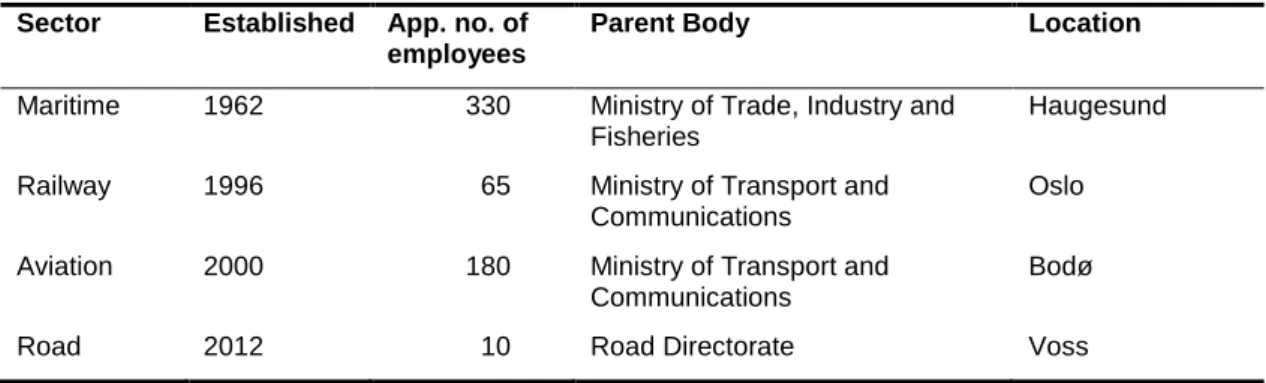
Following the establishment of the Norwegian Road Inspection Authority in 2012, all transport branches have some form of inspectorate. Following the establishment of the Norwegian Road Safety Authority in 2012, all transport branches now have some form of safety inspectorate.

Background
Hypotheses and theoretical perspectives
It is also possible that reorganization may encourage the development of a better safety culture, which may also lead to more effective safety policies. The establishment of security inspectorates can be seen as an example of the more comprehensive phenomenon of public sector agency.
Methodology
The existence of safety inspectorates – and the questions of whether they should be merged – can also be seen as part of an ongoing debate about whether safety is best seen as a separate discipline, or whether the sector knowledge is more fundamental, and how to achieve it. an optimal combination of the two. Authority (at their bequest), the interview guide was used as the basis for an email interview, which did not reflect the opinions of any individual, but of the organization as a whole.
The introduction of transport sector inspectorates
The report concluded with a recommendation to create a separate, cross-sectoral transport regulator, citing a similar solution. Joint regulatory developments could lead to more harmonized rules within the framework of international obligations.”.
Further evolution and cross-sectorial perspectives
The plan also emphasized that "[i]n all parts of the transport sector, the Government considers it important to develop a safety culture and a management philosophy that prioritizes safety", the importance of "safety expertise" and "safety management" being highlighted. , and there is greater emphasis on system supervision. In the national transport plan, the government's commitment to vision zero was confirmed, and it was also emphasized that "the government will pursue an integrated transport policy where separate modes of transport are seen in relation to each other".
The establishment of a road inspectorate
Communications advised the establishment of a road regulatory authority as part of the Norwegian Road Administration (NPRA). The supervisory authority should be independent from the Road Directorate, as is the case with supervision in other sectors (Teknologisk Ukeblad, 8 March 2012).
Summary
He commented to the press that the Norwegian Road Safety Authority should also have the authority to close unsafe roads as a means of improving road standards. The National Transport Plan 2014-2023 opens up the possibility that the Norwegian Road Safety Authority's competence can be expanded, so that county and municipal roads are also subject to supervision.
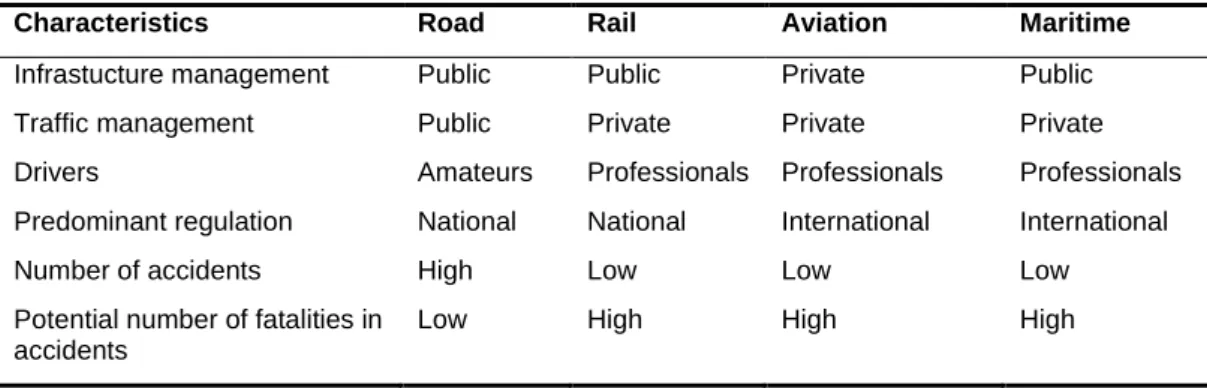
Sectorial differences at a glance
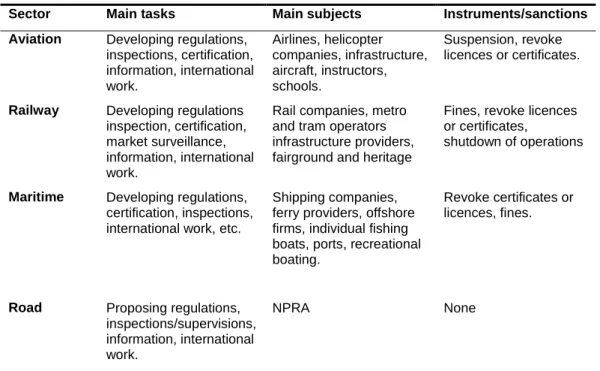
The Norwegian Railway Authority
Presumably this was added because of considerable difficulties of co-operation between the NRA and the National Railway Administration in the Authority's early years (Hommen, 2003). Management meetings: formal meeting where the management of a railway organization gives an account of their safety work.
The Civil Aviation Authority
The Authority's inspection work is based on systemic assessments, supplemented by physical inspections of aircraft. If Authority requirements are not properly met, the CAA has access to a number of sanctions, such as suspension or seizure of licenses, certificates or authorizations.
The Norwegian Maritime Authority
The annual award letters are slightly more detailed than those in the rail sector and specify particular priorities for the coming year. There are many types of inspections in the sector, many of them regulated through international agreements such as the International Convention for the Safety of Life at Sea (SOLAS) (which includes the International Safety Management Code (ISM) and the International Ship and Port Facility Security Code (ISPS) ), the Maritime Labor Convention (MLC) and the International Convention on Standards of Training, Certification and Watchkeeping for Seafarers (STCW).
The Norwegian Road Supervisory Authority
It is also very clearly stated that inspections and reviews must be risk and system based, and the letters expressly focus on improving safety culture as one of the defining tasks of the authority. The road supervision authority also develops a plan for the follow-up of the supervisory findings and determines how the case will be closed, and whether another supervision should be carried out at a later date.
Summary: Sectorial Differences
Various degrees of autonomy
Agencification
A central feature of the regulatory state is that the performance of governmental functions is decoupled from a political context. We are very aware that the Ministry of Transport and Communications should not make assessments when it comes to security, that is someone else's task.
International context
The Norwegian Maritime Authority is specifically required in the separation letters from the Ministry of Trade, Industry and Fisheries to participate in international meetings, such as the IMO, ILO, EU and the Paris Memorandum of Understanding (MoU). The European Railway Agency (ERA) sets the standards for European railways in the form of the ERA Technical Specifications for Interoperability.
Summary
In their capacity as bodies responsible for following up on the recommendations from the Accident Commission (HAB, see box), all the inspectorates (except the Norwegian Road Safety Authority, which does not have this responsibility) also relate indirectly to an international context, such as e.g. that.
From technical to system– and risk based inspections
- Developments in the maritime sector
- Clients’ experiences with the Civil Aviation Authority
- Interactions between the Railway Authority and operators
- Inspections in the road sector
For example, in the 2012 audit, the authority believed [we] lacked a plan to achieve our goals, whereas [we] believed we had a plan, just not a plan that was consistent with the authority's proposal. The authority has therefore started a study on the need for safety regulations for roads, as is the case with the railway sector.
National and international regulations
Despite the general approach to international regulations, the Norwegian authority exceeds them in some cases. The interpretation of the regulations by the authority in some cases is quite different from the interpretation in Sweden and Denmark.
Summary
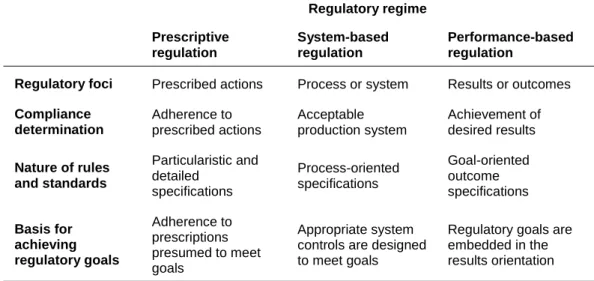
The international rules were described by the Authority as being descriptive, and this potentially inhibits innovation and development. However, there are also problems associated with only having target-based requirements – it can make it difficult to verify compliance.
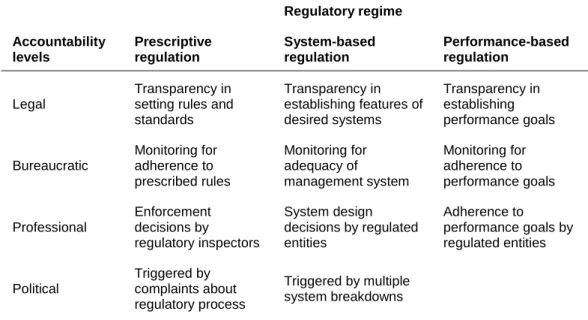
Changing structures of accountability
In the maritime sector (as well as in the railway sector), several actors reported that there was initially some confusion about the responsibility of the inspection. None of the operators interviewed expressed the expectation that inspection after inspections should be responsible.
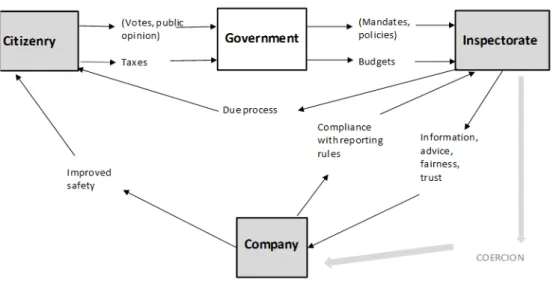
Collaboration or control?
Criticism of the Authority tended to focus on a lack of flexibility and an exaggerated emphasis on formal requirements. Close contact can be an advantage and a disadvantage - the relationship improves, but it should be a little formal, so it should not be too cute.
Integration and separation
In the road sector, the only organizational restructuring that has taken place is the creation of the Supervisory Authority. We have therefore considered that a common basis could be fruitful in the long term."
Borders
In the oil sector, there is cooperation between the industry and the authorities, where they agree on common challenges. In the maritime sector, such demarcation problems mainly concerned the intersections between the Authority and the Norwegian Coastal Administration, which also exercise some control.
Summary
Finances and Safety
For example, better financial frameworks could lead to two people instead of one person on the smallest boats – that is much safer.” For many of the actors, security is also an important factor in their financial well-being – the media has become interested in the issue of security and potential media coverage of security flaws has often been cited as a possible result of reports – as well as a reason why reports should be worded differently, so as not to suggest in a misleading way that the overall level of safety was low (cf. chapter 6.2).
Summary
Despite the fact that we have the highest accident rate of all professions, we have not gained acceptance for this view. Safety is not only the result of a technical device, but also of how your working day is - so other frameworks are very important.
Safety Culture
Thus, the safety culture in the operating organizations will partly depend on the quality of the work of the inspectorates. Measuring safety culture means ] you can follow the development of the organization's experience.
Barriers to safety improvement
In the railway sector, infrastructural problems were perceived as the dominant barrier to improving safety, and also as determining the companies' own safety work. Overall, the main challenges for safety work in the railway sector were not perceived as being under the control of the Railway Authority.
Summary
In the maritime sector, the Authority sought to document that the measures were financially sound and anticipated that the lack of qualified personnel could become a challenge. In the road sector, many effective measures cannot be introduced because they are considered a threat to individual autonomy and privacy.
Reorganisations and experiences in Sweden and Finland
The Swedish Transport Agency
The merger of the Swedish Transport Inspectorates into one Swedish Transport Agency is currently being evaluated. The doubts reported in the preliminary evaluation report may be due to the separation between inspection services and their previous ones.
The Finnish Transport Agency
According to the interviewee, agencies initially had mixed responses to the merger – some supported the merger, others opposed it. They also objected to the decentralization involved, for example the ship registry in Rovaniemi – as they were concerned about the effects on customer service.
The possibility of a merger between Norwegian transport inspectorates
In the road sector, the Directorate for Public Roads acknowledged the advantages of considering all transport sectors as a whole, but also that the Norwegian National Transport Plan made the need for unification less urgent in Norway. In conclusion, it appears that many of the objections to a merger found in the Norwegian transport sector echo those present in Sweden and Finland before the merger.
Potentials for improvement
Expertise
It should be noted that the situations before the mergers in Sweden and Finland also differed. The effects of cross-sectoral learning, which was seen as a major advantage of the reorganizations in Sweden and Finland, may also be more limited in Norway, as the inspectorates have been functioning.
Integrated approach
They could have been better at pointing out to the authorities when things are bad, such as the lack of separate roads. The Norwegian Railway Agency could have been more active in relation to the authorities, and pointed out how many fewer accidents there are in Bergen (ten times more in Oslo, but the difference is smaller when it comes to injuries), the individual companies do not have this overview.
Practicalities and bureaucracy
It should be noted, however, that the House has been given a number of new tasks during the period of staff expansion. Others would have preferred access to the company's own vessels in the Authority's database rather than two separate systems.
Summary
In the maritime sector, it was pointed out that the ISM Code resulted in a lot of paperwork and that the extensive documentation requirements for Norwegian vessels sailing to and from oil platforms involved additional work that could affect safety. Another interviewee would like to see more accessible instructions on the Internet for people who had difficulty understanding the regulations.
Changes in the regulatory regime
How do inspectorates frame safety work?
The distance between inspectorates and operators was generally seen to have narrowed, benefiting smoother interaction and communication.
Do inspectorates clarify the responsibility of system designers?
It was also mentioned that external factors, such as media or political attention, could be influential, rather than security concerns. This common definition is currently not explicit and most probably appears as a reflection of the political willingness to invest in security in different sectors.
What are the main barriers and potentials?
In the maritime sector, the Authority sought to document that the measures were financially sound and predicted that the lack of qualified personnel could become a future challenge. When it came to potentials for improving inspectorates, operators in the maritime and rail sectors were concerned about sector-specific expertise in inspectorates.
Do safety inspectorates improve safety?
Award letter from the Ministry of Transport and Communications to the Norwegian Road Authority. http://www.vegtilsynet.com/Om+oss/Tildelingsbrev. Cecilie Fjordbakk Face to face Ministry of Transport and Communications Erik Reierstøl-Johnsen Face to face The Norwegian Railway Board.