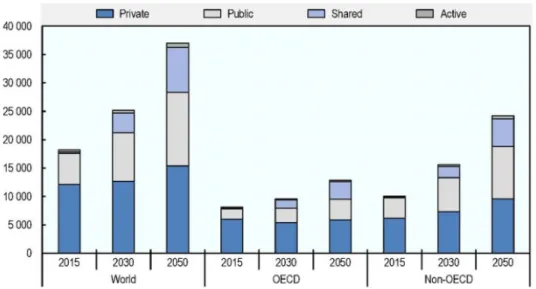
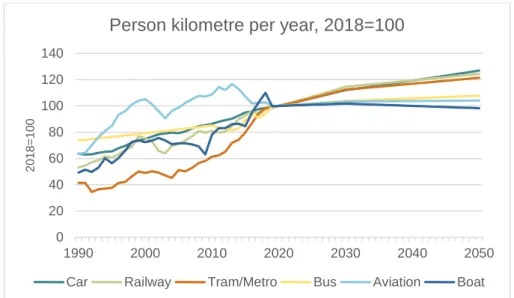
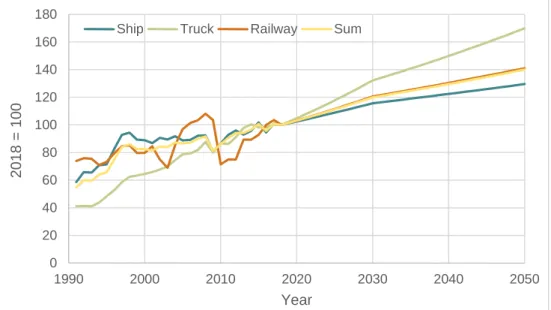
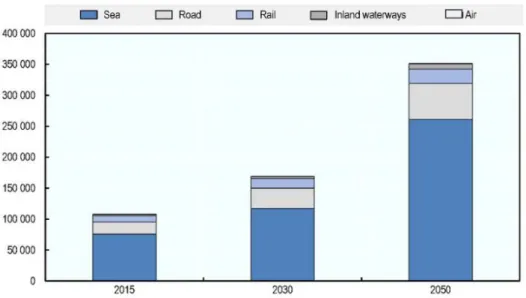
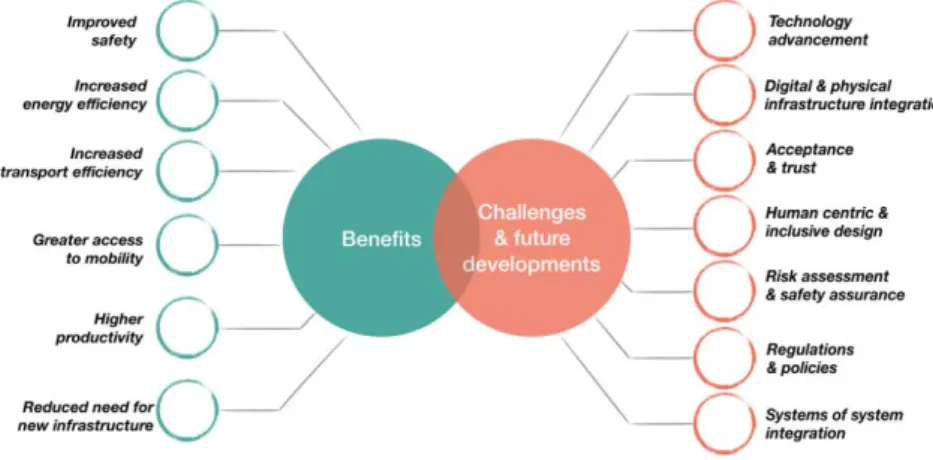
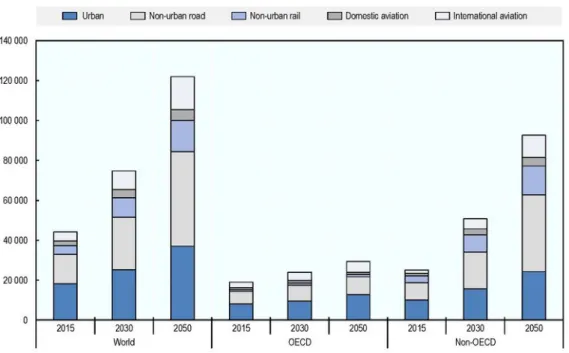
Traffic demand is expected to increase significantly in the coming decades for both passenger and freight traffic. Global demand for passenger and freight transport is expected to triple between 2015 and 2050.
Short description of the DIGMOB project
Background and trends in transport
This chapter will give a brief overview of possible development trends of future transport based on different scenarios for global and national development. How the disruptive developments (especially digitization) that will influence and transform future transport will be expanded in more detail in chapter 4, 5 and 6.
Future transport demands
Transport demand is expected to grow significantly in the next decades for both passenger and freight transport (KPMG 2018, IFT 2019). This will change the urban mobility pattern, shared mobility and public transport are expected to account for larger parts of the increasing demand for passenger transport (see figure 2.2). The freight transport sector has been characterized by growth and structural changes in recent decades and projections indicate that the demand for freight transport will continue to increase.
The main part of the total transport of goods is by sea, followed by road, while the railway makes up the smallest part. In the period 2018-2050, the strongest growth for freight transport is expected for road transport, which will more than double, followed by rail, which will grow by 44% and maritime transport by 30%.
Drivers for disruptive changes
Pathways of transport transitions
Geels and Schot (2007) identify four different transition pathways that differ in terms of landscape pressure and level of niche development. The transformation path characterizes incremental changes and occurs when there is moderate pressure from the landscape and when niche innovations are not sufficiently developed. The reconfiguration path is a result of massive landscape pressure and adoption of more developed niche innovations that gradually transform the existing regime into a new regime architecture.
The Substitution Path arises when there is tremendous landscape pressure and when niche innovations are fully matured and the result is a radical change of the existing regime. In fact, most countries now have detailed plans for further digitization of the transport sector.
Policies and initiatives
Previous versions allowed public data owners to charge more than the marginal cost of their data, and in some cases private public monopolies were created as a result of public outsourcing and procurement. It is expected that more resources will need to be spent on public digital infrastructure to fulfill the directive's ambitions. Although there will still be upfront development costs for government agencies, it is believed that increased tax revenue from new services developed as a result of improved access to data will far outweigh the initial costs.
Data
Band A is about data in context, the suitability of a particular data set to answer a particular question or be subjected to a particular analysis. A task could be "Use the data to predict a user preference" or "Use this data to prove the efficacy of a drug". As a final observation, data tends to implicitly increase the amount of data (Yoo et al. 2010).
Data analytics, data interpretations, and data-driven algorithms tend to increase the total amount of data over time. The more data available about demand changes, the better the fine-tuning of the algorithm.
Data and freight
While logistics and telematics services aimed at car owners may seem niche, the multi-contextual nature of data reuse and digital innovation is leading to new types of connections between previously unrelated industries. As of 2014, some OEMs (GM, Volvo, Audi) are pursuing car trunk delivery services where packages can be delivered to cars rather than homes during business hours. They are currently looking for partnerships with specific logistics partners, but it remains to be seen if and how these business models will scale.
Analytics
Second, the same kind of problem is being addressed by a number of companies by installing smart locks in customers' homes. Regardless of the type of analysis performed, data access and analytics capabilities are highly interdependent and often join forces as two key building blocks of digital platforms (Gregory et al. 2020).
Digital Platforms and ecosystems
Thus, digital platform ecosystems refer to a platform as well as its network of complementors that produce complements in the form of data or services to enhance the perceived value of the platform. Similarly, standards define the technical specifications of the platform and ensure compatibility between architectural components. A data marketplace, to make available all types of data, according to licensing models and pricing and access rights determined by the data provider.
This offers NDW the opportunity to issue tenders that are fully geared to the wishes of the relevant road authority. A final option is to maintain a zone over certain segments or all users of the road infrastructure.
Automation
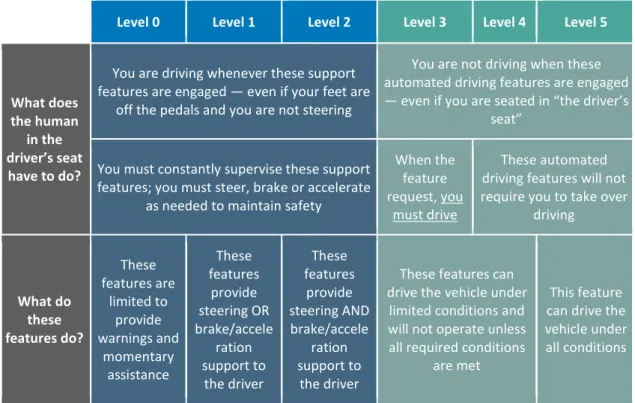
Most AVs still require a safety driver in the vehicle to ensure safety, due to a combination of ADS restrictions and legal restrictions. The size of the platoon is expected to grow and only the first vehicle in the platoon will need a driver in the future. Digital and physical infrastructure: It is widely believed that CAVs should be able to handle existing roads without major infrastructure changes.
They must interact safely, efficiently and seamlessly with other entities in the traffic system. The introduction of CAV into the system can therefore have a significant effect on the entire traffic system and its function in society.
Concluding remarks
Transport system of systems: Transport systems include many stakeholders and components, where CAV and its corresponding stakeholders represent the most important parties. With increasing vehicle and infrastructure connectivity, emerging service innovation and collaboration, the transportation system is transforming from many hidden systems into a system of systems (SoS) with independent yet interconnected and interdependent systems. The transport system is strongly affected by global megatrends such as urbanisation, aging societies and digitalisation (Loos et al 2020).
Changes in urban and demographic structures lead in the next round to changes in transport demand. Digitization plays an important role in meeting the new demand for traffic, but also affects working life and consumer preferences, which is reflected in the growth of e-work and e-commerce in recent years.
Urbanisation
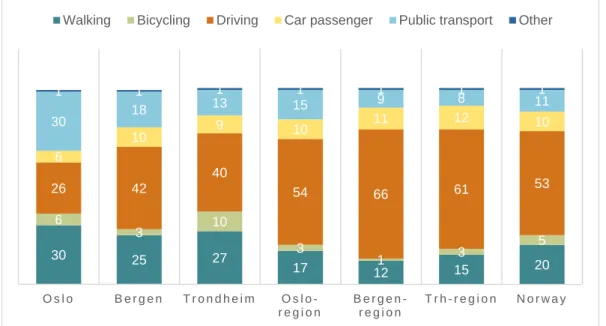
An increasing share of the world's population lives in cities, and the population is also aging. If the current travel pattern persists in the coming years, this means that further urbanization will result in more driving (travel in km). In the context of a 3.4% increase in artificial land cover in Europe between 2000 and 2006, urban and regional planners are increasingly considering 50 years of car-based urban sprawl for its associated externalities (land use, energy, traffic congestion ) with proposed alternatives such as urban intensification, compact development, transit-oriented development (TOD) and, to some extent, smart cities.
The concept of a smart city combines information and communication technology (ICT) and numerous electronic devices (sensors, etc.) to optimize urban traffic. This will lead to increased demand for public transport and a greater share of walking and cycling in the inner city, and is likely to lead to more driving and increased traffic if the trend towards stronger growth in the urban fringes continues.
Demographical change
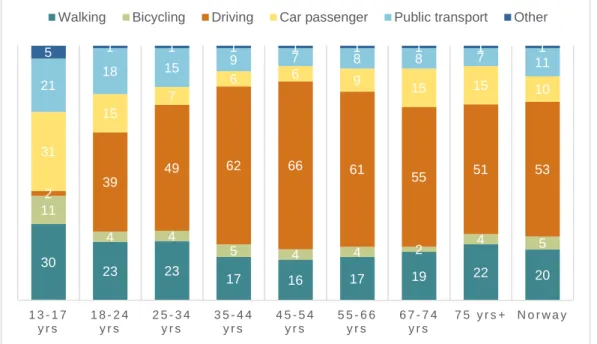
People aged 67-74 are born in the post-war period, who constitute the beginning of the wave of the elderly. 2020 marked 75 years since the end of World War II, and historically a large number of births took place in the years following the war. Therefore, the 75+ age group will grow in the coming years and these seniors will probably have a different travel pattern than previous groups.
All this indicates that there will be more elderly drivers on the road in the coming years. Many will probably move to inner city-regions to find more spacious and cheaper homes, or to live in places they consider more child-friendly.
Changes in work, industries and consumer preferences
Increased use of teleworking and e-commerce can lead to changes in consumer behavior and to changes in the demand for passenger and freight transport. Intuitively, one would expect that increased use of telecommuting and home offices should reduce demand for passenger transport, and that expanded use of e-commerce should increase demand for freight transport. These are mostly services based on digital delivery, where there is less need for human interaction, whereas the growth of platform services based on physical delivery (both professional and personal services) could equally increase the demand for both passenger and freight transport.
However, how this may affect transport demand in the next round is not easy to predict. Digitization can create new forms of work and change markets and industries, and this will undoubtedly have an impact on demand for both passenger and freight transport.
Introduction
Transport and exposures to climate change
(ITS) systems are important to avoid traffic jams and promote the use of intermodal transport (road, rail and waterways); but the widespread use of ITS may also increase the vulnerability of the transport system. The need to make the transport system more robust and resilient with mitigation and adaptation measures has increased significantly as a result of climate change. The use of biofuels in transport is increasing, not only of the first generation (vegetable oil, biodiesel, bioalcohols and biogas from sugar plants, crops or animal fats, etc.), but also of the second generation (biofuels from biomass, not - food crops including wood), the third (biodegradable fuels from algae) and the fourth generation which include electrofuels and solar fuels (Aro 2016).
Consumer information aimed at less driving and more use of public transport and non-motorised modes of transport such as walking and cycling are also more common.
Digitalisation and decarbonisation of transport
Transport-related climate and environmental trends may lead to far-reaching changes in transport systems in the coming years. First and foremost are digitization and technology trends, which could lead to several potentially disruptive developments in both passenger and freight transport in the coming years. Second, societal trends related to urbanization and demographic shifts, changes in labor markets and consumer preferences will impact the demand for personal mobility and freight transport in the coming years.
Urbanization can lead to increased demand for public transport, more walking and cycling in the city centre, but also to increased car-based transport in the larger city regions. Adomavicius, G., Bockstedt, J. C., Gupta, A., and Kauffman, R. J. Making sense of technology trends in the information technology landscape:.