The topic of this report is how the challenge of sustainable mobility has been addressed in urban planning and urban development in the Oslo Metropolitan Area since the 1990s. This report presents the results of a study of the ways in which planners and decision makers in the Oslo Metropolitan Area have understood, interpreted, formulated policies and ultimately acted on transport and land use in a sustainability context during the period since the 1990s.
Introduction
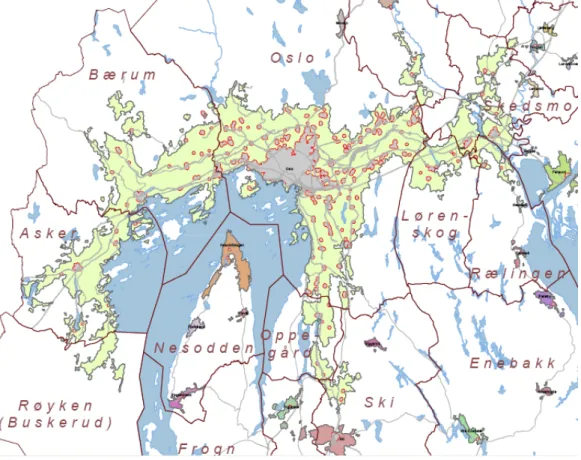
Red: 9 municipalities in the "inner ring" (more than about 40% commute to Oslo municipality). Among the latter, the largest centers are in the municipalities of Bærum (Sandvika) and Skedsmo (Lillestrøm).
Research questions
To what extent the features important for the sustainability of land use and transport infrastructure development in the Oslo region can be explained by natural-geographical conditions, social structural conditions, cultural conditions and influential social actors. These questions are elaborated into a series of detailed sub-questions around which the empirical analyzes presented in the following chapters are structured.
An interdisciplinary approach
How the challenge of sustainable mobility has been addressed in relevant land use and transport infrastructure plans. What types of spatial/physical principles, measures, and solutions have been advocated by land use and transportation planners as conducive to a.
Methods
Such theories combine preferred values with substantive theories about the environmental consequences of different land use and transport infrastructure solutions in cities. However, there may not be a direct correlation between the observed land use and infrastructure and the preceding public decision-making system and discourse.
Introduction
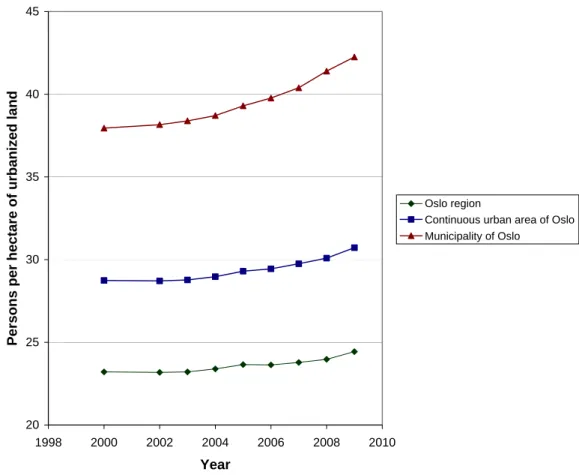
Population density development
The rest of the continuous urban area of greater Oslo has an urban population. In the parts of the Oslo region that lie outside the continuous urban area of Oslo, the urban population density increased from 13.1 to 13.7. persons per hectare, i.e. by 4.7.
Job density development
Location of workplaces and residences
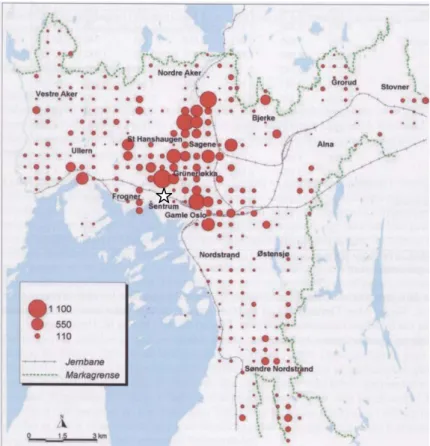
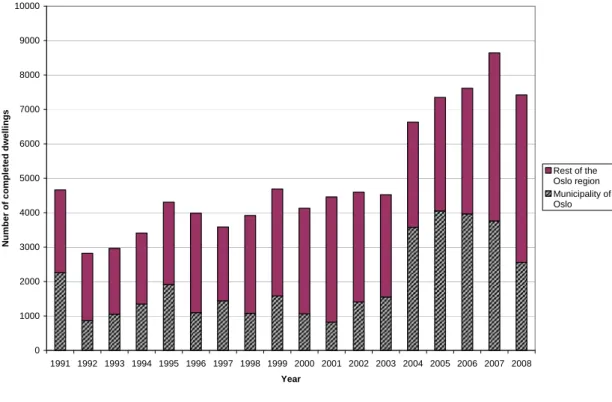
As can be seen in Figure 2.4, the majority of new residences in the Oslo region since 1991 have been built outside the municipality of Oslo. In the ten years to which Figure 2.7 refers, green areas within the urban area of the municipality of Oslo decreased by seven percent.
Consequences in terms of motorized travel
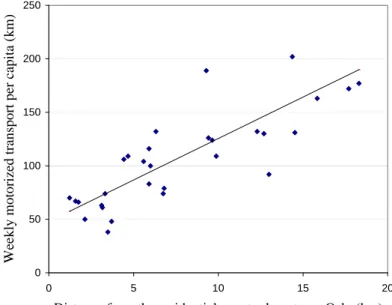
Controlling for a number of socio-economic variables, energy consumption for transport within the urban region is almost four times as high among respondents living in the most peripheral of the. In the figure, the line shows the relationship between residential location and the percentage of commuting distance traveled by car when controlling for a number of socio-economic variables.
Transport infrastructure development
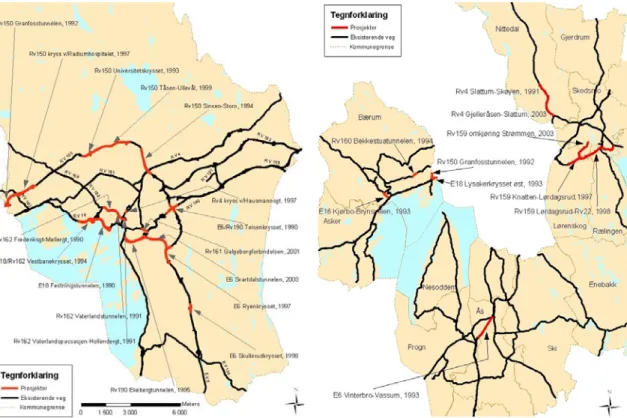
The substantial investments in public transport will, all other things being equal, probably contribute to fewer car journeys in the region. The low average probability of commuting by car among the respondents should be seen in light of the fact that the workplaces were all located in the center of Oslo, cf.
Concluding remarks
In particular, traffic growth was subdued within the municipality of Oslo, where traffic in 2001 was only 13% higher than in 1990. Adjusted for the region's above-average growth in population, jobs and income over the period, the growth rate of Akershus traffic at the same level as the overall national trend.
Introduction
Sustainability as an explicit concept in the investigated plans and policy
The Oslo Municipal Plan 2008 lists sustainable urban development as one of four main goals, and discussions about the implications of this goal occupy 8 of the plan's total 52 pages. When referred to, the concept has been included as a goal of public policy for urban development, coordinated land use and transportation planning, protection of cultural heritage, and limitation of the amount of transportation.
Interpretations of sustainability
It is not surprising that sustainability is an important issue in the Government White Paper on the improvement of the environment in cities and towns (St.meld, although the notion itself is not mentioned very often. Since the needs of commercial, service and residential development are valued in other parts of the plan, sections dealing with the goal of sustainable development focus primarily on environmental issues.
Status of sustainability goals
This emphasis on sustainability as something that goes hand in hand with economic development is also evident in the government's White Paper on the Urban Environment from 2001. The document frames the environmentally sustainable principles of urban development as something that will also improve the position of cities in international competition for inward investments and migration of highly qualified labor force.
Main sustainability issues addressed
The economic and social goals are formulated in such a way that they do not appear to inherently conflict with the environmental goals, but the actual degree of conflict will, of course, depend on the practical interpretation of each sub- and sub-goal. In Oslo's 2008 municipal plan, environmental sustainability, insofar as it is addressed in the plan, is not portrayed as conflicting with the city's growth strategies, but rather as supporting these strategies through improvement and improvement.
Policy measures to promote a sustainable urban development
The municipal and county plans obviously belong to the same discourse on sustainability and spatial urban development as the Ministry of the Environment. Although it is often not possible to say with certainty who has had an influence on whom, there is reason to believe that the content of the municipal and county plans has at least to some extent been inspired by national policy guidelines (and for the National Policy concerned) Provisions on coordinated land use and transport planning, national authorities also have the option to stop municipal land use proposals that violate these provisions).
Positions on the compact city model
The land use principles of the 2004 district plan for Akershus (which was re-adopted for two years in 2007) should be characterized as almost the greatest support for the compact city strategy, given the location of Akershus as a district that does not include the main and central part of the city of Oslo. In addition, it is stated that a greater part of the total housing development should be in Oslo and Akershus than before in the municipality of Oslo, i.e.
Assumptions about relationships between land use and transport
This applies to patterns of development within each urban settlement and municipality of the country, but also in terms of the distribution of population and job growth between the country of. This model calculation shows smaller differences in traffic growth between the alternatives than might be expected from empirical studies in Oslo of the influences of residential location and workplace location on travel.
Transport policy priorities
In the two transport infrastructure packages, no reference is made to the causal effects of land use on travel. The Ministry of the Environment and the Ministry of Transport, where the Ministry of the Environment is allowed to express its support for 'soft' transport policy measures but not to publicly oppose road construction as a strategy in urban areas.
Assumptions about influences of transport infrastructure investments on travel
Interestingly, the government's White Paper on Improving the Urban Environment makes no explicit statements about whether or not increasing road capacity in urban areas is a good idea. The document points out that traffic-restrictive land use planning, improved public transport and better cycle paths could make road capacity increases unnecessary.
Spatial content of urban development discussed without referring to sustainability
Barriers to a sustainable urban development
In the two Oslo packages examined, the need to maintain the delicate consensus that has been achieved is mentioned as a barrier against trying to change the priorities in the packages in any direction. As for the routed Oslo Package 3, this is indicated by the following sentence in a letter from the Steering Group for Oslo Package 3 to the Ministry of Transport, dated March. The group therefore warns against proposing significant changes, as this could lead to the withdrawal of support for the package as a whole from one or more of the parties mentioned.
Growth – an assumed good?
However, it is clear that the document is generally positive for economic growth and also for the growth in building stock that it entails.
Measures for implementation
The recommended land use strategies are not legally binding, but can form the basis for formal objections to municipal plans that violate these principles. These policy provisions can also be used as a basis for formal objections to recalcitrant municipal plans.
Institutional frameworks
It should also be noted that the Office of the Auditor General in Norway (2006) has criticized the work on Oslo Package 2 for an insufficient level of coordination between different sectors and levels of government. According to the Auditor General, this has hindered an efficient and holistic deployment of tools to achieve the goals that justified the launch of Oslo Package 2, namely increasing the market share of public transport and sustainable mobility.
Proposals for institutional changes
Elected officials in Oslo Municipality and Akershus County were also heavily involved in the processes. However, it is clear from the above-mentioned proposals that both Akershus County and Oslo Municipality believe that there is a need for better horizontal coordination between different geographic territories and vertical coordination between the state and the counties of Akershus and Oslo. .
The role of economic driving forces
This is consistent with a 2004 Akershus County Plan statement that there was high demand among the real estate market brokers in the 1990s for centrally located areas for housing and workplace development. The Oslo Package 3 mentions improving the region's competitiveness as a key rationale for its policy to ensure 'good traffic flow for business transport'.
Introduction
Sustainability as an explicit concept in sustainability-relevant articles
Interpretations of the concept of sustainable development
Aspects of urban development dealt with
Geographical scale
Focus of spatial content
Among the contributions that deal with only one spatial aspect, the most frequently focused on the building stock. Interestingly, articles dealing with transport infrastructure as the only spatial topic are much less frequent in the group dealing with sustainability than in the group where sustainability is not mentioned.
Main issues identified as responses to the challenge of sustainable urban
This is especially true when account is also taken of the more frequent discussion of the spatial content in combination with implementation conditions among articles that mention sustainability than among those that do not mention sustainability, cf. Or to put it differently: Although almost half of all the examined articles explicitly refer to the concept of sustainable development, this is the case among less than a quarter of the articles that deal with transport infrastructure as the single spatial aspect.
Relationships between land use and transport as an issue
Duun (1996) presents a study he carried out of relationships between land use and travel in Bergen. The above-mentioned many research articles show that there have been a large number of researchers who have independently carried out studies of connections between land use and travel and published their results in (among other things) the journal Plan.
Positions on the compact city model
He wants more variations in the recommendations and rejects the compact city as a general model for urban development in Norway. Another group of articles expresses a preference for other models of urban development than the compact city.
Transport policy priorities
Strand (2005) also supports public transport improvements but is skeptical of the planned urban rail line in Bergen. Strand (1995) recommends the improvement of public transport by rejecting the increase of road capacity as elements of a sustainable urban development.
Spatial content of urban development discussed without referring to sustainability
The article also points to the combined public transport and road building efforts in Oslo as more successful than Bergen's more one-sided road building strategy. 2001) recommend pedestrians and separate walking/cycling paths in residential areas, even in inner city areas.
Barriers to a desirable urban development
Coordination without changing these power relations may imply that the Ministry of Environment will no longer be allowed to formulate. The identification of a lack of coordination between national government authorities as a barrier can therefore alternatively be framed as the barrier being the unequal power relationship between the Ministry of Transport and the Ministry of the Environment.
Growth – an assumed good?
Even what might appear to be a coordination problem could, upon closer inspection, be seen as a problem of the Ministry of Environment's helplessness. Again, "coordination" could be established by removing or reducing the importance of environmental ministry goals and strategies that conflict with local growth aspirations.).
Institutional frameworks
There is also an article which considers that the current extent of vertical coordination was appropriate in the case of the redevelopment of the former Oslo main airport in Forneb (Habhab, 2005). Enhanced coordination' could perhaps be declared one of the main stories of the planning discourse as it appears in the articles in the journal Plan.
The role of economic driving forces
Third, the greater role of the market has not only pulled the content of urban development in certain directions, but also changed the conditions of urban planning. One reason for this (and for the fact that the vast majority of the articles examined do not mention economic-structural forces at all) may be that current market pressures for densification are largely compatible with criteria of sustainable urban development.
Introduction
Next, the interviewees' own priorities regarding urban spatial development and transport policy in Oslo. The Metropolitan Area will be introduced, followed by a section on their opinions on the impacts of different groups of actors on urban development in this urban region.
Opinions about land use development since the 1990s
Several of those interviewed (Madsen, Schlaupitz, Jensen, Horntvedt, de Vibe, Dahl) speak positively about the location of housing in the city centre. Torheim also emphasizes that land use in the outer municipalities has been quite car-based, especially when it comes to location.
Opinions about transport infrastructure development and transport policies since
She, and several of the other interviewees, think the good public transport system in Oslo is part of the explanation for this. For downtown Oslo, most of the road development has been positive, according to Elvestuen.
Interpretations of sustainable development
As can be seen from the above, among the interviewees in Oslo there is no single dominant position regarding the interpretation of the concept of sustainable development. Most interviewees from Oslo focus primarily on environmental issues as key challenges that need to be addressed in order to ensure more sustainable urban development.
Land use priorities
None of the interviewees in Oslo consider population growth and/or building stock to be a problem. Dahl considers it his duty to make the most of the increased building stock.
Transport policy priorities
Madsen cites good accessibility by public transport as an important feature of the Nydalen district. The rest of the Oslo interviewees (Jensen, Madsen, Gabestad and Brendemoen) also support investments in public transport.
Stakeholder influence
He believes that the changed opinions among the planners may partly be a result of the national political provisions. The Ministry of the Environment has sometimes, based on national policy regulations, stopped car-based locations.
Barriers to sustainable urban development
Taxation policies are in the hands of the Ministry of Finance, and land use, parking policy and public transport (except the national railways) are local responsibilities. Brendemoen says that within the Ministry of Transport, it is the Public Roads Section that has the main responsibility for the Oslo packages.
Plan, market and economic driving forces
Horntvedt also thinks that the development boundary against the Marka areas is an important cause of the high market demand for high-density development in Oslo. According to Schlaupitz, there will be significant market demand for urban development in certain areas outside the Marka boundary in the absence of the planning regulations protecting these areas.
Introduction
In all zoning plans, in the white paper, but hardly in the transport packages. None of the interviewees sees the growth of the population and/or the building stock as a problem.
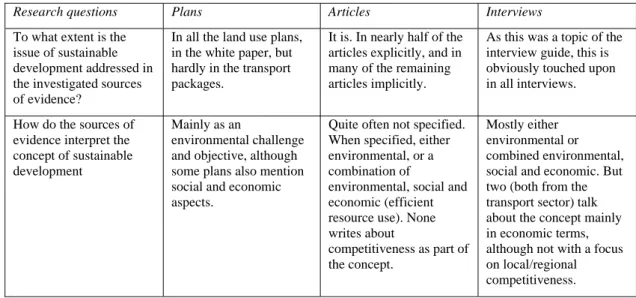
Interpretations of sustainability
On the other hand, under most of the plans and policy documents, environmental impacts of road capacity increases and growth in the building stock are not mentioned. In particular, growth in the building stock seems to be regarded as a 'natural' phenomenon that is not relevant to include in the environmental discussion.
Strong support of compact urban development
Although the tradition of the weekly hiking or skiing trip to Marko, which was very strong in the decades up to the 1980s, may have weakened somewhat in the last few decades, there is still strong popular support for the protection of Marko. areas. The Oslo region was dominated by the urban limitation doctrine for a long time before the transport effects of outward urban expansion entered the Norwegian planning agenda.
Ambiguous transport policy
The interviewees' limited support for increasing road capacity is evident from their opinions on desirable future transport policies in the Oslo region, as well as from their assessment of developments that have taken place over the past decade or two. This assumption is thus a premise in all the researched plans and policy documents and for most of the interviewees, although it is rarely explicitly discussed.
Stakeholder influence
Yet the Progress Party is also calling for relaxation here, including in the form of development in some of the areas now protected by the Marka border. At the Ministry of the Environment, the staff of the planning department consists largely of planners.
Barriers and conditions for implementation
Den delvise frikoblingen mellom vekst i bygningsmassen og negative miljøkonsekvenser som er oppnådd i byer som Oslo har derfor vært. "Hvordan styre arealbruk og transport når "governance" erstatter det. 2005): "MetroBuss - et likeverdig og mye rimeligere alternativ" Plannr.
More is always better
Concluding remarks
There is also considerable market demand for more intensive land use within existing urban areas, particularly in the central parts of the region. Earth." (Between the city - between place and world, space and time, city and countryside.) Bauwelt Fundamente 118, 3.